|
FAQs about Non-Vertebrate Animal Identification
41
Related Articles: Marine Invertebrates, Marine Invertebrate Systems, Marine Invertebrate Compatibility,
Marine Invertebrate Disease,
Marine Invertebrate
Reproduction, Quarantine of Corals and
Invertebrates, Feeding
Reef Invertebrates, Lighting
Marine Invertebrates, Water Flow, How Much
is Enough,
Related FAQs: Non-Vert IDs 1, Non-Vert IDs 2, Non-Vert IDs 3, Non-Vert IDs 4, Non-Vert IDs 5, Non-Vert IDs 6, Non-Vert IDs 7, Non-Vert IDs 8, Non-Vert IDs 9, Non-Vert IDs 10, Non-Vert IDs 11, Non-Vert IDs 12, Non-Vert IDs 13, Non-Vert IDs 14, Non-Vert IDs 15, Non-Vert IDs 16, Non-Vert IDs 17, Non-Vert IDs 18, Non-Vert. ID 19, Non-Vert. ID 20, Non-Vert. ID 21, Non-Vert. ID 22, Non-Vert. ID 23, Non-Vert. ID 25, Non-Vert ID 26, Non-Vert ID 27, Non-Vert ID 28, Non-Vert ID 29, Non-Vert ID 30, Non-Vert ID 31, Non-Vert ID 32, Non-Vert 33, Non-Vert ID 34 Non-Vert ID 35, Non-Vert ID 36, Non-Vert ID 37, Non-Vert ID 38, Non-Vert ID 39, Non-Vert ID 40, Non-Vert ID 42, Non-Vert ID 43, Non-Vert ID 44, Non-Vert ID 45, Non-Vert ID 46, Non-Vert ID 47, Non-Vert ID 48, Non-Vert ID 49, Non-Vert ID 50, Non-Vert ID 51, Non-Vert ID 52, Non-Vert ID 53, Non-Vert ID 54, Non-Vert ID 55, Non-Vert ID 56,
Non-Vert ID
57, Non-Vert ID 58,
Non-Vert ID 59,
Non-Vert ID 60, Non-Vert ID 61,
& Marine Invertebrates, Marine Invert.s 2, Marine Invert.s 3, & FAQs about:
Marine Invertebrate Behavior,
Marine Invertebrate
Compatibility, Marine
Invertebrate Selection, Marine
Invertebrate Systems, Feeding
Reef Invertebrates, Marine
Invertebrate Disease, Marine
Invertebrate Reproduction, &
& LR
Life Identification, LR
Hitchhiker ID 1, Anemone
Identification, Aiptasia
Identification, Aiptasia ID 2,
Worm Identification, Tubeworm ID, Polychaete Identification, Snail Identification, Marine Crab
Identification, Marine Invert.s 1,
Marine Invert.s 2, Marine Plankton,
|
|
Seems to be some controversy about
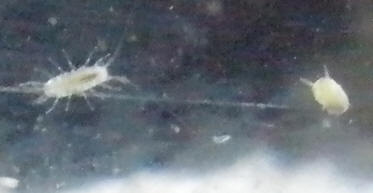
what these are: Munnid and likely Sphaeromatid
11/3/08 <Hi Jared> You guys seem to be very
knowledgeable when it comes to pods. Can you identify the two in
the attached picture? <The creature on the left is a
harmless/beneficial little isopod in the family Munnidae, commonly
known as a Munnid. For more information, please see the following
links: FAQs here: http://www.wetwebmedia.com/isopodid.htm
http://www.reefkeeping.com/issues/2004-08/rs/index.php
http://bb.wetwebmedia.com/viewtopic.php?f=25&t=12 I can't
see much detail on the other critter, but the silhouette looks like
that of another generally harmless isopod, family Sphaeromatidae,
commonly known as a Sphaeromatid. For more information, please see
the following links: http://www.wetwebmedia.com/isopodid.htm
http://www.reefkeeping.com/issues/2002-05/rs/index.php
http://isopods.nhm.org/information/ If you have some time and want
to try for an ID (or at least narrow things down), you can go
through the images at the following site:
http://isopods.nhm.org/databases/isoimages/ . It will only bring to
view a limited number of images for any given search, so you'll
need to pare things down a bit. Check Sphaeromatidae in the Select
taxa column, followed by Show Images. Then select one genus (at a
time), Select view = Dorsal, Select sex = Male, Select age = Adult,
"Select geographic region" = unless you know where your
little guy came from, select "Unknown/could not be
determined" and leave the rest as is. It's a very time
consuming process, but interesting and potentially rewarding.
I hope this helps settle the controversy, if not, please let me
know. The good news is that Munnids and Sphaeromatids are
harmless/beneficial little critters that add biodiversity and
interest to a system (not to mention a livestock food source!>
Thank you, Jared
<You're very welcome. Take care, -Lynn> |
 |
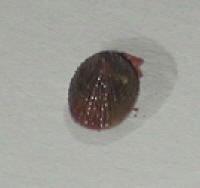
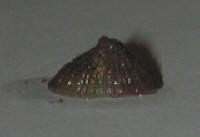
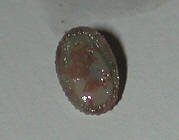
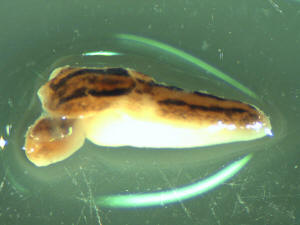
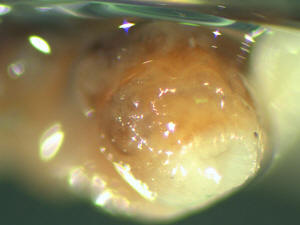
Help Identifying Unusual Object: Likely Garden Slug --
10/29/08 Dear Sir or Madam, <Hello Grant, Lynn here
today> I would be grateful for any help you can give in
identifying the object photographed in the attachments. <Will
certainly give it my best.> A 48 year old man found this in his
toilet and assumed he had passed it. <Oh my> It was submitted
to our laboratory for identification. <Understandable. By the
way, very nice photos!> It is approx. 4mm in length and was
mucoid. It was dried out on the side of the container and the
dorsal surface was damaged when removing it. After overnight
storage in 10% formalin, mouthparts were recognized. I haven't
come across anything like it. It does not appear to be segmented
like an Oligochaete and it does not have horns like a slug. <My
guess is that the tentacles are retracted.> I wondered about it
being Turbellaria (?brown Planaria). <Looks to me like it could
be some sort of Pulmonate terrestrial/garden slug (Order:
Stylommatophora -- possibly in the Family Limacidae (slug whose
dorsal surface is keel-shaped where it terminates at the posterior)
or Arionidae (slugs with rounded backs -- no keel). There
doesn't appear to be an apparent keel on the subject you
provided photos of, but I've seen species of Limax (family
Limacidae) where it's not all that obvious or apparent.
It's also possible that your specimen may have been distorted
through desiccation/rehydration. Please see the following link
showing a Limax sp. with no apparent keel (also note the retracted
tentacles):
http://www.dpo.uab.edu/~acnnnghm/BY255L/BY255LImages/BY255LImages-Mollusca/Limax-1.jpg
More photos of slugs, for general examples:
http://members.tripod.com/arnobrosi/slug.html Slugs and snails of
the UK: http://www.bioimages.org.uk/HTML/T411.HTM Basic biology of
slugs w/diagram: http://www.arnobrosi.com/slugbio.html As unusual
as it sounds to have one of these guys show up in the bathroom
where this one did, apparently, it's not all that uncommon.
After doing a bit of research, I ran across numerous reports. One
poor woman had them reproducing like mad on the inside lid of the
toilet's holding tank -- yikes!> I assume this is an
accidental finding of something which has entered the soil pipe
leading to the toilet, <That would be my guess as well. It
likely gained entrance through some sort of breach to the outdoors
or even via a plant that was recently brought inside.> as it
does not show signs of partial digestion. <That's always a
good thing! What's worse than finding a slug in your toilet?
Finding one that's half digested!> Thanks in advance. Grant
Spence
<You're very welcome. Take care --Lynn> |
  |
|
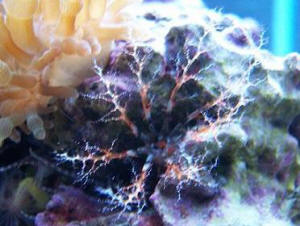
Anemone-Like Creature ID: Rock-Dwelling Cucumber --
10/21/08 Hello, <Hi John> I have a quick question
on a creature that I have residing in my tank. It looks like the
top of a cucumber but has no body that I can see. <You hit the
nail on the head! What you're seeing is the pretty little
feeding apparatus of a rock-dwelling dendrochirote
holothuroid/sea cucumber. The rest of the body is hidden within
the rockwork. By the way, nice photo!> It does not seem to
change positions in the tank, <Typical. They tend to find a
crevice or hole and stay there.> ..and doesn't seem to
have harmed anything so far. <Nope, they're harmless
suspension feeders.> It will spread out it's
"branches" and collect particulate out of the water
column, when it catches something it will put the
"branch" in its mouth and "lick" it clean.
<Terrific observations. That's exactly what it looks like.
When one of the tentacles captures a bit of food, it curls
inward, bringing the food to the mouth; when through, the
tentacle unfurls back into position.> I have tried to find
information on this, but have had little luck. <Try this link,
http://www.wetwebmedia.com/cukeidfaqs.htm - starting at the query
'Odd Invert With Eight Tree Branch Shaped Tentacles!
Holothuroid 8/21/07', and continue on to the one just below
it titled 'Anemone Id? Nope, It's A Cuke! 8/10/07'.
Be sure to also look through the related links at the top of the
page.> Thank you for your help and time. <My pleasure,
John.> Sincerely,
John
<Take care, -Lynn>
|
|
|
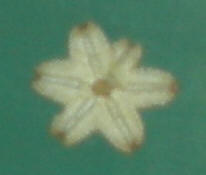
What do you think it is? Asterina star --
10/20/08 Hi <Hi, Dee> I have had my tank for only
about 8 months. While in the process of removing an aggressive
fish, I noticed what appears to be a baby starfish. I have
attached pic's. I have one Chocolate Chip Starfish but I have
only had him/her for about two weeks. I'm confused as to what
it might be. Let me know what you think. <It looks like a
fairly common hitchhiker known as an Asterina star (Family
Asterinidae). The species we most commonly see as hitchhikers are
generally harmless/beneficial, stay fairly small (under
1/2'), and reproduce asexually by means of fission/splitting.
Although there are occasional reports of these stars damaging
corals, they're usually associated with high density, out of
control, population situations. Again, for the most part these
are harmless, so until/unless you see evidence otherwise, I'd
enjoy the little star! Please see the following link (as well as
the associated links at the top of the page) for more
information: http://www.wetwebmedia.com/asterinafaqs.htm >
Thank you Dee <You're very welcome, -Lynn>
Re: What do you think it is? Asterina star --
10/20/08 Thank you and thank you for the site.
<It's our/my pleasure, Dee. Take care, -Lynn>
|
 |
|
|