|
FAQs about Non-Vertebrate Animal
Identification
25
Related Articles: Marine Invertebrates, Marine Invertebrate Systems, Marine Invertebrate Compatibility,
Marine Invertebrate Disease,
Marine Invertebrate
Reproduction, Quarantine of Corals and
Invertebrates, Feeding
Reef Invertebrates, Lighting
Marine Invertebrates, Water Flow, How Much
is Enough,
Related FAQs: Non-Vert IDs 1, Non-Vert IDs 2, Non-Vert IDs 3, Non-Vert IDs 4, Non-Vert IDs 5, Non-Vert IDs 6, Non-Vert IDs 7, Non-Vert IDs 8, Non-Vert IDs 9, Non-Vert IDs 10, Non-Vert IDs 11, Non-Vert IDs 12, Non-Vert IDs 13, Non-Vert IDs 14, Non-Vert IDs 15, Non-Vert IDs 16, Non-Vert IDs 17, Non-Vert IDs 18, Non-Vert. ID 19, Non-Vert. ID 20, Non-Vert. ID 21, Non-Vert. ID 22, Non-Vert. ID 23, Non-Vert. ID 24, Non-Vert ID 26, Non-Vert ID 27, Non-Vert ID 28, Non-Vert ID 29, Non-Vert ID 30 Non-Vert ID 31, Non-Vert ID 32, Non-Vert 33, Non-Vert ID 34, Non-Vert ID 35, Non-Vert ID 36, Non-Vert ID 37, Non-Vert ID 38, Non-Vert ID 39, Non-Vert ID 40, Non-Vert ID 41, Non-Vert ID 42, Non-Vert ID 43, Non-Vert ID 44, Non-Vert ID 45, Non-Vert ID 46, Non-Vert ID 47, Non-Vert ID 48, Non-Vert ID 49, Non-Vert ID 50, Non-Vert ID 51, Non-Vert ID 52, Non-Vert ID 53, Non-Vert ID 54, Non-Vert ID 55, Non-Vert ID 56,
Non-Vert ID
57, Non-Vert ID 58,
Non-Vert ID 59,
Non-Vert ID 60, Non-Vert ID 61,
& Marine Invertebrates, Marine Invert.s 2, Marine Invert.s 3, & FAQs about:
Marine Invertebrate Behavior,
Marine Invertebrate
Compatibility, Marine
Invertebrate Selection, Marine
Invertebrate Systems, Feeding
Reef Invertebrates, Marine
Invertebrate Disease, Marine
Invertebrate Reproduction, &
& LR
Life Identification, LR
Hitchhiker ID 1, Anemone
Identification, Aiptasia
Identification, Aiptasia ID 2,
Worm Identification, Tubeworm ID, Polychaete Identification, Snail Identification, Marine Crab
Identification, Marine Invert.s 1,
Marine Invert.s 2, Marine Plankton,
|
|
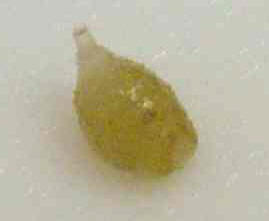
Soft Coral ID Help'¦ More Likely
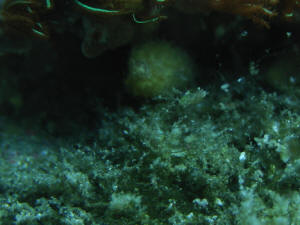
Algae -- 06/16/07 Good Afternoon, <Good day! Mich
here.> I am having some difficulty in trying to figure out what
this coral is (assuming it is a coral at all). I have searched and
searched all morning to no avail, so I thought I would see if you
happened to know what it was. I have included a picture, but due to
the limitations of my camera (and my own photography skills), I
will also try to describe it as best I can. <Sometimes as
helpful as pics.> I know one fact that may help in
identification. It came from waters off the Florida Keys, it
hitched a ride one some zoanthids I bought direct from a diver. It
was not at all apparent when I placed the zoanthids in the tank. It
sprouted from the small rubble the zoanthids are attached to, and
in a matter of two weeks has gone from barely visible to the size
of a cotton ball. It is very "poofy" looking and is white
to grayish in color. The polyps (still assuming it is a coral) are
very tiny and do not look like clove or star polyps do, they appear
to be very tiny single stalks with the appearance of extremely tiny
Italian Parsley (best description I can think of). It does not
react when touched. There is no stony or calcified structure I can
detect. Hopefully I was thorough enough in the description. The
picture is attached. <I suspect this is some type of algae,
though I can't really tell from the pic. The quick rate of
growth makes me doubt it is a soft coral, as does your description
of the polyps. Soft corals are generally octocorals, this does not
sound like an octocoral. My best guess... algae. Thought the
featherlike structures shown in the photo are hydroids! Be careful
not to touch them. They can pack a powerful sting! More here:
http://www.wetwebmedia.com/hydrozoans.htm and related links in
blue.> Thank you for your time,
<Welcome! Scot M. |
|
|
|
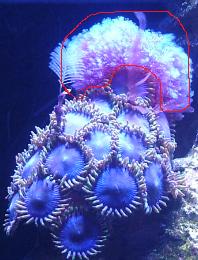
Hitchhiking Brittle Stars - 6/15/07 <Hi Matt> I have
searched for hours and hours attempting to identify these
critters I have living in my rock. I just want to know what they
are and what they look like. I would guess that there are at
least six of these guys hanging out in tiny holes, some no bigger
than a 1/4 inch in diameter, in my rock. The only thing visible
is two, half inch tentacles reaching out. I actually saw one pop
out for an instant after a feeding of brine shrimp. It looked
segmented like an insect but it was so quick I cannot be certain.
Can you help me identify these critters? <I sure can!
They're small brittle/serpent stars, most likely a species
that stays small (usually around an inch or less across), and a
neat addition to your tank. They hitchhike in and like to hang
out in crevices in, and around, the rockwork. What you're
seeing are several of their little 'arms' reaching out in
hopes of catching a bit of food floating past. Please see WWM for
more information, starting here:
http://www.wetwebmedia.com/brittlestarreprofaqs.htm > I
attached a photo and I can also send a higher resolution copy if
needed. <Thanks, but I think we're good to go!> Thanks
Matt Huppert <You're very welcome! -Lynn>
Re: Hitchhiking Brittle Stars (Maybe not?!)- 6/15/07
<Hi Again!> It is definitely not a brittle star. What is
your second guess? <Hmmm, sorry about that! If there's any
way you can get a good close up shot of one of these, that would
be terrific. Thanks. -Lynn><<RMF would swear this is an
Ophiuroid also>> H
|
|
Input on FAQ "Hitchhiking Brittle Stars -
6/15/07" -- 06/16/07 Hey Crew, <Hi Andy! Mich
here.> Was perusing today's questions and noticed the
above Q/A regarding tentacles sticking out of rock at night. I
have tons of these, tan and red/brown striped with what appears
to be bristles--some are quite (relatively) large in diameter. I
assumed that they were bristle worms, <Unlikely.>
especially since I keep seeing more and more, but thought it odd
that 3 and 4 "worms" would be sticking out of the same
hole and pretty much remaining stationary. Not that I'm
afraid of worms, <Heee! Just don't eat them! Won't
make people like you more!> but glad to hear that they are
stars. <Yes. Beneficial members of the clean up crew!>
Learn something new every day . . . . <More here for your
edification! http://www.wetwebmedia.com/brittlestaridfaqs.htm
Mich>
Andy
|
|
|
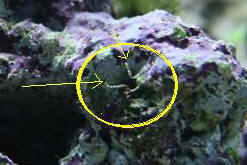
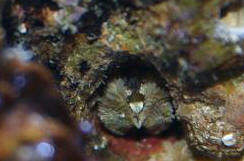
| Invert. ID, SW 6/13/07 Hey
guys, I've been trying to figure out what this little guy is.
http://www.craigberry.net/tmp/aquarium/IMG_0440.JPG
http://www.craigberry.net/tmp/aquarium/IMG_0442.JPG
http://www.craigberry.net/tmp/aquarium/IMG_0443.JPG
http://www.craigberry.net/tmp/aquarium/IMG_0444.JPG As far as I can
tell it never leaves that spot day or night. It's in a hole in
my live rock about the size of a pencil and it blocks himself into
it with some sort of shield looking thing. It only opens up about
1/4 to 1/3 of the way and if there is a bump or fast motion it
covers back up. More curious then concerned about it. Thanks! Craig
<Is a Bivalve... likely an Arca species:
http://www.google.com/custom?q=arca+clam&cof=AH%3Acenter%3BGL%3A0%3BAWFID%3Ac12f9ba1e9294d73%3B&domains=wetwebmedia.com&sitesearch=wetwebmedia.com
Bob Fenner> |
|
|
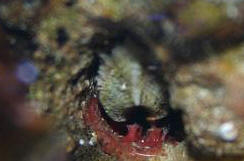
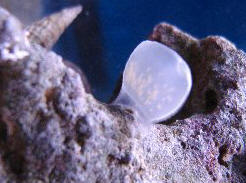
Can You Tell Me What This Is? A Filter Feeder. -
6/7/07 Hello, <Greetings, Mich here.> Can you help
identify these dime sized growths? I have a 55gal. saltwater tank
with live rock. The temp in the tank was around 90 deg. <Too
warm as I presume you know.> They pretty much grew overnight.
<Looks like a harmless filter feeder to me. It might be a sponge
or perhaps a tunicate. It looks quite pretty. Enjoy your new
addition!> Thanks
<Welcome! Mich> |
|
|
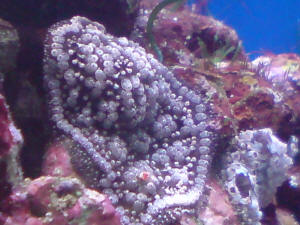
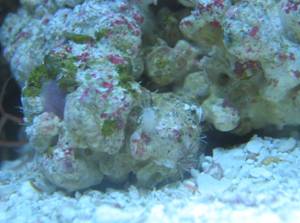
Marine Multicellular Organism ID? Anemone
6/6/07 Hello All, <Hi Lisa, Mich with you today.> I am
hoping that you can help with ID-ing an organism which hitchhiked
into my tank on a piece of live rock. <Will try!> The rock
was bought from the South-East UK, and was the
'Eco-Friendly' man-made type <Eco-friendly man-made type
is a bit of an oxymoron; nature does a better job and is a
renewable resource. The processing of cement isn't exactly
environmentally friendly, to quote Wikipedia.com: cement
manufacture contributes about 5% of global anthropogenic CO2
emissions.> - I'm unfortunately unsure of its original
provenance. <Ok.> The rock was placed in my tank about two
months ago and this organism has been expanding ever since. At
first it was a small irregular patch of dark purple and white
'barnacle-looking cells'. Now it has split into several
patches, the largest of which has taken on a more regular rounded
'colony' shape (centre of photo), surrounded on the outside
margin by what seem to be more filamentous structures. The colony
reacts as one organism when touched - contracting slightly and
rapidly as a whole. The surface of the organism feels a little
papery, and as you can see from the colony on the right hand side
of the picture, sometimes appears to rupture open in places. My
partner claims to have seen the red spot in the bottom centre of
the photo protruding out of the surface of the organism, but I
really cannot tell if this is directly connected to the
purple/white organism in question. <Appears to be an anemone of
some sort, perhaps an Epicystis sp. More here and related links in
blue:
http://www.wetwebmedia.com/marine/inverts/cnidaria/anthozoa/twaanemones.htm
> Apologies in advance if this is something obvious or
often-discussed. My main concern is whether or not it is dangerous
to my other tank-dwellers (a variety of soft corals, a couple of
snails, and two true perculas). <Is a stinging celled creature,
like so many soft corals we keep.> Many thanks for any advice
you can offer. <Hope this helps!> Lisa (Midlands, UK)
<Mich (Middle of Nowhere, USA)> |
|
|
Re: Marine Multicellular Organism ID? -- 06/07/07
Hi Mich, <Hello again Lisa!> Having done some more research on
this (while I should have been working today!), <I won't tell,
if you don't tell!> my feeling is that this organism may
actually be an ascidian, possibly Botryllus or Botrylloides spp.
(http://www.edge-of-reef.com/tunicati/htmen/TUNlistacomposteen.htm
really helped), although I bow to your superior knowledge. <Mmm,
hard to tell with just one photo, but I don't think this is the
case and I stick to the original ID as an anemone. Here's why: a.
The movement you describe "contracting slightly and rapidly as a
whole" is more typical of an anemone than a tunicate. b. I believe
the red spot is actually the mouth of the anemone and the protruding
behavior you stated would be consistent with an anemone. c. Tunicates
are difficult to keep in captivity. The relatively rapid growth is more
inline with an anemone than a tunicate. d. It sounds like this organism
has split and divided which would also be more likely with anemones
than tunicates.> Either way, it's interesting! <I will
definitely agree with you there! Please enjoy it!> Many thanks for
your input and I shall continue to do my research into this hitchhiker.
<Please do.> Keep up all the good work! <Thanks, will try!
Mich> Lisa.
Tiny White Tubes All Over Rocks and Pumps --
5/25/07 Hi, <Hi Adrian> I tried to find answer to my problem
in my reef tank but don't believe I found it, so decided to send
you this email and hope you can provide guidance/tips. <I hope so!
What's up?> I've a 55 gal reef and fish tank. In
the past couple of months, I noticed a lot of tiny, 2-3mm long tubes
growing on rocks, pumps, and corals. The tubes are hard and brittle,
and I don't see anything coming out from the tubes <Can be very
difficult to see in something this small.> and don't think they
are tube worms. I feel helpless but want to do something to
stop the growth before they take over the tank and destroy corals in
the tank. Any help is greatly appreciated. <Hmmm, well let's see
if we can figure this out. This is where a photo would be
terrific, but I know how difficult that can be! Have you seen any signs
of irritation among your corals? Also, how long has your tank been up
and running? At any rate, unless you're seeing problems with your
corals, I wouldn't worry too much about these guys. What you
describe sounds like one of many possible, but very common and
harmless, filter feeders. They hitchhike in on rock, etc,
and can become quite numerous for a time. Just when you
think the tank is going to be overrun, the population subsides all on
its own. Incidentally, you can scrape them off the pumps (and tank
sides if they appear there) with an algae scraper. Actually, I find
that a credit card works well for this and does a lot more good there
than in my wallet! I hope this helps. Be sure and let us know if you
have any additional concerns or if there are any new developments.>
Thanks, Adrian <You're very welcome! Have a great, and safe,
holiday weekend! --Lynn>
|
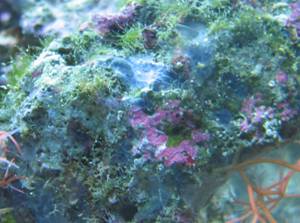
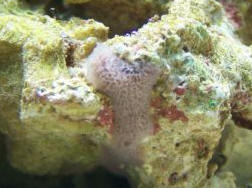
Mysterious LR
Guests: Sponges 5/23/07
Hello Bob, <Hello Aimee, Mich filling in for Big B.>
I have attached 2 pictures of some things that are growing on my
live rock that I have not been able to identify. I
have some green hair algae, but these are still
stumping me. I have a false percula clown, yellow
damsel, 2 Banggai Cardinals, 5 blue leg hermit crabs, zebra mat
anemone, leather coral, golden polyps, pulsing xenia,
and a few star polyps in the tank that have been doing
well. Any help would be greatly
appreciated. 1st picture - looks like Jell-O polyp
type things <Looks like a sponge to me.> 2nd picture -
center has white pineapple looking (possibly
sea squirt?) <Also looks like a sponge, a Syconoid
sponge I believe. Actually, is possible that both
photos are Syconoid sponges. More
here: http://www.wetwebmedia.com/sponges.htm
<Welcome! Mich>
Aimee
|
|
|
|
Re: Identification... A
Sponge. 5/22/07 <Hi there, Mich
here!> Wondering if you guys could tell me what this soft
sponge like thing is that is growing on a piece of my LR? <It
does look to be a sponge. There are some 5000 types,
most requiring microscopy for identification. So the
ID is a little vague... sorry. Enjoy
it! Mich>
|
| Re: Identification... A Sponge
5/22/07 I too would have guessed it to be a
sponge, thanks for the confirmation. <Yes, sorry I can't
offer more here.> crazy there's that many kinds out there!
<Mother Nature loves diversity!> Keep up the good work.
<Always trying! Thank you for your positive
comments. They are
appreciated. Mich> |
|
|
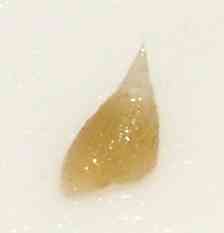
| Weird White Pod or sack on tank - looks like
something that was attached to Alien Or Syconoid
sponges 5/18/07 <Greetings Earthlings!> Well,
we have been up and running almost 16 weeks now. I just
posted the pics at http://www.mmrcsl.org/fish <I see, a nice record to
have.> I'm having an identity crisis!!! <Dissociative
Identity Disorder, shades of Sybil or Dissociative Fugue, shades of
Agatha Christie?> About 3 weeks ago I noticed the Gracilaria in
my refugium was no longer growing. <OK.> Is it
possible that running a poly filter all the time is starving
it? <Mmm, I would be more concerned about other
issues such as circulation, is the algae tumbling, getting enough
light? More here and many related links in blue:
http://www.wetwebmedia.com/redalgpropfaqs.htm >
Anyway, attached are 3 pics. I see quite a few of these growing in
the refugium on the inlet side probably 15 or so, but I don't
even know what to begin with for search criteria as to their
identity, of course white spot and white pod are really bad search
criteria. <Heeeheeeee! Vague.. wait, no more
vague! Close to 2000 hit combined on WWM
alone! Looks like harmless Syconoid sponges to me.>
Enjoy the pics at the address above, if you have the
time. <Thank you for sharing!> As always I
appreciate your help!! <A pleasure to assist!> Oh
and for some perspective, these guys range in size from tiny booger
<Niceee description!> to real small pea.... actually 2/3 of a
small pea! <Are you sure 2/3 of a small pea, and not 3/5 or
9/16? Perhaps the size of a
lentil? Hee! Mich> |
|
|
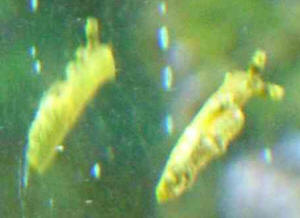
| Re: Weird White Pod or Sack on Tank - Looks Like
Something That Was Attached to Alien Or Syconoid Sponges Identity
Crisis - Dying Gracilaria -- 5/19/07 <Hello Earthling,
now called Dan, Mich with you again.> Hmmm, I think the problem
is one in the same Mich. More in depth look in the
fuge. This pod seems to turn into a two antennae white
slug. <Mmm, nope! You have two different creatures
here. Sea Slugs and Syconoid sponges> I've seen
two crawling in the fuge...very small & they appeared white.
<These Sea Slugs look to be of the order Sacoglossa or
Sap-Sucking slugs which feed mainly on algae. Likely
they are part of the genus Elysia. More here: http://www.wetwebmedia.com/seaslugsopisthobranchs.htm
> This one in the pic was in the tank... not so white.
<Perhaps greenish?> Also is a pic of what I would call a
bunch of Pupa entwined in the Gracilaria. <Nope, still Syconoid
sponges.> Thanks with the help. <Welcome!> Man I am
scratch'n for an answer... <I won't ask
where...> with out the Gracilaria, my nitrates are beginning to
rise. <Gracilaria can be a challenge to grow. If
it's growing sponges, it's not tumbling enough.> I could
put Chaeto in there but would that be fuel for these things as
well? <No, but Chaeto or Caulerpa may be a better food source
for the slugs which can be difficult to keep in
captivity. Mich> DanH Picture Too
Large! 5/18/07 <Please return with a smaller picture
attached. This one is overloading out
bandwidth. Thanks, WWM Crew> <No worries.> |
|
 .jpg)
|
| Weird White Pod or sack on tank - looks like
something that was attached to Alien Or Syconoid
sponges 5/18/07 <Greetings Earthlings!> Well,
we have been up and running almost 16 weeks now. I just
posted the pics at http://www.mmrcsl.org/fish <I see, a nice record to
have.> I'm having an identity crisis!!! <Dissociative
Identity Disorder, shades of Sybil or Dissociative Fugue, shades of
Agatha Christie?> About 3 weeks ago I noticed the Gracilaria in
my refugium was no longer growing. <OK.> Is it
possible that running a poly filter all the time is starving
it? <Mmm, I would be more concerned about other
issues such as circulation, is the algae tumbling, getting enough
light? More here and many related links in blue:
http://www.wetwebmedia.com/redalgpropfaqs.htm >
Anyway, attached are 3 pics. I see quite a few of these growing in
the refugium on the inlet side probably 15 or so, but I don't
even know what to begin with for search criteria as to their
identity, of course white spot and white pod are really bad search
criteria. <Heeeheeeee! Vague.. wait, no more
vague! Close to 2000 hit combined on WWM
alone! Looks like harmless Syconoid sponges to me.>
Enjoy the pics at the address above, if you have the
time. <Thank you for sharing!> As always I
appreciate your help!! <A pleasure to assist!> Oh
and for some perspective, these guys range in size from tiny booger
<Niceee description!> to real small pea.... actually 2/3 of a
small pea! <Are you sure 2/3 of a small pea, and not 3/5 or
9/16? Perhaps the size of a
lentil? Hee! Mich> |
|
|
| Don't know where to start looking.
(Hitchhiker ID with pics) 5/16/07 Greetings
and good day to you. I have a 55g reef tank, with a 29g fuge.. diy
skimmer, 65wX6 PC lighting. The tank has been up for about 6
months. This tank was upgraded to from a 29g. Recently, I have seen
these sponge appearing creatures in a couple of spots in my tank.
Here are a couple pics: [IMG] http://i45.photobucket.com/albums/f98/triggerjay/hitchiker/55gtank001.jpg[/IMG]
[IMG] http://i45.photobucket.com/albums/f98/triggerjay/hitchiker/wierd003.jpg[/IMG]
<Okay... too blurry, dark to make much
out...> My main worry here is that they are
something bad. All the ones I have seen are near my corals. The one
pictured is at the base of my green star polyps. I also have one
near a Kenya tree, and another near my mushrooms. At night, they
extend out about 6 inches or more, and dance around. During the
day, they do not move, and are about the size of a pencil eraser.
Last night, I got the flash light out, and the video camera. The
video is shaky at first, but will progress and you can clearly see
the worm like creature. It was suggested to me they may be peanut
worms, but from what I have seen on the web, they are not. Here are
the video clips I took last night: [URL= http://s45.photobucket.com/albums/f98/triggerjay/hitchiker/?action=view¤t=wierd030.flv][IMG]
http://i45.photobucket.com/albums/f98/triggerjay/hitchiker/th_wierd030.jpg[/IMG][/URL]
[URL= http://s45.photobucket.com/albums/f98/triggerjay/hitchiker/?action=view¤t=wierd029.flv][IMG]
http://i45.photobucket.com/albums/f98/triggerjay/hitchiker/th_wierd029.jpg[/IMG][/URL]
Any information would be greatly appreciated. Thanks in
advance. You guys rock! Jason Sanders
Springfield MO <Please peruse our marine ID pix...
starting here: http://www.wetwebmedia.com/marinvind1.htm Bob
Fenner> |
| Re: I don't know where to start looking.
(Hitchhiker ID with pics), A Priapulid?
5/18/07 I searched your database, and could find nothing that
even looks like it. I posted on another site, and it was identified
as being from the phylum Priapula, which I also did a search for on
your site and came up empty. <Very rare...> It seems there is
not much known about this creature, and the person that identified
it said he has been keeping saltwater tanks since 1967, and have
never run across this creature in all his years in the hobby. He is
also has a major in zoology and geology. I am bringing this to your
attention, so you can compare our findings and your own, and
possibly add it to your database. Thanks in
advance. Jason Sanders <Thank you
for this further input. Bob Fenner> |
|
|
|
|

