|
FAQs about Non-Vertebrate Animal Identification
45
Related Articles: Marine Invertebrates, Marine Invertebrate Systems, Marine Invertebrate Compatibility,
Marine Invertebrate Disease,
Marine Invertebrate
Reproduction, Quarantine of Corals and
Invertebrates, Feeding
Reef Invertebrates, Lighting
Marine Invertebrates, Water Flow, How Much
is Enough,
Related FAQs: Non-Vert IDs 1, Non-Vert IDs 2, Non-Vert IDs 3, Non-Vert IDs 4, Non-Vert IDs 5, Non-Vert IDs 6, Non-Vert IDs 7, Non-Vert IDs 8, Non-Vert IDs 9, Non-Vert IDs 10, Non-Vert IDs 11, Non-Vert IDs 12, Non-Vert IDs 13, Non-Vert IDs 14, Non-Vert IDs 15, Non-Vert IDs 16, Non-Vert IDs 17, Non-Vert IDs 18, Non-Vert. ID 19, Non-Vert. ID 20, Non-Vert. ID 21, Non-Vert. ID 22, Non-Vert. ID 23, Non-Vert. ID 25, Non-Vert ID 26, Non-Vert ID 27, Non-Vert ID 28, Non-Vert ID 29, Non-Vert ID 30, Non-Vert ID 31, Non-Vert ID 32, Non-Vert 33, Non-Vert ID 34 Non-Vert ID 35, Non-Vert ID 36, Non-Vert ID 37, Non-Vert ID 38, Non-Vert ID 39, Non-Vert ID 40, Non-Vert ID 41, Non-Vert ID 42, Non-Vert ID 43, Non-Vert ID 44, Non-Vert ID 46, Non-Vert ID 47, Non-Vert ID 48, Non-Vert ID 49, Non-Vert ID 50, Non-Vert ID 51, Non-Vert ID 52, Non-Vert ID 53, Non-Vert ID 54, Non-Vert ID 55, Non-Vert ID 56,
Non-Vert ID
57, Non-Vert ID 58,
Non-Vert ID 59,
Non-Vert ID 60, Non-Vert ID 61,
& Marine Invertebrates, Marine Invert.s 2, Marine Invert.s 3, & FAQs about:
Marine Invertebrate Behavior,
Marine Invertebrate
Compatibility, Marine
Invertebrate Selection, Marine
Invertebrate Systems, Feeding
Reef Invertebrates, Marine
Invertebrate Disease, Marine
Invertebrate Reproduction, &
& LR
Life Identification, LR Hitchhiker ID
1, Anemone Identification,
Aiptasia
Identification, Aiptasia ID 2,
Worm Identification, Tubeworm ID, Polychaete Identification, Snail Identification, Marine Crab
Identification, Marine Invert.s 1,
Marine Invert.s 2, Marine Plankton,
|
|
|
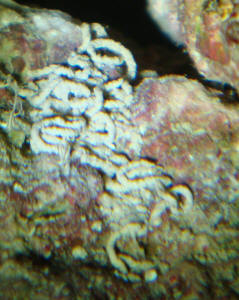
Parasite on Clam or Not? 2/25/09
<Hi Vickie, Lynn here this morning.>
I've posted this on several forums and no one can answer
this. Barry at ClamsDirect said to forward it to you.
<Ok>
I purchased a clam from a local fish store. It's a 3"
deresa. When I got it, it looked like sand was stuck to its
shell. First mistake, it was late and didn't qt it.
<Can you move it into a QT now? By the way, how did it look at
the store? Did you see any signs of stress?>
When I started thinking about it I was afraid that it might be
pyramid snails. We took him out and tooth brushed off his shell
(while he was still in saltwater bowl). They wouldn't come
off. We thought we'd stick him (while in bowl) under our high
powered microscope to see if we could see pyramid snails. We saw
shark tooth shaped something and what looked to be clear flat
worms, (too fast to get photo of) but came up with some
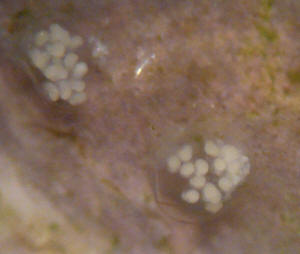
interesting to say the least, photos. The shell was covered in
egg sacs (hundreds), with thousands of eggs. We have no idea what
the eggs are from;
<They look like snail eggs to me, but I couldn't tell you
what species. I can tell you however, that Pyramidellid eggs are
encased in clear gelatinous masses instead of individual
capsules, so that's good news.>
...they covered the shell on both sides.
<As individual capsules, right?>
They also wouldn't come off with a toothbrush. A freshwater
dip didn't remove them either. They had to be scraped off his
shell one by one. The fw dip removed and killed the clear
flatworm things.
<Ok>
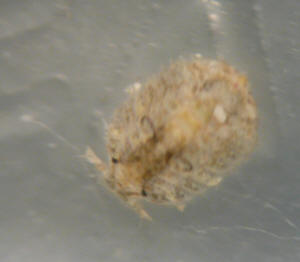
One critter, we were able to get a photo of through the eyepiece
of a 30 power microscope and the eggs. We don't know if these
are bad eggs or good critter eggs or if they will damage my
tank.
<Sure wish I could help you here but I just don't know
which species left those eggs. Do you remember seeing any snails
at the store?>
They may not even be eggs to the critter in the photo.
<I'm thinking that it's unlikely, but we need to
figure out what the critter is in the photo before we can be
sure.>
We never saw any obvious pyramid snails under the microscope.
<Good. I'd check the clam thoroughly tonight though (after
the lights have been out for awhile), since that's when the
snails would be most active.>
The white (what we thought originally might be snails, looked
like barnacles under the microscope.
<I'm guessing you mean the white things within the egg
capsules? Regarding the critter, I need a bit more
information/clarification. Was it one of the 'clear flatworm
things' that fell off during the FW dip or something else?
Also, what size is it - less than a millimeter, several mm's?
It looks like it's segmented all the way down the back/dorsal
surface, which should help with the ID process. Another question
I have relates to locomotion. Did you see how it moved around?
Did it slide along the shell surface, or did it move in a more
erratic/jerky fashion? I don't see any apparent legs in the
photo -- but maybe you did? It may be lacking those and uses
instead, a muscular foot or some other means. If you still have
the little critter, and can get a photo from underneath, that
would be super. Whatever it is, it's tickling something in
the back of my mind. I just need some time to see if I can't
figure out where I saw it!>
Can you id these? They were not visible to the naked eye.
<Gotcha, so they're very small indeed. Just get back to me
when you can about the questions I asked above and we'll see
if we can't solve this puzzle.>
Thanks,
Vickie
<You're very welcome. --Lynn>
|
 |
Micro-spider 'pods? 2/22/09
I just set up a 90 gal reef system with about 120 pounds of live
rock.
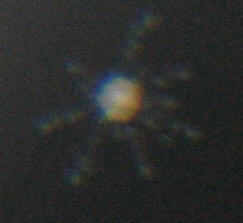
I'm seeing the usual suspects as far as 'pods go, but I saw a
new one today:
about the same size as other tiny pods, but have 8-10 legs in a
starfish type pattern. They are about 1mm across, including legs, less
than .5 mm without legs. Baby stars?
<Maybe>
A type of 'pod I can learn about?
<Certainly>
Thanks,
Dan
<Photo/s please. Bob Fenner>
|
Re: micro-spider 'pods? 2/22/09
Thanks. My camera won't focus in closely enough. Looked
through everything I could find on your site (plus others), so
I'll probably just have to live
with the mystery. Appreciate the time.
<Welcome Dan... do keep your eyes peeled for someone with a
"close up" feature on their small digital camera... A
common feature now a week!
BobF>
Re: micro-spider 'pods? 2/22/09
Best I could do (attached). Thanks for the idea...I'll keep
my eyes peeled.
<Ooohhh, this looks a lot like Staurocladia. Please scan
here:
http://wetwebmedia.com/jellyidfaqs.htm
Bob Fenner>
|
 |
Re: micro-spider 'pods? 2/22/09
BINGO! Thanks, and have a good one.
<Ahh! You as well Dan. BobF> |
|
What's wrong and what is this 2/17/08
Names Randy and I have a 12 gal nano up 3 yrs now have had no
problems in (major) essence. Lately my ph dropped slightly from
8.3 to 8.0 (using pro buffer to get back in shape)
<Mmm, be careful here Rand... change through completely
dissolved water during change-outs>
tank has polyps, mushrooms, tube worms, feather dusters, small
anemones (babies) no mother colony though.
<... What species?>
also we have some red xenia, my wife loved the pulsing so much at
the LFS that we bought it very healthy pulsing at about 5 inches
long, long story short we get it home it opened up within hours
and was happy, 2 days go by and i noticed what looks to be burned
tips on 2 of the arms, we noticed it is near a colony of red
mushrooms, read up and heard they are aggressive towards other
animals, and that they can wage chemical warfare on other
corals.
<Yes>
that being said is this true and if you look at the att pic does
this look like what may happen?
<Possibly>
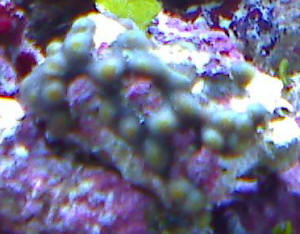
also after cleaning the junkyard of a tank after 3 yrs we moved
some rocks and noticed some spore looking rock creature that is
soft to the touch and has a green center, no activity since
we've seen it, looks to me like a radioactive green but i
don't know sorry the pic is blurry a bit but if you can tell
me or direct me as we cannot find any incipient stage photos
<Neat descriptor... Can't really make out what this is
from your pic... At first glance would have said a green algae...
but could be an Ascidian, even a Zoanthid... Bob Fenner>
Thank you
Randy
param.s are as follows
ph 8.0 +-
temp 78
nitrates 0
nitrites 0 ammonia 1
<This last is hopefully an error... Ammonia must be
zip>
sal 1.025
|
 |
|
Please HELP, Invert IDs... 2/16/08
Hello, and in advance, thank you. You are a wonderful crew.
<Thanks>
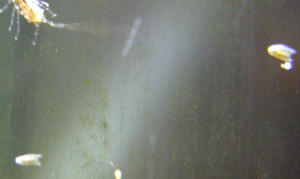
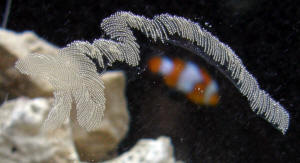
I have posted what I thought to be baby Nassarius snails to a
forum, only to have someone tell me I've got flatworms.
<A bit of all here>
Some posters say, no, she's got Nassarius snails and some say
flatworms.
Please assist me in the identification process.
I've attached all the images I can.
Thank you,
Renna
<See WWM re Flatworms, Snail eggs... "pods"... Bob
Fenner>
|
/nassarius_babies_next_to_a_teensy_copepod[1].jpg) |
Re: Please HELP 2/16/08
I'm so sorry, but I don't understand your response where it
says "a bit of all here". What do you mean?
Thank you
<Sorry for the lack of clarity. I see Amphipods, Snail young and
eggs, and Flatworms in your images. BobF>
Re: Please HELP... Flatworms 2/17/08
Thank you and once more, another question. First off, I'm sorry
for so many.
My tank is a host to many inverts..Nassarius snails, a fire shrimp
(who is my favorite pet), copepods and Vermetid snails,
tubeworms...everything invert that's good for a tank, and I am
really worried now that my tank has been diagnosed with
flatworms.
First of all, do you happen to know what kind I have?
<Mmm, nope... and please don't panic... Most
"types" are neither deleterious, nor
problematical>
Are these a fast-spreading flatworm?
<No way to tell>
Should I put my yellow Coris in the 29 gallon tank which the
flatworms are in?
<You could>
He is now in a 55 along with his best friend, an orange Coris. In
fact, they seem to be a mated pair, although separate colors, so I
figure busting them up won't be too mean...or will it?
<Mmm, likely not>
Also, I have Acropora, and my two treasured Rose Bubble Tipped
Anemone in the aquarium which has the baby flatworms in it. If I
use something over the counter, what is the chance of harming the
anemone?
<Yes...>
Please accept my grateful thanks for your wonderful answer, in
advance.
<Please just search, read on WWM re:
http://wetwebmedia.com/fltwmcont.htm
and the linked files above>
You are awesome people over there at WWM. And, I can't thank
you enough for the time you spend helping the little people, like
me, who have never had to
deal with FWs before. :)
TYVM
<Read, relax... BobF> |
Can You Help? Not Without A Pic/Critter ID 2/16/09
Hi Crew, <Hello Tim> Last night whilst watching television I
noticed something stuck to the side of my marine tank. Upon turning the
light on and a closer inspection I found a clear, almost see-through
slug looking creature working its way up the glass. It was about 2
inches long and didn't seem to have any eyes or mouth or anything
in particular except a faint brown stripe down the middle of its body
that I assume is its insides etc. I have looked all over your site and
the web but could not find anything that would give me a clue as to
what it may be... anything would be greatly appreciated <Pretty
tough without a pic. My first guess would be a slug. James (Salty
Dog)> <<Mine's a flatworm... RMF>> Tim,
Sydney, Australia
|
Algae? Mr. Hanky? 2/16/09 Hello again. Thank
you for being so helpful in identifying creatures in my tank. I
have two additional questions that I am hoping you can help with.
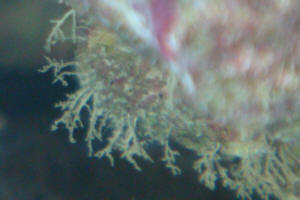
1. Algae? We have these white strand things growing on live rock.
Is it algae or something else that I should worry about? Pic Name
- Algae.jpg (picture was taken with zoom. The length of strands
in about 1/8 of an inch.) <Might be an algae... could be a
Hydropolyp... do you see any "fine strands" at the
branches perimeters?> 2. There is something in the tank that
leaves this pile of "poo" in the same place everyday
24x7. <This is what it is> The pile can get quite large.
The picture shows the pile after about 12 hours or so. I have not
identified anything in that area that could be causing the pile.
We currently have in the tank, 1 cleaner shrimp, 1 butterfly
shrimp, turbo snails, red & blue legged hermits, Astrea
snails, blue knuckle crab and a Halloween crab. But none of them
hang around that area for very long. We do not yet have any fish.
Anything else in the tank have been hitchhikers such as bristle
worms and Stomatellas. Pic Name - pile.jpg Thanks. Cindy <Most
likely a sea cucumber you've not noticed yet (keep a
flashlight handy near the tank for periodic viewing forays at
night)... but could be a meandering mollusk... Not a problem in
any case... just vacuum out during regular water change-outs. Bob
Fenner>
|
  |
NEON FLASHES?! SW invert. ID f' 2/14/09
WetWebMedia, something extremely bizarre and un-earthly just happened
in my tank. I have searched online for answer answers but find nothing!
I wonder if you know something about this. At exactly 11.30Pm here,
while admiring my tank in the pitch darkness, just to see my cardinals
darting about (yes I have very good eyesight), I noticed a BRIGHT GREEN
NEON FLASH being released at the middle-top portion of my tank. This
happened for about 1 second. It seemed like chemiluminescense...
<Maybe bio->
or some light display. I swear as unbelievable as it may seem, I am not
lying. I turned on my tank lights for a quick second and saw, at that
spot, was my peppermint shrimp, its either a Lysmata Wurdemanni, or a
L. Boggesi.
Now i have NEVER heard shrimps like this emitting light....and I am
almost VERY certain my eyes were not playing tricks on me. It is a
shame I don't have any evidence, but does this all sound like mumbo
jumbo to you?
<Mmm, no>
Do let me know if you know anything like this. Or is it something
paranormal?
<Am not a believer in such... we make our own gods, ghosts,
terrorists>
Perhaps my shrimp may not have arrived from the sea....I'm actually
quite afraid now. Do let me know if you have any answers to this? Maybe
it was my eyes playing tricks after all.....but as I am inexperienced
in this field, and no one can seem to answer this, I thought perhaps
you have some knowledge to share on this. Thanks
<There are quite a few organism groups that might have produced this
event.
Worms, crustaceans... though I don't think I've ever heard of
the genus Lysmata, Hippolytids creating such. Bob Fenner>
Re: Neon Flash... invert. ID -- 02/14/09
Hi Bob,
Re: flashing shrimps. Do look up sonoluminescence and the
Alpheidae.
Turns out some species move water so fast from the pistol action it can
flash. Not sure about the science, but apparently a real effect.
Cheers, Neale
<Ah yes... have seen a good deal of this in the wild... Met some
folks studying energetics, motion of some small marine crustaceans in
S. Sulawesi two years back... and these could move something like a
meter in a tenth of a second or so... For animals of a few millimetres
in length, this is incredible. Cheers, BobF>
|
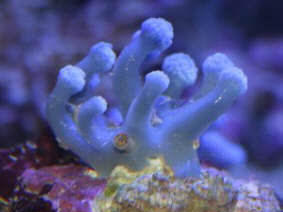
Is it a sponge? Nope, Blue Lollipop Tunicate --
2/13/09
Hi,
<Hey, I know you! Hope you're doing well and enjoying
life!>
Can someone tell me what this is?
<Yep, it's a beautiful little Ascidian/Tunicate called
Oxycorynia fascicularis or Neptheis fascicularis (family
Polycitoridae). It's commonly called (and unfortunately sold
as) a Blue Lollipop Tunicate, Blue Palm Coral, or Blue
Cauliflower Sponge.>
It looks like a kind of sponge
<It certainly does.>
...but I'm not sure. If you could tell me what it needs too,
that would be great.
<Although these are commonly offered for sale around the
'net and elsewhere, I personally wish they weren't
because of their extremely low survival rate. Tunicates are
primarily planktivores and bacteriovores and most home aquariums
simply don't have enough readily available food to sustain
them. Please see these links for more information and photos:
http://www.wetwebmedia.com/AscidianPIX/Ascidians5.htm
http://www.fishdb.com/db/salt/specimen/Blue_Lollypop_Tunicate.php
http://seadwelling.com/v-web/gallery/MarineInvertebrate/bluetunacate080904
>
Thank you
<You're very welcome. Take care, Lynn>
|
| How
nice! RMF |
|
|

