|
FAQs about Non-Vertebrate Animal
Identification
33
Related Articles: Marine Invertebrates, Marine Invertebrate Systems, Marine Invertebrate Compatibility,
Marine Invertebrate Disease,
Marine Invertebrate
Reproduction, Quarantine of Corals and
Invertebrates, Feeding
Reef Invertebrates, Lighting
Marine Invertebrates, Water Flow, How Much
is Enough,
Related FAQs: Non-Vert IDs 1, Non-Vert IDs 2, Non-Vert IDs 3, Non-Vert IDs 4, Non-Vert IDs 5, Non-Vert IDs 6, Non-Vert IDs 7, Non-Vert IDs 8, Non-Vert IDs 9, Non-Vert IDs 10, Non-Vert IDs 11, Non-Vert IDs 12, Non-Vert IDs 13, Non-Vert IDs 14, Non-Vert IDs 15, Non-Vert IDs 16, Non-Vert IDs 17, Non-Vert IDs 18, Non-Vert. ID 19, Non-Vert. ID 20, Non-Vert. ID 21, Non-Vert. ID 22, Non-Vert. ID 23, Non-Vert. ID 25, Non-Vert ID 26, Non-Vert ID 27, Non-Vert ID 28, Non-Vert ID 29, Non-Vert ID 30, Non-Vert ID 31, Non-Vert ID 32, Non-Vert ID 34, Non-Vert ID 35, Non-Vert ID 36, Non-Vert ID 37, Non-Vert ID 38, Non-Vert ID 39, Non-Vert ID 40, Non-Vert ID 41, Non-Vert ID 42, Non-Vert ID 43, Non-Vert ID 44, Non-Vert ID 45, Non-Vert ID 46, Non-Vert ID 47, Non-Vert ID 48, Non-Vert ID 49, Non-Vert ID 50, Non-Vert ID 51, Non-Vert ID 52, Non-Vert ID 53, Non-Vert ID 54, Non-Vert ID 55, Non-Vert ID 56,
Non-Vert ID
57, Non-Vert ID 58,
Non-Vert ID 59,
Non-Vert ID 60, Non-Vert ID 61,
& Marine Invertebrates, Marine Invert.s 2, Marine Invert.s 3, & FAQs about:
Marine Invertebrate Behavior,
Marine Invertebrate
Compatibility, Marine
Invertebrate Selection, Marine
Invertebrate Systems, Feeding
Reef Invertebrates, Marine
Invertebrate Disease, Marine
Invertebrate Reproduction, &
& LR
Life Identification, LR
Hitchhiker ID 1, Anemone
Identification, Aiptasia
Identification, Aiptasia ID 2,
Worm Identification, Tubeworm ID, Polychaete Identification, Snail Identification, Marine Crab
Identification, Marine Invert.s 1,
Marine Invert.s 2, Marine Plankton,
|
|
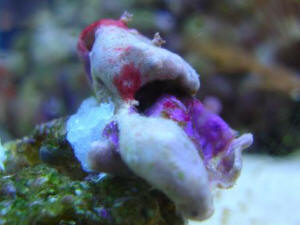
| ID needed 2/22/08 Hi Crew at WWM!
<Adele> Love the site. I use it all the time when something
new and confusing happens in my tank. Your information is always
helpful. I have been having a bit of a frustrating period with my
FOWLR 55 gallon tank. Between the green hair algae, red slime and
excessive Caulerpa, keeping a saltwater tank has been more work
than joy lately. <Hopefully you have been investigating, reading
re the control, reorientation of your system...> My biggest
problem (being somewhat new to the saltwater world, less than two
years) is that all the above got out of control because I, at
first, thought all of it was a new interesting phase that my tank
was going through, and let them run rampant before finding that
these things are not what you want then had to take steps to
eliminate them. <Your situation is common... adding, replacing
some LR will likely be of benefit here... as well as adding a
refugium... Read here re:
http://wetwebmedia.com/marsetupindex2.htm< I am still battling
the green hair but it is slowly dying. Thus, my current dilemma. I
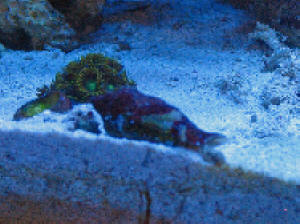
just got some new liverock with coralline algae <Oh, good> to
reseed my pathetic looking rock I currently have. In the process I
came home with a bright red tipped looking piece that on the end
looks like a raspberry. Quite lovely I think. However, 9 times out
of 10 if I think it's cool that means it's not good for the
tank. I shall attach a picture and await your prognosis on if it
should stay or go. Thanks again for all the help. Kind Regards,
Adele <Should stay... is most likely a sponge... Bob
Fenner> |
|

|
Polyps growing on mushroom!
2/21/08 Good afternoon WWM crew, A kind reefer recently donated
two mushroom frags to my aquarium two weeks ago. One is doing
great, the other appears to be struggling. They are sitting in near
identical flow/light conditions. The downfall of the struggling
mushroom may well be that these were my first attempts to mount
frags. My question relates to the struggling frag. This mushroom is
folded up, with the bottom sides now partially facing
"up" (think of a piece of mail that has been tri-folded).
While inspecting this mushroom last week I noticed two small polyps
(for lack of a better term) growing on the "bottom" of
the mushroom that now faces the light. (photo can be seen here:
http://www.saltbucket.com/v/scottandjodie/Picture+014.jpg.html
"polyps" are near top/center of mushroom, one with base
in red section of mushroom, one in white portion) These polyps
appear to be reaching for the light. 2 more days of observation has
revealed that these polyps extend during the day and disappear at
night. I also have noticed that the tentacles on one of them are
green tipped. As I have never had any corals in my tank, I am
curious as to what these polyps could be. Have you ever heard/seen
such a thing? Any advice/information would be appreciated. <Wow,
that's pretty weird. Could you please send some other photos
from different angles? My first thought is that this might not
really be a mushroom coral (or that possibly something is growing
over the mushroom). But I can't tell much from just the one
photo unfortunately.> Thank You,
Scott
<Best,
Sara M.> |
|
 Sponge? Sponge?
|
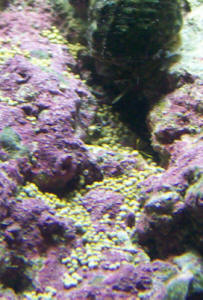
Can you tell what these are 2/21/08
They popped up almost over night. I have added no new rock during
the last 12 months <If you're talking about the little
yellow balls, they're just harmless sponges (probably Syconoid
sp.).> Best Regards,
Paul
Sara M.> |
|

|
|
What Is This? Possible Snail Egg Collar -- 2/19/08 Hi
there! <Hi Kerstin!> I have looked, and asked, and am
drawing a blank... <Let's see if we can't fix
that!> I have a 92-gallon corner tank that has been set up
since just before Thanksgiving, when I transferred everything
over from my 3-year-old 29- gallon tank. I have slowly been
working on trading in soft corals and assorted other items at my
LFS for new stony corals. But this past weekend I suddenly had a
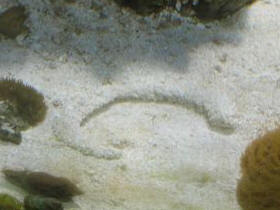
circle in the sand (see the first picture). I could pick up the
sand "circle" without it disintegrating; over the
course of the week, the left side has slowly started to blend
back into the sand bed. While I used to have a feather duster in
my old tank, I traded it to a friend about 6 months ago. I have
never purchased a sea cucumber or sea squirt...those are the
three items this shape has been guessed to be. <Okay> Do
you have any clue what it could be? <I have a possibility,
yes.> I have had a diatom problem - which has now apparently
cycled through; I am still working on ridding my tank of the red
slime, but even that is on a downturn. <Excellent> My fish
are a Six-line Wrasse and a Purple Tang. I have 4 Skunk Cleaner
Shrimp, and today added 2 blood red shrimp. <That's an
awful lot of shrimp, especially given that there are two
different species. Keeping them well fed will help, but keep an
eye on them.> My other livestock is a brittlestar, and an
assortment of snails (~12-15) <What species?> ..and hermit
crabs (only 3-4 left, not being replaced). My specific gravity
runs at 1.0265, <Hmmm, watch that this doesn't get too
high.> pH around 8.2, and temperature varies between
78.5-79.3. Any ideas you have would be greatly
appreciated...everyone I know here is at a loss. <Heeheee! I
can certainly understand. I'm not exactly sure myself! Among
the snails that you have, by any chance do you have any
'Moon' snails (Family: Naticidae)? What I see in your
photo looks a lot like the remnants of an egg collar, sometimes
called a 'sand collar'. It's actually two layers of
sand and mucus with eggs sandwiched between. Please see this link
for comparison:
http://www.manandmollusc.net/Mystery_shell_pages/mystery_shell_steve.html
> Thanks tremendously for your great web site...I have spent
many hours browsing and learning (I am currently trying to
determine what other fish I would like to get, and your site
helps tremendously in the decision-making process).
<Super!> I look forward to hearing from you, Kerstin:-)
Fig. 1 - sand "circle" - can be picked up...My current
tank setup - ~40-50 lbs. LR <There are a couple of other
possibilities if you rule out the Moon snail, but I'd need a
livestock list to narrow it down. At any rate, this structure
will assuredly continue to disintegrate, becoming part of the
food chain without issue. Take care, -Lynn>
Re 2: Question...what is this? Re: What Is This? Possible
Snail Egg Collar, Lysmata spp. Compatibility - 2/19/08 Thanks
for the quick response! <Hi Kerstin! You're very
welcome!> However, that snail doesn't look like any of the
ones I have. <Steeee-rike! That's one guess down. You were
asking about snails. I have some Astrea, a Mexican, 2 Margarita,
2 Cat's Eye, several Nassarius snails, several Cerith snails,
and I think that's it. Most of these are still alive -
<Hmmm, wouldn't be any of those listed. If you happen to
see one of these structures again, do try to get a photo of it
asap and we'll take another look. :-)> I am not replacing
hermit crabs because, to reflect the "opportunistic
nature" mentioned so often on WWM, <Yep> the last time
I added empty shells, they still preferred to get the shell from
a live snail vs. a clean shell with no one living in it - an
expensive habit to support! <Yes indeed! I've had the same
issues with several hermits in one of my tanks. It's
annoying, for sure.> You seem surprised at the number of
shrimp - and the mix. Interestingly enough, I haven't run
across anything that indicates how many shrimp one should have on
average - and I got the impression that the two types of shrimp
would get along well. <Given enough room and food, they
usually do just fine.> Is there generally a rule on shrimp I
should be aware of? <Nope, there's no hard and fast rule.
It depends on how much food is available, the aquascape (enough
hiding areas, etc), and the personalities of the shrimps
involved. Basically, as you increase the number of shrimps you
have, you increase the competition for food and risk of
territorial issues. This is compounded when you increase the
number of species involved. I think the four Cleaner Shrimp
(given enough food) are fine because they do tend to group
together. The Scarlet Shrimp (Lysmata debelius), however, are a
separate species and need their own area. Please see this link:
http://www.wetwebmedia.com/marine/inverts/arthropoda/shrimp/cleaner.htm
> I am sure my LFS would let me trade some of them back in if
I needed to. <I'd just make sure everyone's well fed
and keep an eye on things for now. As long as they're all
happy in their areas and have enough food, you should be
okay.> Also, r.e. the Specific Gravity - over the past 3-1/2
years, that is what my tank seems to have stabilized at. At one
point my 29-gallon tank had around 25 different corals in it (why
I upgraded), and it generally moved up to that, even if I worked
at lowering it with water changes...should I worry, or just make
sure it doesn't go any higher? <I think you're fine
with it where it is. Mine has been right around the same number
for years with no problems. My concern was that it not get a
whole lot higher. As long as you're able to keep it stable
where it is, you're good to go!> Thanks again for all your
help and your fast response, Kerstin:-) <You're very
welcome, Kerstin, it was a pleasure :-) Take care, -Lynn>
Re: What Is This? Possible Snail Egg Collar, Lysmata spp.
Compatibility - 2/19/08 2/21/08 Wow...fast!
<Heheee!! We aim to please! :-)> I did actually look at the
link you provided...and will keep a watch on the shrimp. So far
they seem happy, we'll see how it goes. <Yep, sounds
good.> R.e. the picture - I actually took the picture the
morning it showed up. <Woops, I thought that it was taken
after a few days!> I had a smaller (only 1/3 of that C) one of
these about 1 month ago, when I was at the height of my diatom
problem <Interesting> (I had the diatom problem because I
didn't change my RO filter, and started out with very high
silicates; needless to say, it self-propagated the diatom problem
until I changed enough water to lower the silicates....lesson
learned about filter changes!). <Yes indeedy! I wish I had a
dime for every lesson I've learned the hard way!> I took
it out, didn't think about it at the time - but this is the
same structure. Could I have somehow imported something with LR?
<Is indeed possible.> I have gotten several new ones as I
have taken advantage of the new tank to switch out some of my
rocks - but I haven't seen any new snails. <Okay>
Anyway, open to suggestions...you saw in my first email what my
LFS was thinking. <Yes, and I don't believe any of those
are what created this (mainly because of the size/shape). For
example, if you had a cucumber/Holothuroid in there that left a
casting this size, you'd likely have seen it. I've also
never seen one leave castings with this consistent "C"
shape. Unfortunately, I've checked every source at hand and
haven't seen a similar structure anywhere. What I'd like
to know is whether this casting/casing/whatever is rubbery, hard,
hollow, etc. I'd like to know what's under that top layer
of sand! Is it a gelatinous/rubbery mass or does it appear to be
sand through and through? Is the sand covering a parchment tube?
If you blew water at it with a turkey baster, would it
disintegrate or would it hold its form? Have any of the shrimp or
hermits been picking at it? Sorry, but as you can see, I have
more questions than answers. I do love a good puzzle!
Unfortunately, at this point, I'm not sure what made this
object. Even if you could answer all of the questions I listed
above, my answer(s) would still be just supposition. Wouldn't
it be great if we could set up cameras in front of our tanks so
that we could see all the neat things that happen when we're
away - and answer some of these perplexing questions!> Thanks
again, and it's fun chatting with you, Kerstin:-) <With
you as well, Kerstin, it's been a pleasure. Of course,
it's driving me nuts not being able to solve the puzzle, but
hey, the journey's been fun!
|
|
| Follow-up: What Is This? Possible Snail Egg
Collar -- 2/21/08 Hi there again! <Hi there,
Kerstin!> Well, I tried to answer some of your questions,
and don't know that I succeeded. However, here goes:
<Thank you so much! I know I loaded you down with every
question I could think of! :-D> 1. I forgot to list 2
other creatures I have in my tank (at least that I know of):
a small Blue Tuxedo Urchin, and a small conch (see the
attached picture for his size compared to the casing). As far
as I can tell, this conch was the only one who ever worked on
the casing - and the casing's length was ~3 inches from
top to bottom. I have a fair amount of worms in my sand from
where I took LS from my DSB in the old tank to this one - but
I had never seen this in the old tank. <Okay> 2. The
original photo of the casing was taken on Feb. 13; the last
photo was this morning (Feb. 21). This morning I also tried
to take out the casing, and by this time it was falling apart
into pieces, although on Sunday I could still pick it up
easily. Without having a microscope, I did not see anything
in it this morning other than sand. However, parts of it did
feel rubbery - I am sure it was even more so when it was
fresh. <Likely so.> I hope that helps <Absolutely,
it all helps!> - otherwise, since I seem to have had this
before, I will write back if I get another one... <Please
do. My best guess is that we're seeing the remnants of an
abandoned tube formed by some sort of tubiculous Polychaete
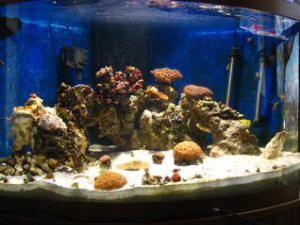
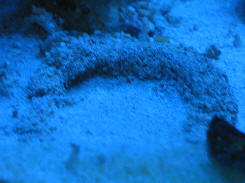
(of which there are many possibilities).> Fig. 1 - left -
small conch and the left (disintegrating) side of the casing;
Fig 2 - right - the casing after 1 week - looks solid, but
falls apart into pieces if picked up. (Pictures taken under
actinics only) <Thank you for the additional photos!>
Thanks again for all your help, and I hope the weather is
better where you are than here, Kerstin :-) (from snowy/icy
Kentucky) <Brrrrrr! We're actually having an unusual
stretch of gorgeous weather out here in Seattle. Lol I'll
do my best to send some your way! By the way, you're very
welcome and thank you for the additional information! Take
care and stay warm! -Lynn> |
|
|
| Follow-up 2: What Is This? Possible Snail
Egg Collar? Sand Clumping? 3/8/08 <Hi Kerstin!> And
a cheery good morning (or afternoon). <Thanks, and right
back at you!> Apparently this might not have gone through
yesterday, so I added another comment... <Thanks, it did
indeed go through, and I apologize for the delay in
responding! I've just been wracking my brain trying to
figure out once and for all what these things are.> Well,
after our last foray with the unknown, these casings seem to
be coming up more regularly - I have two more casings within
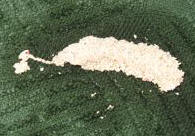
3 days of each other (March 4 & 6) - but they're more
like the first one I found, not the perfect C shape I wrote
about earlier. You had asked several responses ago, and so I
picked up the first one (pictured on a towel). It was about 4
cm long, and solid sand - did not feel rubbery, but I also
did not look with a microscope as to what might be in it.
<That's okay. No need for a microscope!> For what
it's worth, if it is of any help, my aquarium contents
are (I have been working on making it a full listing):
<Thanks, it's all helpful!> - A 92 gallon tank
(moved from a 29 in mid-November), with 1 Purple Tang
(Zebrasoma Xanthurum) and 1 Sixline Wrasse (Pseudocheilinus
hexataenia) - About 60 pounds of LR, a DSB, and a variety of
other critters - 4 skunk cleaner shrimp, 2 blood red shrimp,
1 or 2 peppermint shrimp (they disappeared during the move,
have recently reappeared), 3-4 hermit crabs (all that
remains), a variety of snails (multiple Astrea, a Mexican, an
Olive, <Watch out for Olive snails. They're
predators/scavengers that although pretty, can deplete your
sandbed fauna, attack other mollusks.> ..a Tiger cowry,
several Nassarius, 2 Ceriths (laid eggs several days ago), a
small Conch, and several Margarita, <Sorry, I should have
mentioned this before, but these snails (usually Tegula
funebralis, Tegula brunnea, or Margarites pupillus) are
cooler (to downright cold) water species. Although
they're sold fairly regularly as reef snails, they
shouldn't be. The warmer temperatures in our reef systems
greatly shorten their lifespans.> ..a Cat's Eye) and a
small blue tuxedo urchin. - My coral collection is 2
Acroporas, 1 Stylophora, a Caulastrea, a Micromussa, 2 Fungia
(1 orange, 1 green), a green Favia, an Acanthastrea, and a
Lobophyllia. - 2 anemones - Eric identified them as
Bunodosoma cavernata'¦the Warty Sea Anemone -
Running a Tunze 9010 skimmer in the tank, also have 3
powerheads - Hydor Koralia 2 and 3, <Love these!> and a
MaxiJet 1200. Like I say, I just wanted to let you know that
they are still coming up - apparently seemingly regularly,
although not necessarily in the perfect C shape. I greatly
appreciate any ideas you have...I don't think they hurt
anything, it is just a curiosity thing at this point as to
what may be creating them. <Heheee! Do I ever understand!
I really want to know what these are too, but I don't see
anything in the above list that stands out as a
possibility.> Additional comment - I was reading Anthony
Calfo's forum on Reef Central, and ran across a mention
of aragonite clumping. <It's interesting that you
should bring this up. I've been wondering whether it was
possible that these formations were aided/created by a snail
or urchin and clumping action. In other words, in the course
of its foraging/burrowing, one of these critters plowed up an
area of sand that had on the surface, something sticky enough
(mucus, bacteria, etc) to hold the top layer together and
roll it into these forms. Any thoughts, Bob?> A quote from
Dr. Ron Shimek was: "Here is what Dr Ron has to say on
the subject
http://www.reefcentral.com/forums/s...hlight=concrete quote:
Originally posted by Dr Ron Many aquaria are saturated with
dissolved mineral salts such as magnesium and calcium
carbonates. In the sand bed where water flow is slow and the
chemical milieu is different than in the water column,
precipitation of calcium salts can cause clumping. The high
pH environment you mention facilitates this clumping. In
essence, in such a situation what is created is a type
calcareous sandstone. The other cause is clumping due to
bacterial cementation. The bacteria in the sand bed glue the
grains together with a material referred to as a
glycoprotein; basically this is a material about the
consistence of rock candy. Once the bacteria have bound the
sediment, the minerals can also precipitate and make the
binding permanent. When one inoculates a sand bed, one needs
to strive for maximum diversity of the burrowing infauna. The
action of these small animals will keep the sediment rather
continuously in motion and prevent the cementation. In
addition to the lack of these "motivators" of
sediment motion, the larger sediment particles tend to resist
movement, and consequently facilitate the cementation."
So to check, I also want to say I have the following
measurements (after a 10 gallon water change done just
earlier today, using SeaChem's Reef Salt): Calcium around
300, Alkalinity at 2.06. mEq/L. :-( Apparently over the
course of the last month it went from both values being high
to now both being low...so I will work on correcting them,
<Good, just take it slowly.> ..but that means this
isn't a possibility for the clumps, and we're back at
square 1, right? <Hmmmm, well clumping can be caused by a
number of things, pH problems, not enough water flow, lack of
adequate sandbed fauna, overcorrection of calcium, etc. You
might want to stir the top layer (~1/2') of sand and see
what happens (look for sticking or clumping). Please search
the term 'clumping' at WWM for more information:
http://www.wetwebmedia.com/WWMAdminSubWebIndex/question_page.htm>
Thanks again for any input you can provide, and I hope
you're having a nice and warm day, Kerstin:-)
<You're very welcome! So far, so good on this end as
far as weather goes. Hopefully the new winter storm they
predicted for y'all never happened and that you're
nice and toasty! Take care, -Lynn> IMG_6924.JPG On a towel
IMG_6932.JPG Same size, in tank under MH with flicker |
|
Follow-up 3: What Is This? Possible Snail
Egg Collar? Sand Clumping? 3/8/08 <Hi Kerstin!>
Thanks for the great response. <You're most welcome.
I just wish I had a concrete answer for you!> I will
keep searching on "clumping". <Sounds good. I
have my doubts as to whether that's really what's
causing the formations, but it's something to
consider/rule out.> I thought I had pretty good water
flow (~1750 gph + my skimmer), and before I sold my
29-gallon tank, I got about 1-1/2 cups sand from it, so my
sandbed seems pretty well along. <Good> Re: the
Margarita snail - yes, I bought it before I researched -
and this point I will let them survive until their death,
but will not be replacing them...and feel bad for
shortening their life, in fact. <Yes, it's sad,
isn't it. I doubt there's an aquarist out there
that hasn't made a similar misstep at some point, and
felt horrible about the inevitable result. I know I have.
Complicating matters is the fact that these snails are
often sold as part of reef-cleaning packages. People are
led to believe that the various animals included are well
suited to reef systems. It's a very unfortunate
practice and I'm going to stop right there before I get
on a roll! Suffice it to say, experiences like this serve
to teach us all a sad but valuable lesson.> Thanks again
for all your help. We did end up getting about 5 inches of
snow - but it's nice, and once the drive is shoveled,
it melts pretty fast...so it's not all bad. <Oh
good! LOL I wish you could send some out here. I'm one
of those crazy people that loves snow!> Thanks again for
your help and this great website, Kerstin:-) <You're
very welcome, Kerstin, and thank you - it's been a
pleasure! Have a great weekend, -Lynn>
|
Follow-up 4: What Is This? Possible Snail Egg
Collar? Sand Clumping? Nope! 3/8/08 3/10/08 Hi again! <Hi
there, Kerstin!> Well, I have continued searching, and you
know that looking for people who have written in about worm poop
or castings or sand being compacted...well, I seem to be the
first one...or I am just not searching the right words. <This
has been quite a challenge, hasn't it!> In any case, since
Dr. Shimek had mentioned sand being "concrete", I
submitted my query to him as well, and his response was:
"Your structures appears to be fecal castings (= "used
food" ) of a deposit (= sediment) eating large worm or sea
cucumber. It is definitely not a snail egg collar, very much the
wrong shape and "texture." " <Yes, although the
initial photo did remind me of a sand collar/egg casing from a
Moon snail, the subsequent photos did not.> That made me think
it must be a huge worm (!), which I asked about (esp. since I
have not knowingly purchased or imported one into my tank); in
return, he responded: "These animals are occasionally found
as hitchhikers, and they come in as small individuals and may
grow in the tank. It is likely it is living in your sand buried
out of sight. Such creatures are good additions to a tank; as
long as it can get enough food, it will be a good
detritus-feeding animal. You may never see it, even with staying
up at night looking for it. Such worms typically live their
entire lives under the surface of the sediments, and just back up
to the surface, stick their anus out of the sand a bit and
defecate the fecal casting. My guess is that this is happening
far more frequently than you realize, probably once a night or
so. I suspect most of the time fish, other animals, or currents
disperse the sand before you observe it. " I hope that
information is useful to someone else out there as well...I think
it's also interesting that something as big as this possible
worm could be hiding in my DSB. Personally I still like the idea
of egg casings - there are some neat ones out there, that I could
find pictures of - but don't you know, that would have been
too simple an answer. :-)) <Heheeee -- too true! I'm so
glad you were able to have this answered! This does indeed help
me, as well other aquarists with similar castings showing up in
their tanks! I too would love to see the critter that's
leaving poo of this size! The reason I discounted the possibility
originally was that since the sand/substrate had been transferred
from one tank to another, it seemed unlikely that such a sizeable
worm, or Cuke, would go unnoticed. Ah well, maybe it was hiding
within some rock, etc, that was also transferred/introduced. The
point is that I implicitly trust Dr. Shimek's judgment in
these things and am relieved to finally have this mystery solved
for you! Yay! By the way, if you ever do see this critter out an
about, please let us know!> Thank you again for all of your
help - I really appreciate it, and all the work you did
researching about this. It's been fun talking about this, and
hopefully someone else will be able to use the information as
well. <Absolutely! You're very welcome and thank you as
well! It's been a fun learning experience and I know the
information will be very helpful to others.> Also (shameless
plug) because of all the help you and everyone at WWM have
provided, I did make another donation - I think something this
great should be considered in the same light as shareware - it
will improve and continue to be there for everyone who needs it
if people have it in their hearts to consider what it is worth to
them... <Awww, that's so kind of you! On behalf of Bob and
the rest of the crew, a most sincere thank you! :-)>
Kerstin:-) <This has been a real pleasure, Kerstin! Take care,
-Lynn>
|
|
Please help ID these...Eggs?
2/19/08 Good Day! I am a Long-time reader and 1st time
writer! I hope you can help me as I've witnessed you help
millions! We have a 16G Bow front Display FOWLR tank (actually we
have a few Paly's and Mushrooms in there) w/ 2 True Perculas
and 1 Citron Goby. There are plenty of snails, crabs and even an
Urchin. I have seen many fire/bristleworms, spaghetti worms, pods
and feather dusters. Parameters are: Nitrite: 0 Nitrate: <15
Ammonia: 0 Salinity: 1.024 Temp: 79 degrees Calcium is normal and
Phosphates/Silicates are in check We woke up this morning and
found these little brown things everywhere! They look like little
pieces of dirt, but appear to be eggs. There was a large snail
that was in the area of these and may be the culprit. <I do
believe so...> I have had Nassarius snail eggs before and they
looked nothing like these! I hope the picture helps. My question
is what are they, will they last and are they good?? <Might
otherwise be urchin eggs... likely will be consumed... Are
"good"... not toxic> Any help would be appreciated.
Thanks in advance and keep up the good work! Derek L. Rush
<We're trying! Bob Fenner>
Re: Please help ID these... Eggs? Thanks for
the quick response!!! It's an honor to be answered by the one
and only Mr. Bob Fenner!!! Anyways, someone told me that the
things I see are just harmless pieces of Urchin Pooh! <Heee!
Could be this as well... There are some snails that do lay eggs
that are quite similar though (as well as the more familiar
clusters by some species found arrayed on viewing panels, and in
webbed clusters attached to hard substrates...)> If that is
true I was wondering 2 things: 1) Will this cause a rise in
Nitrates? <Mmm, not likely appreciably> 2) I've heard
that Urchin feces carries Coralline Algae spores? Is that true?
<Likely so... digested to some extent> Thanks again and I
will be looking forward to your response! Derek L. Rush
<BobF>
|
|
|
|
|