|
FAQs about Non-Vertebrate Animal
Identification
31
Related Articles: Marine Invertebrates, Marine Invertebrate Systems, Marine Invertebrate Compatibility,
Marine Invertebrate Disease,
Marine Invertebrate
Reproduction, Quarantine of Corals and
Invertebrates, Feeding
Reef Invertebrates, Lighting
Marine Invertebrates, Water Flow, How Much
is Enough,
Related FAQs: Non-Vert IDs 1, Non-Vert IDs 2, Non-Vert IDs 3, Non-Vert IDs 4, Non-Vert IDs 5, Non-Vert IDs 6, Non-Vert IDs 7, Non-Vert IDs 8, Non-Vert IDs 9, Non-Vert IDs 10, Non-Vert IDs 11, Non-Vert IDs 12, Non-Vert IDs 13, Non-Vert IDs 14, Non-Vert IDs 15, Non-Vert IDs 16, Non-Vert IDs 17, Non-Vert IDs 18, Non-Vert. ID 19, Non-Vert. ID 20, Non-Vert. ID 21, Non-Vert. ID 22, Non-Vert. ID 23, Non-Vert. ID 25, Non-Vert ID 26, Non-Vert ID 27, Non-Vert ID 28, Non-Vert ID 29, Non-Vert ID 30, Non-Vert ID 32, Non-Vert 33, Non-Vert ID 34, Non-Vert ID 35, Non-Vert ID 36, Non-Vert ID 37, Non-Vert ID 38, Non-Vert ID 39, Non-Vert ID 40, Non-Vert ID 41, Non-Vert ID 42, Non-Vert ID 43, Non-Vert ID 44, Non-Vert ID 45, Non-Vert ID 46, Non-Vert ID 47, Non-Vert ID 48, Non-Vert ID 49, Non-Vert ID 50, Non-Vert ID 51, Non-Vert ID 52, Non-Vert ID 53, Non-Vert ID 54, Non-Vert ID 55, Non-Vert ID 56,
Non-Vert ID
57, Non-Vert ID 58,
Non-Vert ID 59,
Non-Vert ID 60, Non-Vert ID 61,
& Marine Invertebrates, Marine Invert.s 2, Marine Invert.s 3, & FAQs about:
Marine Invertebrate Behavior,
Marine Invertebrate
Compatibility, Marine
Invertebrate Selection, Marine
Invertebrate Systems, Feeding
Reef Invertebrates, Marine
Invertebrate Disease, Marine
Invertebrate Reproduction, &
& LR
Life Identification, LR
Hitchhiker ID 1, Anemone
Identification, Aiptasia
Identification, Aiptasia ID 2,
Worm Identification, Tubeworm ID, Polychaete Identification, Snail Identification, Marine Crab
Identification, Marine Invert.s 1,
Marine Invert.s 2, Marine Plankton,
|
|
ID Requests: Syconoid Sponges, Majano -
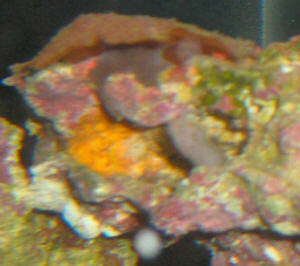
1/5/08 Dear Crew, <Hi Ann!> I would like to thank you for
your time and expertise. <It's our pleasure!> I have sent
two attachments of some live rock in my 55 gallon. My tank contains
one Ocellaris Clownfish, a "Flower Anemone", a large
Featherduster, and a dozen blue-legged hermit crabs. It used to
have a flame scallop in it. <Very difficult to keep/feed, made
worse by their habit of settling themselves into caves/other
inaccessible spots.> Getting to the point of the pictures. I
would like some help on identifying some new inhabitants. I have
1/4" tubular growths that are spreading like wildfire across
my tank. Like always they are hard to rid of. <They're
actually harmless/beneficial little Syconoid sponges (genus
Sycon)-- normally a sign of a stable, healthy tank. Unfortunately,
a population explosion usually indicates an excess of nutrients.
Please see WWM for more info regarding nutrient control:
http://www.wetwebmedia.com/nutrientcontrol.htm . By the way, I
don't know how old your tank is, but it's not unusual to
see an initial explosion (and subsequent subsidence) of these
little guys, as well as the Spirorbids I see in your photo.
Spirorbids are harmless filter feeders that appear as tiny white
coils on just about any/every surface - glass, rockwork, equipment,
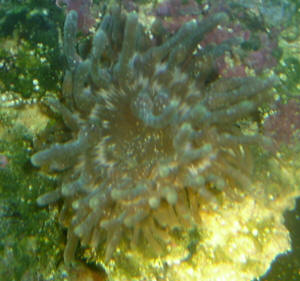
etc.> The second picture is of my so-called "Flower
Anemone". My LFS doesn't usually have scientific names
available. <Is frustrating, I know.> I did some research, but
I am suspecting this is not a Flower Anemone. I have a feeling it
is something else. I'm just looking for some scientific names
to start my research on it. Any help is greatly appreciated. <It
looks a lot like a Majano to me (Anemonia majano), sometimes called
a Rock/Flower/Tulip anemone. They can be very pretty, vary in
color, and in some cases relatively 'well behaved'. Other
times, they become quite the pests as they are capable of
multiplying and delivering a nasty sting to their neighbors. Please
see WWM and the internet for more information regarding, starting
here: http://www.wetwebmedia.com/anemoniafaqs.htm.> I am
extremely sorry for the quality of the pictures. <No worries, I
think we're good to go!> I hope I did everything right, I
fear the wrath of the WWM crew. <Heeeee!! Ah yes, the wrath of
'Lynn, The Wicked Witch of WetWeb' is a terrible thing
indeed - just kidding! As much as my flying monkeys are itching to
get out, you're much too nice and have done nothing to warrant
their release! Have a great weekend. :-)> Happy New Year,
<Thank you kindly, and the same to you!> Ann
<Take care -Lynn> |
|
|
Invert ID Spiral Tube Feather Dusters (Spirorbis
spp.) 1/3/08 Hi Crew ! <Hi Lisa! Mich here.> I am
a new Reef tank keeper, <Welcome to the salty world!> I still do
not have much in my tank yet <Good. Is best to go slow.> only few
damsels <Mmm, you may end up with just one winner.> and a cool
yellow stripe maroon clown <Not the best fish to have this early in
the process. They tend to be bullies and can make the introduction of
new fish near impossible.> with an anemone <Oh, I really wish you
didn't have the anemone. They are not beginner animals. Anemones
really shouldn't be kept in a tank that is less than year old. It
would be best to find a more appropriate home for the anemone and
perhaps the yellow striped maroon. More here:
http://www.wetwebmedia.com/marine/inverts/cnidaria/anthozoa/anemones.htm
> and some peppermint shrimp <OK.> and a sally crab. <Not a
fan... too predatory....> I love to look for life on the live rock
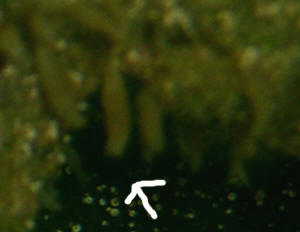
and discovered several ?fans? <Yes, likely so.> look like tiny
daisies about the size of a pinhead. They do retract when touched and
retract when the lights are out. I have about 6 so far on one of the
rocks. do you know what they are? <Yes, sounds like Spiral tube
feather dusters (Spirorbis spp).> Lisa
<Mich>
Question About Things In My Tank I Have No Idea
What They Are... Polychaete Worm and Stomatella Snail
01/03/2008 <Heehee! I have similar things in my
refrigerator!> Hi Bob and or crew <Hi John, you've got
Mich today.> Thank you for the time to look at my question and
pics. <Welcome and thanks for sharing> A little history first
off. I am a newbie to the saltwater aquarium. My tank has been up
for 7 weeks. <OK. Very new.> My water tests are as follows:
Ammonia 0 Nitrites 0 Nitrates >20 PH 8.2 I have a 90-gallon
FOWLR with a 30-gallon long sump and about 150 pounds of live rock.
The sump has a refugium with Caulerpa. <I would avoid
personally. Chaetomorpha is a far better choice in my opinion.>
I am using a Sea Clone 100 protein skimmer ( when I can afford I
will upgrade but its pulling gunk at the moment and I figure
that's better than not pulling). <You are correct!> I
have a cinnamon clown, cardinal fish and a lawnmower blenny ( which
are now in a 30-gallon QT tank). <Congrats on using a QT system.
This will serve you well.> I currently have my display tank in a
fallow state for 6 weeks due to being a dumba$$ and not running a
QT tank from the start and introducing a Kole Tang and a tiny blue
hippo tang which introduced Marine Ich to my system ( lesson
learned). <Very good. Better to learn early!> I have sent you
some pics of the creatures in my tank that I have no idea what they
are and have been unable to ID. Could you please help?
<Certainly will try.> #1 What is under the mushroom? It looks
like a tube like worm with purple spots up close. <Mmm, I'm
not sure what you're referring to here. Any chance of getting a
better shot? Likely a Polychaete worm, it sounds like it could be a
tubeworm or perhaps a Peanut worm (Sipunculid sp.)> #2 Is this a
sea slug and should I be worried about the 10 or so I have? <No
is a beneficial Stomatella snail. They generally reproduce well in
captivity. Is a lucky addition for you.> I have so many
questions and hate to clog your mailbox. <No worries. Is why
we're here.> Could you please advise. <Don't eat
yellow snow...>
John
<Mich> |
|
|
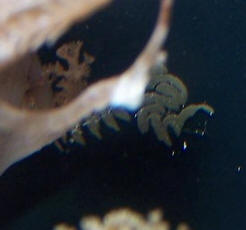
What is this tiny creature? A Spionid/Chaetopterid
worm! - 12/23/07 <Hi Lisa.> I purchased some live rock and
one of the pieces had what looks like a two armed anemone. It lives in
a tube made up of the fine sand in my tank attached to the rock.
<These are neat little creatures. They live in tubes of hardened
mucus, complete with cemented on bits of substrate/shell, sand grains,
etc. The mucus part isn't too appealing to me, but hey, it's
their castle! See this photo of one in my tank for comparison (sorry,
it's not the best photo, but you get the idea):
http://wetwebfotos.com/usermedia/high/0/2470_62.jpg> It will send
out these translucent arms about an inch long searching for food.
<Yep, those are called 'peristomial palps', most often
shortened to 'palps'. What you have sounds like either a
Spionid/Hair worm, or a Chaetopterid worm. Both are similar in that
they construct/live in a tube, have two characteristic hair-like
feeding 'tentacles', and are generally harmless little
detritivores/particulate feeders.> They don't seem to hurt
anything, <For the most part, no. The exception is if they're
within/near a colony of zoanthids. Continual contact with those
flailing little palps can sometimes irritate, causing them to stay
closed/decline.> but they have spread out over the other rocks now.
So far they are not on the glass or in the sand without being attached
to the rock. <Okay.> My tank size is 65gl. I have 5 peppermint
shrimp, 2 hermit crabs, 2 sally crabs, 2 cleaner clams, a few damsels,
and a Maroon yellow strip clown fish. So far it does not seem as though
the peppermint shrimp are eating them or the hermit crabs. <Noticed
the same in my tank. Maybe there's just more readily
available/appealing food about?> Any suggestions on getting rid of
them and do you know what they are?? <No need to remove unless they
become too numerous/encroach on a coral, or irritate it. Please see
these links for more info, as well as WWM via search engine: Spionids:
http://www.reefs.org/library/aquarium_net/1197/1197_1.html
Chaetopterids:
http://www.reefs.org/library/aquarium_net/0897/0897_5.html> Lisa
<Take care --Lynn>
|
Snail ID and Mystery "Things" in Tank
- 12/16/07 <Hi there. I sincerely apologize for the delay
in answering!> First, I have a massive population explosion of
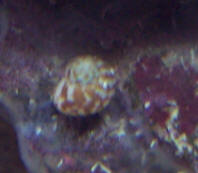
limpets and snails. I have attached a picture of the snail.
Hopefully you can help me ID this sucker. <Sure can! The
little snails you're seeing are Collonistas. They're
harmless/beneficial grazers, vary in color (tan/brown and white,
white, even some pink and white), reproduce readily in our tanks,
and are mostly nocturnal. They also stay small, around 3-4mm.
Please see this link for more info/photos:
http://www.reefkeeping.com/issues/2004-05/rs/index.php> The
second is more complicated. <Heee, I'll second that!>
About a 5-7 days ago I noticed a white web or cocoon type
structure in my life rock. The white material has since gone away
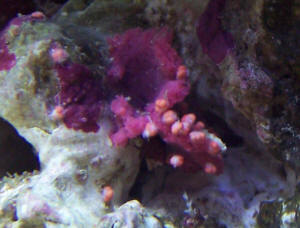
and left behind are these reddish pink multi-lobed balls with a
bit of white "fuzz". Could these be some kind of egg or
something? I have attached a pic? <They don't look like
eggs. However, I need a bit more information in order to narrow
things down. Are these things hard, leathery, or soft? Has there
been any change in appearance since you first wrote in? By the
way, I couldn't help but notice several fine examples of
'tree-like' white foraminiferans in your photo. Very
pretty!> Thanks <You're very welcome, and again, my
apologies for the delay! -Lynn>
Re: Snail ID and Mystery "Things" in
Tank - 12/17/07 <Hello again!> Thank you for the
response. <You're very welcome.> I have taken a close
look, and although they have been moved around by the current,
they seem to have attached themselves where they lie. Not much
has changed in their appearance with the exception of a tiny bit
more white fuzz on them. <Would love to see a close-up of
this!> Could this have been a way that the pinkish-red
structure on the live rock, that they are sitting on in the pic,
replicates itself? <Wondered the same thing myself. Is that
pinkish-red structure hard, or soft (need to know same regarding
the little nodules)? The larger structure, at first glance, looks
very much like a foraminiferan (Homotrema rubrum). Problem is,
after taking a close look at it, I don't see the typical
white, hair-like, feeding structures. Another possibility is that
it's a Rhodophyta (red algae) of some variety. That's why
I need to know if it's soft/flexible, or hard/stony
feeling.> Size wise they are about the size of a pin head.
<Thanks. That's a little smaller than I thought.> I
also have another potential issue. I have a Scopus Tang that
seems to be exhibiting some dark wear marks on its dorsal fin and
tiny "light colored" marks along either side near the
upper part of it's body. - seems to be acting fine but I am a
little concerned. I have tried to get a good pics but have been
unsuccessful. I will keep trying. Any thoughts?
<Unfortunately, this is out of my area of expertise. Please do
try to obtain a good photo and submit your query with as much
information as possible regarding tank size/parameters, whether
fish is still acting/feeding normally, what you feed it, how long
you've had it, other tankmates, etc. Take care -Lynn>
Re: Snail ID and Mystery "Things" in
Tank <Hello!> The structure is hard and previous to the
"white webbing" showing up, it did have longer white
hair like extensions. <Yep, that fits right in with a foram. I
think we've got a winner -- Homotrema rubrum!> Thanks
again <You're very welcome! Take care --Lynn>
Follow-up Re: Snail ID and mystery
"things" in tank - 12/19/07 <Hi there.>
Update - It looks as though the nodules are now growing.
<Could still be a foraminiferan (Homotrema rubrum). Keep an
eye out for similar white hair-like projections, to confirm.
Otherwise, when these things get a little larger, take the best
resolution/detailed photo you can and we'll take another
look/try to ID.> Also I believe my Tang is exhibiting signs of
HLLE - <Uh-oh.> What is your best recommendation for
treatment? I have read several different thoughts on your site.
<Good vitamin enriched diet, pristine water conditions.
However, I'm not the best person to give advice on this. What
you need to do is get a good photo and submit a query with as
many details as possible, including diet, water parameters, tank
size, how long you've had it, etc. Take care -Lynn>
|
|
|
I need sleep! Please help me... -12/14/07
It's 10:39pm and I can't sleep... Let me explain... <Ha!
It's 3:36AM here! :P > A few months ago, when starting my
saltwater tank, I purchased some beautiful live rock from the local
shop. I allowed this to sit in my tank for a few weeks before
adding fish. <just a few weeks?> One night, no fish in the
tank, I see this odd little larvae swimming in the tank... Odd
because it was fairly large. (about two inches...) It was swimming
very fast and like an eel. <...or like a worm?> See attached
photo (the day I first saw it several months ago) <I can't
honestly ID this from the photo, but my guess is that it's the
larvae of some errant Polychaete.> Well I never saw it again and
assumed it had been snatched up by a fish as a tasty treat. <Or
it settled, developed into adulthood.> Four months goes by. A
few days ago I came home from an evening outing and turned on my
living room lights. (tank lights were off) I nearly screamed when I
saw this thing in the tank swimming towards the light. It was the
equivalent of a snake, Courtney Love, <Hey now... be nice!>
and a centipede in one. I was unable to capture a photo of the
beast... we'll call it "ogopogo" for reference
sake... and have never seen it again... I'm too freaked out of
this thing to reach in my tank any more... or sleep for that
matter, wondering if it will attack me in my bed, smother me with a
pillow... and whisper "it's all your imagination"
<LOL, chillax my friend... it's more than likely nothing to
worry about, much less fear.> So in an attempt to take control
of the situation... I took the blue led moon light and shone it
into the tank in hopes it would swim to the light and I could
scream and then regain my composure and capture the beast. No Luck
<Don't be scared, but there might be more than one! Ooooo...
duh da duh dun!> What is it? <In all likelihood, it is a (or
they are) harmless invert larvae.> How do I capture it? How do I
call myself a man if I can barely stay in my apartment? <I
say... education separates the men from the boys.> The scoop:
It's flat... It no longer looks like an eel... It's flat
and dark on one side and translucent on the underside... It's
big... You wouldn't want to find this in your gravel while
sifting through with your fingers looking for debris... It's
about 3 inches now... It has a flat round mouth... <Hmm... this
sounds like something else (other than what you sent in the photo).
Or, possibly the adult form of the free-swimming juvenile in the
photo.> My educated Googling leads me to the following: a Gill
Fluke a species of parasite a relative of a sea lamprey? a juvenile
fish species? <It's hard to say without a very good photo.
But I still wouldn't freak out.> If it were a parasite;
should it not have to live off a fish? <Yep> I would be able
to see it on the fish... <Most likely yes> My theory is that
it lives in the gravel... It's obviously nocturnal... DESPERATE
& SLEEPING WITH LIGHTS ON IN TORONTO, <LOL... go to sleep my
friend. They only attack small children who don't eat all their
vegetables. j/k!> Mark
Sara M.> |
|
|
Misc'¦ Majanos'¦ Maybe, Maybe
Not'¦ Sedentary Snail... SW invert. ID f' -
12/13/07 Hi Crew, <Greetings, Mich here, apologizing for the
lengthy delay.> I have a few creatures that I assume are Majanos.
They are very small with a red base and lots of tentacles. The
tentacles are almost clear but they have a white bulb at the end.
<Hmm, likely Aiptasia, but your description may also describe other
desirable corals such as a Pseudocorynactis. A picture would b most
helpful and the best way to give a solid ID> Similar to pictures in
the WWM forums. One is in a hole in a rock and a couple others are on
the undersides of shells where they get little light. <Again,
consistent with both the nuisance Aiptasia and a desirable coral.>
Is it typical for these to be in such low light areas or is this some
other creature. <Either are possibilities.> I have seen them in
various places in my tank over the past year but this is the first time
I have seen a few at the same time. I never bothered to remove them
because they look nice, were not hurting anything nor were they a
nuisance. <Good rationale.> Sometimes weeds are nice if they
don't get out of hand. <Very true.> I also have an
interesting, but ugly, tubeworm that came on a candy cane colony. The
tube is about 1/4 inch across. A few times a day he lets out some
lines, barely visible, and stuff in the water sticks to it. Then he
reels it in eating the line and whatever is caught on it. <Yes,
sounds like a sedentary snail... a beneficial filter feeder.> Thanks
<Welcome! Again I apologize for my tardiness. Mich>
|
Creature ID? Hermits, Strombus, Sea Cucumber -
12/11/07 Hello again WetWeb Crew! <Hi Sarah!> Thank you
so much for your help with my previous question. <On behalf of
the crewmember, you're very welcome!> I have acquired a
few new creatures and was hoping that you could help me ID them
so I can learn more about their native habitats and care info. I
have attached pictures of a few of my new creatures. <The
seller did not have this information? Unfortunately, I've run
across this all too often. It's so important for us to know
what we're getting, and whether we can properly care for it,
*before we bring it home. It can save many lives and much
frustration!> I have attached pictures of a few of my new
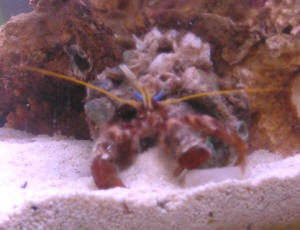
creatures. <Okay, let's get to work!> The first is a
hermit crab about 2.5 inches across (including the shell). I
looked at your hermit ID page and thought it looked like
Clibanarius vittatus. It seems very easy going. <Looks like
that species to me, as well. Common along Gulf Coast states,
size: up to about 3', mostly a scavenger, hardy.> 2. A
golf ball sized hermit. It is a decorator with orange-yellow
antennules and blue eye stalks. It's a little high-strung, in
my opinion, and voracious. <Typical of many hermits.> I am
having a hard time searching it online <Understandable.
I've looked everywhere (books, online, etc) and can't
find this hermit. The good news is that I'm sure we've
both learned much while searching!> and am hoping that it will
not get much larger because I have a feeling that it will cause
some damage if it does... <Understandable, and without knowing
which species it is...? In order to have a better chance at
identifying, I'd need more detail in the photo (to see
whether one claw's larger/which one, legs smooth or hairy,
shape of claws, etc). Looks like the little guy decided to move
just as the photo was taken - drat! Please see the following link
for more info, as well as related links above:
http://www.wetwebmedia.com/marine/inverts/arthropoda/crabs/hermitcrabs.htm
. This is an excellent site with many photos of hermits for
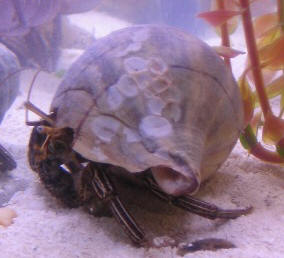
comparison: http://www.recif.be/article/hermit.htm > 3. I
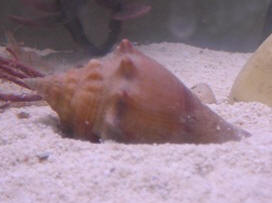
thought this gastropod might be a young whelk <!> because
the tank I acquired it from contained large Busycons, but I
really have no idea. Maybe miniature variety of Strombus? lol.
<Heeee! Well, they all start off small, but some get huge!>
The shell is about 1 and 3/4 inches long. The inside of the shell
is mother of pearl and light purple. <Pretty> The snail
inside is dark brown with a tan-yellow operculum. Its eyes have
black centers surrounded by a silver-white ring and a thin,
black, outer ring. <Typical of Strombids. Whelks have black
dots for eyes. Is definitely something in the Strombidae family.
Looks very much like Strombus alatus/Fighting conch, which can
vary somewhat in color/shape -- see link re:
http://www.gastropods.com/9/Shell_1329.html. Also similar to
Strombus pugilis worki (see slender spire):
http://www.gastropods.com/5/Shell_4465.html Here's a helpful
link showing thumbnails of the Strombidae family (for additional
comparison):
http://www.gastropods.com/Taxon_pages/TN_Family_STROMBIDAE_STROMBINAE.html
Information re:
http://reefkeeping.com/issues/2004-07/rs/index.php > 4. A sea
cuke. Just a plain old brown cucumber. The stripes of podia are
slightly lighter in color. It's about 3 inches long. Sorry
about the picture quality on this guy. <Can be difficult, I
know! Unfortunately, I can't see much in the photo, but
please see this link (and related links above) re:
http://www.wetwebmedia.com/seacukes.htm > I don't really
need the species names, but if you can give me an idea as to
their native habitat that would be great. <See above>
Thanks so much, <You're very welcome! Take care
-Lynn>
|
 |
 |
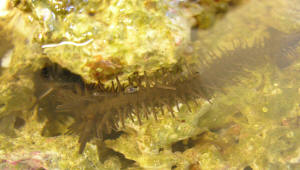
| Creature ID, ophiuroid 12/9/07 Good
afternoon to the amazing guys and gals at WetWeb! <Hello
Scott> I picked up a couple of small pieces of live rock today
and I noticed a hitchhiker. I believe it to be Ophiocoma erinaceus
but I'm not certain. <It is definitely an Echinoderm of the
Ophiuroidea species.> Would you please verify (if you can from
the attached photo) and let me know if it is safe to place in my
FOWLR system (containing one Arothron hispidus, one Cephalopholis
miniata, one Zebrasoma flavescens, and one Batrachomoeus
trispinosus)? If it isn't suitable for the main tank, would it
be safe to place in my refugium (containing two unknown mithrax
crabs)?<I think the puffer would be the quick to sample the
Brittle starfish. Therefore the sump may be it's best bet.>
Thank you once again for your ongoing work at teaching us laypeople
the proper ways to creating and maintaining a successful tank. I
owe any of the Southern California WetWebbers a beer. What's
your schedule look like? <Thanks for the beer!-Mr. Firemouth>
The Other Scott F. |
|
|
|
Snail Eggs -- 12/6/07 <Hello Julie!
Brenda here> I've attached a photo of something that has
grown onto the back of my tank in the past 10 days. I don't
even know how to describe it so I hope the picture is detailed
enough. It's about 3 inches long. <It certainly looks like
snail eggs to me, possibly Cerith. What kind of snails are you
keeping?> Thank you! Julie <Brenda>
Re: Snail Eggs -- 12/6/07 I have Astrea and
Nassarius. <It is definitely not the Astrea. This species
releases gametes into the water column. See here:
http://www.reefcorner.com/SpecimenSheets/astrea_snail.htm It is
likely the Nassarius snails. Neat!!! See here:
http://forum.marinedepot.com/Topic20750-11-1.aspx?Highlight=nassarius+eggs
Good luck to you! Brenda>
|
|
 .jpg)
|
|
|