|
FAQs about Non-Vertebrate Animal
Identification
37
Related Articles: Marine Invertebrates, Marine Invertebrate Systems, Marine Invertebrate Compatibility,
Marine Invertebrate Disease,
Marine Invertebrate
Reproduction, Quarantine of Corals and
Invertebrates, Feeding
Reef Invertebrates, Lighting
Marine Invertebrates, Water Flow, How Much
is Enough,
Related FAQs: Non-Vert IDs 1, Non-Vert IDs 2, Non-Vert IDs 3, Non-Vert IDs 4, Non-Vert IDs 5, Non-Vert IDs 6, Non-Vert IDs 7, Non-Vert IDs 8, Non-Vert IDs 9, Non-Vert IDs 10, Non-Vert IDs 11, Non-Vert IDs 12, Non-Vert IDs 13, Non-Vert IDs 14, Non-Vert IDs 15, Non-Vert IDs 16, Non-Vert IDs 17, Non-Vert IDs 18, Non-Vert. ID 19, Non-Vert. ID 20, Non-Vert. ID 21, Non-Vert. ID 22, Non-Vert. ID 23, Non-Vert. ID 25, Non-Vert ID 26, Non-Vert ID 27, Non-Vert ID 28, Non-Vert ID 29, Non-Vert ID 30, Non-Vert ID 31, Non-Vert ID 32, Non-Vert 33, Non-Vert ID 34 Non-Vert ID 35, Non-Vert ID 36, Non-Vert ID 38, Non-Vert ID 39, Non-Vert ID 40, Non-Vert ID 41, Non-Vert ID 42, Non-Vert ID 43, Non-Vert ID 44, Non-Vert ID 45, Non-Vert ID 46, Non-Vert ID 47, Non-Vert ID 48, Non-Vert ID 49, Non-Vert ID 50, Non-Vert ID 51, Non-Vert ID 52, Non-Vert ID 53, Non-Vert ID 54, Non-Vert ID 55, Non-Vert ID 56,
Non-Vert ID
57, Non-Vert ID 58,
Non-Vert ID 59,
Non-Vert ID 60, Non-Vert ID 61,
& Marine Invertebrates, Marine Invert.s 2, Marine Invert.s 3, & FAQs about:
Marine Invertebrate Behavior,
Marine Invertebrate
Compatibility, Marine
Invertebrate Selection, Marine
Invertebrate Systems, Feeding
Reef Invertebrates, Marine
Invertebrate Disease, Marine
Invertebrate Reproduction, &
& LR
Life Identification, LR
Hitchhiker ID 1, Anemone
Identification, Aiptasia
Identification, Aiptasia ID 2,
Worm Identification, Tubeworm ID, Polychaete Identification, Snail Identification, Marine Crab
Identification, Marine Invert.s 1,
Marine Invert.s 2, Marine Plankton,
|
|
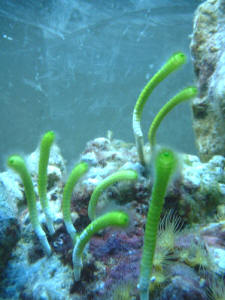
ID for a Green, Stationary, Segmented tube worm
growing in my tank Green, Stationary, Segmented tube worm growing in my
tank, Algae Actually 6/30/08 Hello, <Hi> Hope you all are
well, and thanks so much for providing the wealth of information and
insight that has made this hobby even more rewarding! This email is a
bit lengthy, but I think that it is always helpful to give a complete
history, especially in the case of a tank crash. <Fire away> I
have a 55G long, Indo-Pacific reef tank that has spent the last six
months recovering from a 4 day power loss in PA in the middle of
December. Prior to the crash, this tank was populated with 6 different
color/types of Zoanthids, yellow polyps, green star polyps, white clove
polyps, red mushroom corals, and assorted crabs/snails, two huge
batches of Halimeda and 3 fish (coral beauty, false percula and blue
damsel). After the crash, this tank was populated with really smelly
mud. I was breaking down the tank and noticed that, in fact, there were
a handful of crabs and snails that actually survived 4 days at 40
degrees. <They are survivors.> I didn't have the heart to
chuck them down the driveway with the stinky water, so I pulled out all
that I could find, scrubbed down the rock in a batch of RO/DI salted
water and re-established the tank. (The insult to injury in all of this
was the fact that I had a 20,000 watt home generator installed that I
thought would allow me to avert such a crisis, but, unfortunately, it
wasn't installed correctly and we could never get it to come on and
give power.) <Ouch> Flash forward six months later and I once
again have 3 fish (all new): a coral beauty, a false percula, and a
yellow Coris wrasse. Believe it or not, I've gotten about 50-60
yellow polyps that have come back, a bunch of purple coralline algae
encrusting the rock again and I random worms/feather dusters that have
crept out of the rock that I'd never seen prior to the crash.
<They have no competition for the moment.> This brings me to my
question. I've attached some JPG files of some stationary tube
worms that seem to be growing out my rock. I've searched your site
and across the web, but have found not a single picture or description
that matches these critters. They have a white, calcareous base that
starts narrow and gets wider to a rounded tip. They extend about 1.5 -
2 inches up from the rock. They almost look like elongated thumbs. As
you progress up the tube, there are rings of fine, green
"feathers" that get larger as the tube widens, then taper
towards the tip. They appear to be segmented. <Not worms actually,
algae, Neomeris annulata.> NOTE: The only thing new in this tank is
a rock with some blue-green Zoanthids on it, but it was placed in the
tank after these guys showed up. The rest is all indo-pacific rock from
about 8 years ago. Any help that you can give me in identifying these
worms would be greatly appreciated! Deb <Neomeris annulata is
harmless, calcium loving algae. Fairly common in tanks, although it
seems to fade over time. Enjoy it while its there.>
<Chris>
|
|
| Strange particles -- 06/28/08 Hi,
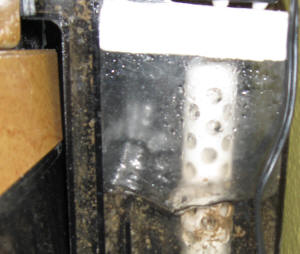
<Hello there> I see some green/brown particles in my aquarium
sump and in the overflow. They don't look like green algae but
they look like some polyp. They stick to the wall and grow from
there. I have attached some images to make it clear. Can someone
please help me identifying what this is? <Not from these pix...
look like... as you say, particulate matter... could well be a
biological component. Perhaps a magnifying glass, small microscope
will show more... I'd use a mechanical filter... likely an
Emperor Aquatics "bag" on the discharge end of your drain
line/s going into the sump to capture a good deal of this>
Another question that I had was the problem with the overflow. The
overflow always gets some bubbles and the siphon is lost.
<Yikes... dangerous> I have installed Aqualifter and its
still working but the bubbles don't seem to enter the hole
unless I tilt or move the overflow around. Any help would be
appreciated. <... I'd drill the tank, have it drilled. Read
here: http://wetwebmedia.com/marsetupindex2.htm the fourth tray
down... Bob Fenner> |
|
|
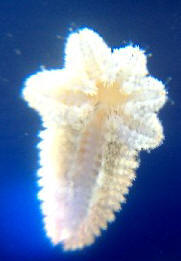
| New Critter Needs ID, Asterina 6/27/08 Hello
again crew, <Hi> I don't suppose my tank stats matter for
this question, so I will skip those. This little guy showed up on
my glass yesterday and I have no idea what he is. A few weeks ago I
asked you guys about some things that showed up when the lights
were out, and Lynn identified them as Collonista and Stomatella
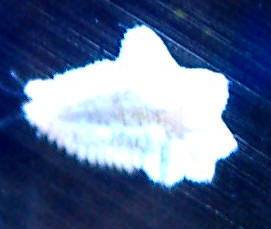
(thanks again for that!). Anyway, this guy is about the 4 or 5 mm
long, and looks like some kind of snail. However, as you can see
from the pic, he looks 5-sided, with one longer side. Some sort of
starfish maybe? My fish keep investigating him, its kinda funny
actually, but none have bothered him yet. Any ideas crew? Thanks
again, Jared S. <Looks like an Asterina star to me. See here for
more http://www.wetwebmedia.com/asterinaidf.htm .>
<Chris> |
|
|
Better Pic of New Critter on Glass 6/27/08
Hey crew, I was able to take a better picture of the new critter on
my glass. I am pretty sure its some kind of starfish now, just
would like to know which. Thanks again, Jared S.
<Yep, an Asterina.>
<Chris> |
|
|
|
Re: Critter ID. 6/24/08 Hi, I wish I'd
seen this query - I'd have nabbed it for sure! I saw
something similar to this a couple of days ago while on the hunt
for Tineke's mystery shell/slug/Rhodophyte combo. I'll
see if I can't backtrack and find out what it is. -Lynn
<Thank goodness... I swear I've seen, read about this sort
of "bivalvish", footed, ambulatory marine life... but
can't for the life o me wake up and smell da cacao and recall
what the Dickens group it belongs to. Be chatting! B>
LOL Yep, I know what you mean. Now the trick for me is to
remember where I saw the blasted thing! Take care, -Lynn <Know
whatcha mean... Hey, where are my pants!? Will do. B>
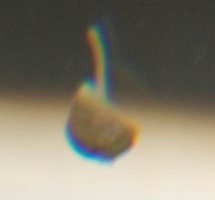
Critter ID: Bivalve Mystery - 6/24/08 Hi there, <Hi
Carl, Lynn here this afternoon!> Firstly congratulations on
the great site! <On behalf of Bob and the crew, thank you very
much!> This is my first marine aquarium and your site has
provided me with a great amount of information to help me on my
way. <Excellent> I was wondering if you could help me
identify this little chap which seems to have hitched a lift on
my last batch of live rock. <Will sure try.> He's only
a few millimeters in size and brown in colour, the main part of
the (shell?) looks like a split seed casing out of which comes a
small white worm. <Okay> It moves by basically attaching
the (head?) end of the worm <The shape is reminiscent of a
clam siphon.> ..to a rock or the glass and then dragging
itself along. It seems to be around day and night and doesn't
seem to be causing any problems in the tank. <That's
always a plus!> Just curious as I've not been able to ID
it.
http://h7lwpw.blu.livefilestore.com/y1p4IDr1MtfX0zR2RucSIySuNcmVaXc7KuxbCiaLHGLht
FTkVWWLqzE8IFbeJTW3-OK_HeGwiouZZhJjzRoDIj7KA/Untitled-1.jpg?download
<Okie doke. Is there any way you can get a higher
resolution/more detailed photo of this little guy? If not,
that's okay. Hopefully, together we can solve this mystery!
When it comes to bivalved critters, the choices that come to mind
are mollusks in the Class Pelecypoda/Bivalvia (clams and such),
Ostracods ('seed shrimps'/Crustaceans), Brachiopods (aka
'lamp shells'), and Opisthobranch sea slugs in the Family
Juliidae. Of these possibilities, the most mobile are the
Ostracods and sea slugs. I think we can rule out Ostracods
because they have multiple long hair-like antennae protruding
from their shells instead of a single, thicker stalk/siphon
(whatever that thing is in the photo). See this example of an
Ostracod for comparison:
http://www.friendsofwarnhamlnr.org.uk/images/pondlife/crustacea/ostracoda/cypris05.jpg
Sea slugs in the genus Juliidae are also out because all have two
obvious rhinophores/antennae on their heads. I don't see any
on your creature and I think you would have noticed them had they
been there. By the way, let me know if you take another look at
your little guy and do indeed see rhinophores! In the meantime,
please see these links for sea slug examples: http://www.seaslugforum.net/display.cfm?id=19650
http://www.seaslugforum.net/factsheet.cfm?base=julizebr
. Now we're left with mollusks/bivalves and Brachiopods. Most
live either attached to hard surfaces or buried in sediments.
Although they're mostly sessile, they can and do move about
when very young (before settling) and, if possible as an adult,
when necessary. Brachiopods attach themselves to hard surfaces
and anchor themselves in the sand by way of what's called a
"pedicle" or stalk. Bivalve mollusks (except for
scallops and such) use a muscular foot to move about/bury
themselves in the substrate, while those that attach themselves
to hard surfaces secrete byssal threads as holdfasts. Now that
you have some of the general terms, please see the criteria
listed below. Hopefully it will help narrow things down. By the
way, if you have a magnifying glass somewhere, dig that puppy out
and take a close look at your little critter. 1. Pedicle that
emerges from a single hole on one side of the shell = Brachiopod.
2. Long, slender pedicle that emerges from what appears to be a
hinged area (where the two shell halves meet) = Brachiopod. 3. A
Muscular foot that emerges from the open side of two shell halves
(not at the hinge) = bivalve/mollusk. 4. Shell with no pedicle
hole + foot/siphon that can completely retract into shell =
bivalve/Mollusc. 5. Once attached to a surface, the creature is
able to pivot about on the stalk/holdfast = Brachiopod. Hopefully
this helps! One thing I'd like to mention is that there may
easily be other possibilities as well that I'm totally
unfamiliar with! As is, I'm inclined to think that what you
have is likely a very young bivalve (mollusk) of some sort trying
to find a place to settle, rather than a Brachiopod. The
reasoning behind this is mainly because the latter is less
common. That and the fact that I can't come up with any other
possibilities! Please see the following links for photos:
Brachiopod (see pedicle):
http://www.dse.vic.gov.au/CA25677D007DC87D/LUbyDesc/WPB-lamp_il/$File/lampshell_il.jpg
Ostracods as well as a photo of a juvenile bivalve (bottom left):
http://www.chucksaddiction.com/hitchpods.html > Many Thanks,
Carl. <You're very welcome. Keep in touch --Lynn> Bob-
I doubt that that is the animal's foot in the pic of the
"bivalve." Could you and Lynn be thinking of "Lamp
shells" (Brachiopoda)? Best, Sara M.
<Dat's a right>
|
|
 Oh, yeah. B. Oh, yeah. B.
Re: Bivalve mystery . 6/25/08 "Bob- I doubt
that that is the animal's foot in the pic of the
"bivalve." Could you and Lynn be thinking of "Lamp
shells" (Brachiopoda)? Best, Sara M.<Dat's a
right>" Hi Sara and Bob, Yes, a Brachiopod was most
definitely one of the possibilities that came up. I'm hoping
that Carl will be able to determine whether he has a mollusk or a
Brachiopod by the placement, etc, of that slender appendage. It
does indeed look more like a clam siphon or a Brachiopod pedicle
to me than it does a mollusk foot, but after seeing Charles'
photo of a juvenile clam/scallop at the link provided, I had to
admit that the possibility was there (see the photo on the bottom
left: http://www.chucksaddiction.com/hitchpods.html ) . That
still looks like a foot to me because it's a bit broader at
the base, but given the possibility of odd positioning with
Carl's creature and a bit of a blurry photo?? I just
don't know. I'd actually love for it to be a Brachiopod.
Anyway, I'm hoping to hear back from Carl so that we can have
this answered! Take care, -Lynn
|
|
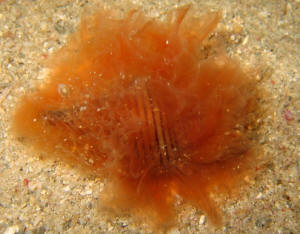
A strange shell or Nudibranch? 6/21/08 Dear Bob or Lynn,
<Greetings Tineke! Lynn here today.> Do you know what this
is? <Yes, it's pretty - hehe!> I thought it was a shell
with some algae, but on a site
(http://www.aqualifeimages.com/Default.aspx?ShowImage=66
http://www.aqualifeimages.com/Default.aspx?ShowImage=66&QueryIs=89%20results%20for%20%22Latest%20Images%22&sqlstr=SELECT%20*%20FROM%20IMAGES%20WHERE%20INACTIEF%20=%200%20AND%20Release%20=%2048%20ORDER%20BY%20NAAM&QueryIs=89%20results%20for%20"Latest
20Images"&sqlstr=SELECT%20*%20FROM%20IMAGES%20WHERE%20INACTIEF%20=%200%20AND%20Release%20=%2048%20ORDER%20BY%20NAAM)
<Unfortunately, I couldn't get through to the link (error
message), but was able to locate the photo - yay! For anyone
wanting to see this, please go to this site:
http://www.aqualifeimages.com, choose 'Nudibranch' in the
drop down menu under 'Aqualife subjects'. Once the page
has opened (may take awhile), go to the third row from the bottom
and see the photo on the far right. By the way, that's a neat
site!> ..I saw almost identical picture as an unknown
Nudibranch. <Yes, it looks like the same creature. Apparently,
it was photographed in the Red Sea so I'm guessing that yours
was taken there as well? You saw some neat things while you were
there, didn't you! That does it, I've got to go!> I
hope you know this one! <Well, at first I thought that this
should be fairly easy to ID, but after hours of searching and
exhausting every resource I have, I'm more than willing to
admit that I just don't know! The frilly exterior reminds me
of something in the genus Hydatinidae (family Acteonidae, Order
Cephalaspidea -- 'Head Shield' slugs and Bubble shells).
I didn't see any however, that had their shells completely
covered/obscured. See this species, for example:
http://www.seaslugforum.net/factsheet.cfm?base=hydaphys
http://www.seaslugforum.net/display.cfm?id=4463 Then I checked
various Cowries as some of these have very elaborate mantles
covering their shells. See these for example:
http://chemistry.csudh.edu/faculty/jim/cozaugo4-600/atlantic.jpg
http://www.seaslugforum.net/factsheet.cfm?base=ovulids . It's
a shame we can't see a bit more of the shell underneath, that
would be a big help! My recommendation to you, at this point, is
to send your photo and information along to Bill Rudman at
SeaSlugForum.net and see what he says. By the way, please let us
know if/when he does ID this neat little guy!> Greetings from
Holland, Tineke <Take care and good luck. I'm sorry I
couldn't ID this for you! --Lynn>
Re: A strange shell or Nudibranch? 6/21/08 Hi Lynn,
<Hi there!> I will send this one also to Bill. I didn't
get an answer yet on the other Nudi I sent him...no problem. I
will wait a little bit longer. <Well, from what I read on his
site earlier today, they had a problem recently with a hacker so
that might well be part of it.> No problem that you
haven't found it...still a mystery to solve! <Thank you
for understanding! I do love a good mystery and am looking
forward to seeing this one solved. I'm sure Bill Rudman will
have an answer for you soon!> Greetings
Tineke
<Take care, -Lynn>
|
|
 Shell and Rhodophyte, BGA? B. Shell and Rhodophyte, BGA? B.
|
|
Fw: Gastropod ID - a long time coming!
1/11/13
Well darn - after all that, I spelled the name wrong - doh! It's
not Galaga succincta, it's Gelaga succincta! Sorry about that, Bob!
-Lynn
<Heeeee! Will amend/append. B>
Gastropod ID - a long time coming! 1/11/13
Hi Bob,
I was going through some of my files, pulling out and organizing the
ID's I've worked on over the years and ran across an unsolved query
that's bugged me since day one (four years ago!). It's titled "A
strange shell or Nudibranch? 6/21/08" at this link:
http://www.wetwebmedia.com/invertidf37.htm?h=
The good news is that I was able to contact the original querior,
Tineke, and solve the puzzle. According to Phillipe Poppe (of
Poppe Images, son of Guido Poppe - THAT Poppe - yay!), the organism in
question is a gastropod known as Galaga succincta, aka the "Lesser
Girdled Triton" (family Ranellidae). Depending on where you look,
this species is also listed as Cymatium succinctum. Which one is
right...or more right...is not something I could figure out.
Interestingly enough, the orange exterior that I thought might be an
elaborate mantle of some sort is instead the snail's periostracum. I've
seen hairy, prickly versions before, but never one as elaborate and
delicate as this. At any rate, the snail is a type of triton, and
is therefore carnivorous. I was unable to find any specific diet
information, but in general, the genus preys on a variety of things
including echinoderms, tunicates, some Polychaetes, and other mollusks.
It may also be a bit of a scavenger as well. On the whole, it's a
beautiful little snail that's "gilded the lily" with an ornate exterior.
By the way, here's another site with additional photos for comparison:
http://www.jaxshells.org/gelagna.htm
Needless to say, I am very thankful to Tineke and Phillipe Poppe, for
solving this long-time question!
<The Poppes are amazing, tireless photographers, catalogers of
Mollusca... RMF>
Hope you had a terrific time over the holidays and are enjoying the new
year!
Take care,
Lynn Z
Re: Gastropod ID - a long time coming! 1/11/13
No kidding, I'd love to meet any one of them so that I could thank them
in person for all they've done. Their site has always been one of
my first "go to" sources when looking for photos. It's simply
awesome.
-Lynn
<Indeed; agreed. B>
|
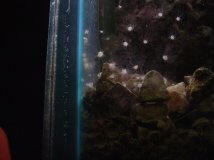
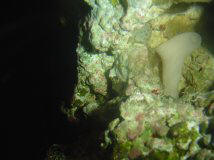
Help identifying 2 pics? 06/21/08 Dear wet
web media, I have searched way too many hours on these things
growing in our saltwater aquarium (120 gal). It's been
established for a couple years now, but I am noticing these things
multiplying recently. I've attached a pic of some of them. They
seem to be mostly at the bottom of the tank on the glass. Their
tentacles seem to move. <The pics are really too blurry to make
much out... but from your description below, I'd say
they're likely harmless Spirorbis worms.> In the second pic
I have many tubes of different shapes. They seem to be growing
larger. Some are long & skinny, where this one is kind of boot
shaped with an obvious hole in it. <They look like sponges to
me.> One thing I notice is white specs all over the glass at
times. If you look really close they look kind of spiral shaped. I
sort of think it looks like a snail (and I have hundreds of
different sized baby snails that just keep showing up). Cold they
be reproducing? <Could be... are these things stationary or
mobile?> Thank you for your help. Kristie
<De nada,
Sara M.> |
|
|
Re: help identifying 2 pics?
6/22/08 Just to clarify, I have two things I am trying to
identify. One is the specks that show up on the tank glass, that
develop into spirals. I'm just curious about these. Was
wondering if they were snails reproducing. <possibly...> The
one I am most concerned with is the tentacle like things that are
multiplying on the glass near the bottom of the tank. Please let me
attach one more pic that is a little more close up. Maybe you can
identify it better. These don't seem to move at all, although
the tentacles or arms (like hairs) seem to be alive & moving
(not just with a current). They worry me that I should be getting
rid of them. I probably have 20-30 of them that have developed in
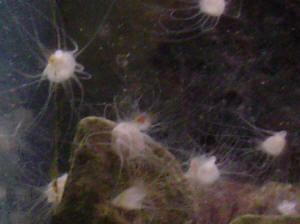
the last month or two. <Ah, now I can see them... looks like
Hydroids. http://www.wetwebmedia.com/hydrozoanfaqs.htm > Thank
you for your Kristie
<Best,
Sara M.> |
|
Ohh, Hydrozoans. B
|
|
|


