|
| |
|
FAQs about Non-Vertebrate Animal Identification
38 Related Articles: Marine Invertebrates, Marine
Invertebrate Systems, Marine Invertebrate
Compatibility, Marine Invertebrate Disease, Marine
Invertebrate Reproduction, Quarantine
of Corals and Invertebrates, Feeding
Reef Invertebrates, Lighting Marine Invertebrates,
Water
Flow, How Much is Enough,
Related FAQs: Non-Vert IDs 1, Non-Vert
IDs 2, Non-Vert IDs 3, Non-Vert
IDs 4, Non-Vert IDs 5, Non-Vert
IDs 6, Non-Vert IDs 7,
Non-Vert IDs 8,
Non-Vert IDs 9,
Non-Vert IDs 10,
Non-Vert IDs 11,
Non-Vert IDs 12,
Non-Vert IDs 13,
Non-Vert IDs 14,
Non-Vert IDs 15,
Non-Vert IDs 16,
Non-Vert IDs 17,
Non-Vert IDs 18,
Non-Vert. ID 19, Non-Vert.
ID 20, Non-Vert. ID 21,
Non-Vert. ID 22, Non-Vert. ID 23,
Non-Vert. ID 25,
Non-Vert ID 26,
Non-Vert ID 27, Non-Vert
ID 28, Non-Vert ID 29, Non-Vert ID 30,
Non-Vert ID 31, Non-Vert
ID 32, Non-Vert 33, Non-Vert ID 34
Non-Vert ID 35, Non-Vert
ID 36, Non-Vert ID 37, &
Marine
Invertebrates, Marine Invert.s 2, Marine
Invert.s 3, & FAQs about: Marine Invertebrate Behavior, Marine
Invertebrate Compatibility, Marine Invertebrate Selection,
Marine
Invertebrate Systems, Feeding
Reef Invertebrates, Marine Invertebrate
Disease, Marine
Invertebrate Reproduction, &
& LR
Life Identification, LR Hitchhiker ID 1, Anemone Identification,
Aiptasia
Identification, Aiptasia ID
2, Worm Identification, Tubeworm ID, Polychaete Identification, Snail
Identification, Marine
Crab Identification, Marine Invert.s 1, Marine
Invert.s 2, Marine Plankton,
|
 |
|
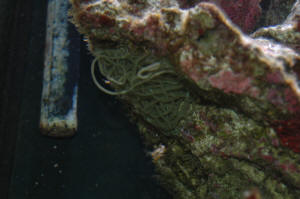
Critter Ids – 10/09/08
Good Afternoon, <Good morning.> I have just a few questions that I
cant seem to find an answer to. First all the pertinent info, the tank
is 90 gal with 2-250w 14k HQI bulbs and 4 65w actinic CF. with a 30 gal
sump. The water parameters are as follows. Salinity-1.024, Ammonia-0,
Nitrate-0, Nitrite-0, Phosphate-0, Alk-8, Cal-480, Temp 77 day 75 night.
Okay here are the questions I recently re-arranged some rock to provide
better water circulation and I found this weird spiky egg looking thing.
It is approx. 2'' in a egg shape. Its kind of hard to see the little
spikes in the pic but they are there. <A sponge. See here:
http://www.wetwebmedia.com/spongeidfaq2.htm and the other FAQs.> The
other "thing" in question is this little tube like worm growing on the
side of my hammer coral. It appears to be a pinkish tube with a black
worm inside. It sends out a long string of mucus which traps stuff then
sucks it back in. I read the other post on this but there were no pics.
The pic that I have is not the best as I would have to disassemble quite
a bit to get a great pic of it but if you look in between the two heads
you will see the little black creature with the two "pincher's?" and the
mucus trail. <A Vermetid snail (worm snail, a sessile gastropod).
Another harmless animal, only in few cases with thousands of individuals
they apparently somewhat irritated corals with their mucus nets See
http://www.wetwebmedia.com/snailidfaq7.htm and do a WWM/Net search on
Vermetid.> Just curious if either of these little creatures are
anything to be worried about? <Absolutely harmless. Enjoy them.>
Thxs, Kris. <Welcome. Marco.> <<Spot on, as usual Marco. RMF>>
|
 |
|
If I could bother you or one
of the other crew members with a snail and parasite, ID, 9/27/08
Thanks, Bob!!! <Welcome> If I could bother you or one of the
other crew members with a snail and parasite, ID, I'd appreciate it. I
have gone through all the snail ID pictures and descriptions on all the
17 plus pages and of course, like most people, no one has a snail "just
like mine". I had it narrowed down to the three most common ones people
ask to have ID'd, Nerite, Collonista and baby Turbo, but I went through
that site you have linked that shows all of the shells of those and I
could find a few that were similar, but, of course, none "just like
mine". They are primarily nocturnal but do appear during the day. I find
them every where. On the glass. On the rocks. And on the corals,
especially Zoas and leathers. I've even found some under the microscope
in water samples that I couldn't see with the naked eye. It does have a
pattern similar to a sundial but it has a smooth shell and doesn't have
the pagoda shaped operculum. They also appear to have calcareous egg
shells on the rocks but they are not round or sesame seed shaped, they
are more like a pentagon. <I don't see these in my ref. works
either. Am sending your query to friend and "shell nut" Marty Beals of
Tideline for his input> The parasites I got off of a small piece of
Acropora and Kenya Tree that I was given by a friend that I had in
quarantine. <Mmm, don't consider these parasites... other than
"space"... perhaps predators... Am pretty sure these are Ostracods>
They were both fine for about 3 weeks and then the Acropora went in less
than 3 days. It started losing tissue at the base and went right up to
the tip. The Kenya Tree started throwing off it's own branches but is
still doing okay in quarantine. Since the Acropora was already lost, I
did a dip in Iodine and all that came off were these little critters. I
dipped one of the branches of Kenya Tree and found the same thing. One
picture is magnified at 40 times, the other is at 100 times. You can
barely see the critter with the naked eye. It looks like a flea with
shorter legs. Iodine dip doesn't seem to kill the critters. They were
even alive after a day in RO/DI water. You know microscopes are
addictive when you have a reef tank. <Ah yes> Once you think
you've seen everything in your reef tank, you are sadly mistaken until
you've seen it under a microscope. Thanks Everybody!!!!! <I don't
think these small crustaceans were/are the root of the Cnidarians health
issues. Bob Fenner>
|
 |
 |
Hi Bob, Is it me, or do those look a
lot like larval cirripedes? Cheers, Neale <Mmm, you may be
right... will amend. Thank you, BobF> |
|
Question about hermit crab
growths 9/26/08 Hey there Crew, Grant speaking. <Howdy
Grant> I've got some hermit crabs in my tank and just recently I
noticed one of them with some type of growths all across the back of the
shell. <I see them> They are very tiny, they look like little
anemones. They are pink hued, but I think they might just be clear and
since the shell has coralline algae, they look pink? <Yes> Any
idea what they might be? <A few guesses, yes> I've included a
picture but it is really hard to get a good shot, they are so tiny. They
act like a little anemone, but they don't move around at all, I was
thinking maybe some type of Xenia or the pulsing hand corals? <Mmm,
not my first guess... Likely either a red algae or some sort of
Hydrozoan> I don't know much about them, but if I had to guess they
look like miniature versions of the ones I've seen in pet stores.
Small stalk with a white center and some frilly finger type appendages
all around the white center. The only thing that makes me thing they
aren't Xenia is they have what looks to be a lot of "fingers" whereas
all the Xenia I've seen only have 5 or so. But again, it is so tiny I
cant really tell. Thanks for any help you can give! <If you can
make a higher resolved image... maybe look for a "macro" mode on your
camera... and/or larger file size... if a digital SLR a "macro" lens...
I'd like to see this a bit more clear, close-up. Oh, at any length, this
is not likely a problem for the Hermit, your other livestock, system.
Cheers, Bob Fenner>
|
 |
|
Re: Question about hermit crab
growths 10/6/08 Thanks for the reply. I got a somewhat
better picture of it, still not GREAT but hopefully helps you out a
little more than the last one. Grant <Ahh, thank you for this
pic... do look "Polypoid"... am more sure these are indeed
Hydroids/Hydropolyps... There are many "kinds" as you will see... as
long as these don't spread to your hardscape, I would count your Hermit
lucky to have such a built in defense. Cheers, BobF>
|
Oh yeah |
|
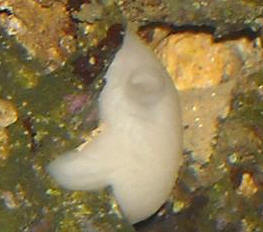
What's this stuff? – 09/22/08 Hello. <Hi
Eric.> I recently added this nice Favia as the first coral in my new
30g setup, which has been cycling with 25# of Tonga LR since June. No
fish yet, just a CUC. Lighting is 150w MH. Anyway, I've noticed recently
these white colored "sprouts" growing downward from the underside of the
rock that the Favia is attached to (hopefully, you can make this out in
the attached pics). <Yes, a little blurry, but I know what you
mean.> Any guess as to what this is? They're growing from what appear
to be little white polyps--but what do I know? <Harmless Syconoid
sponges. See http://www.wetwebmedia.com/sponges.htm , and
http://www.wetwebmedia.com/spongeidfaq4.htm and the other FAQs linked at
the top of this page.> This is why I seek your expertise, which I
very much respect and appreciate. Thanks, Eric <Welcome. Marco.>
|
 |
|
Unknown organism 9/19/08 Hello Crew,
<Peter> Hope everyone is well.? I am attaching? two pictures of an
organism that has shown up in my in the 1st chamber (which houses my
protein skimmer) and 3rd chamber (return pump) of my refugium.?
Currently there are about 19 of these organisms throughout these two
chambers and it seems like they are multiplying quickly.? One of them is
even inside the protein skimmer.? No signs of any in my main tank or
refugium chamber. Please help me identify it. Thank you in advance
Peter <Mmm, these are sponges... see here:
http://wetwebmedia.com/spongeidfaqs.htm and the linked files in the
sequence above... Not harmful, actually of use. Bob Fenner>
|
 |
|
Re: Unknown organism 9/20/08 Hi
Bob...Thanks for the response. Would you suggest feeding some of the
sponges to my Imperator angelfish? Thanks again Peter <Worth trying.
BobF>
|
|
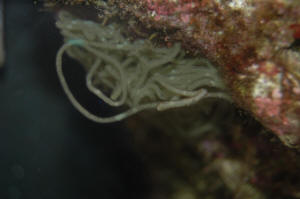
Question, ID... invert. related 9/18/09
Hello Gang, <Oliver> I have included a few images of something I
noticed floating around my aquarium the other night. I apologize for the
quality of the photos, but I was scrambling to piece my camera together
and before I knew it, it flew into a powerhead and was destroyed. Every
now and then I would noticed a few strands of spider web silk on the
rocks and wonder where it was coming from, but have never seen a huge
blob like this floating! <Neat!> The "stuff" floating around
looked like a ball of spider web! I looked around the internet to see
what I could find, and there wasn't much, especially in terms of photos
to match this too. I did read that certain worms are known to produce a
silk like material, and once and only once did I see a small worm
swimming around the aquarium, but as soon as I hit the lights, the
little guy zipped inside a rock. It happened so fast that I'm not able
to give an accurate description of it. I have had my tank for about 4
months, and when I purchased my rock, a Spaghetti Worm (Terebellid
Polychaete) hitchhiked along. Recently I have noticed a second set of
spaghetti-ing coming out of another rock, and after doing some research,
led me to believe that they are capable of multiplying. Could this
ball of spider web-ish silky "stuff" be coming from the Spaghetti Worm,
or something else? <Maybe...> From my description, can you
identify the producer of this release? Should I be worried? Do I have
some type of cannibalistic Spider Fish Monster Hybrid? Thanks in
advance, Oliver Kiss <This is very likely a "feeding"
structure... made of mucus... that something, perhaps a worm, is
producing, sending out to trap food particles... usually would be
ingested... Not a problem. Bob Fenner>
|
 |
|
Tired of Nerite Eggs, or Whatever They Are: Foraminiferans -
9/15/08 Hi Crew, <Hi Tom, Lynn here today.> About six
months ago you ID'd these calcareous discs as Nerite egg casings, thank
you for that. <On Mich’s behalf, you’re very welcome! She’s a real
gem when it comes to ID’s! I just took a look at your original photo (at
this link: http://www.wetwebmedia.com/snailidfaq6.htm) and those do
indeed look like Nerite egg capsules. Had I answered your query, I would
have given the same answer. However, after looking at your new photo,
I’m thinking that you might have something else entirely, specifically
Foraminiferans. Nerite capsules are sesame seed shaped, a bit “pillowed”
(not flat), usually a uniform opaque white, fairly consistent in size,
and are adhered fairly well to whatever surface they’re on. See the
photo at this link under the query titled “What Is This!?! Nerite Snail
Egg Capsules 9/10/07” for comparison:
http://www.wetwebmedia.com/snailid12.htm What I see in your photo
(after enlarging it quite a bit), are objects that look thin,
wafer-like/more discoid in shape, vary considerably in size, and appear
to be loosely arranged on top of the rockwork/algae. I’d love to see an
extreme close-up of one, but it would understandably be difficult to
achieve. For more information on Foraminifera, please see the query
titled “ID Help: Foraminiferan, Likely Marginopora sp. - 4/21/08” at
this link: http://www.wetwebmedia.com/invertid34.htm . Here’s a terrific
article as well, with photos:
http://www.reefkeeping.com/issues/2003-07/rs/index.php .> I
understand they're harmless and all, but I would really like to get rid
of them. <Foraminiferans are indeed harmless, even beneficial.
Personally, I’d leave them but if you’d like to reduce their numbers,
there are some predators Dr. Shimek mentioned (in his article listed
above) that may consume them. They include hermits, various sand sifting
fishes (if the forams you have also inhabit the substrate), and
bristleworms. Mind you, none of these creatures feed solely on forams.
They may have other preferred foods they consume first before going
after these. Another option you might try is suctioning them out. You
could knock them loose with something like an algae scraper, then
vacuum.> Would you have any suggestions? Anything that will
eat/kill/slow these things down (either the eggs, adult snails, or
both). <See above.> I've tried scrubbing them off the rock but
they eventually reappear... <I’d opt for diligent vacuuming, possible
introduction of a predator.> ..in all this time I haven't seen a
single adult snail. <That's understandable!> Thanks, Tom
<You’re very welcome Tom, and good luck! –Lynn>
|
 |
Re: Tired of
Nerite Eggs, or Whatever They Are: Foraminiferans - 9/15/08
Hi Lynn, <Hi Tom!> Thank you very much for this ID...you seem to
have nailed it. <Yay!> I Googled better pictures at:
http://www.poppe-images.com/images/image_info.php?picid=910670
http://www.poppe-images.com/images/image_info.php?picid=907142
http://www.cushmanfoundation.org/resources/slides/forams.html (the third
one down looks exactly like mine) <Excellent. Yep, it’s a common
tropical species in the genus Marginopora that can get surprisingly
large. Many forams are very small indeed (<2mm). They’re odd, but neat
looking little things, aren’t they!> I used to have a few (40-50)
hermits in this tank, mostly Clibanarius tricolor and kin. They
eventually consumed each other <Typical> or otherwise died out,
now that I think about it, this may have been just a few months before
these discs started to show up...now it seems this was no coincidence.
<Wouldn’t surprise me a bit. While the crabs are away, the forams
will..run amok - wheee!> I think I'll do some crab shopping. <LOL
This time, maybe start off with just a couple and see how they do. That
way, maybe you can end up with a healthy balance of each.> Tom
<Take care, -Lynn> |
|
Strange Snail: Young Astraea – 9/15/08 <Hi there, Mitch>
I keep finding these in my reef at home....(not the quarter now) <Heheee!> never
see them on corals, but always on glass. <Yes, that’s typical. They’re
herbivorous grazers that pose no threat to corals and seem to prefer hard
surfaces (glass/rockwork/equipment).> My turbo snails are always having
babies, <Hmmm, I’m wondering if you aren’t perhaps seeing Collonista snails,
aka “Mini Turbos” (very common/beneficial little hitchhikers). If what you have
are the typical “Turbo grazers” sold through most LFS, those are
broadcast-spawners whose young have very little chance of survival in most home
systems. Please see this link for comparison/more information:
http://bb.wetwebmedia.com/viewtopic.php?f=25&t=242 > ..could these be small
Astraea? <Yes, that’s exactly what they look like. Please see this link for
more information (see second photo down for comparison):
http://bb.wetwebmedia.com/viewtopic.php?f=25&t=375 > Please let me know....
mixed sps/high dollar LPSs reef. Thanks, Mitch <You’re very welcome. Take
care, -Lynn>
Re: Strange Snail: Young Astraea – 9/15/08
Hello, my name is Mitch <Hello again, Mitch> ..and I sent a picture txt
message from my phone to you guys a minute ago. My comp is not working so I
wasn’t sure if you would get the message from earlier. <Yes, we got it just
fine, thanks.> If you could reply in regards to the picture to this email, I
would be thankful. Thanks, Mitch p.s.the pic was about snails in my reef
<Got it. You’re very welcome. Take care, -Lynn>
|
 |
|
What's on my Halimeda? 8/21/08
Good evening Crew! I was checking out my tank tonight and noticed
that my Halimeda algae has something wacky covering the blades. See
attached pics. These were not there last night. Any idea what this is?
Thanks as always.
Andy
<Mmm, would really like to see this under magnification... Am guessing
that due to its upright structure, repeated appearance, that this is
some sort of Hydrozoan. Do you have access to a sort of dissection
microscope with a camera? Bob Fenner> |
|

What's on my Halimeda? 8/22/08
A dissection microscope? That sounds fancy. I have some binoculars
and a pirate's telescope made for a 3 year old, but I feel that
neither of those will work.
<Mmm, just the QX scope... even I have/use one>
All growths are gone 24 hours later . . .
<Bizarre!>
I guess I will research whether hydrozoans are bad . . .
<Can be if too numerous, the system small...>
Thanks for your insight.
Andy
<Happy to share. BobF> |
Need Help 08/12/2008
Wet Web Media Crew -
<<Hi there>>
I was hoping you could help identify what is in the attached picture.? I have a
60 gallon hex tank? as well as a 90 gallon corner tank.? Both are? salt water
and non reef tanks.? This sponge like substance is in both tanks.? It grows in
my filter and low light areas.? Do you know what this is and how I can get rid
of it?? Any information would be appreciated.
Thanks.
Jim
<<Please re-send with the mentioned picture, attached. Thanks. A Nixon>>
Re: Need Help... ID 08/14/2008
Sorry... I thought the picture was attached.? I hope you can see this
one clearly.
<<he he he.. Its fine, received the pic now. Just common sponges which
are found in near enough all our home aquariums. Simple filter feeders
which cause no harm, and will grow with nutrient levels. If you dislike
them, then yes, feel free to remove them, however, be prepared for a
constant battle as sponges will soon grow back.>>
<<Thanks for the questions, hope this helps. A Nixon>> |
|
 |
Yellow "squiggly" slime?? what's that!?
8/7/08
Hi again...you guys helped before...thought this was interesting (@
least for me) to send along. Wondering what you think this may
be.....pls see attached pic. Just noticed it today when I got home. It's
in two areas.. Another just below and to the left. more in the corner of
tank.
30 gal reef tank
turbo snails
sand sifting snails
narcassis snails
and fishies
<Mmm, snail eggs... see WWM re IDs of such:
http://wetwebmedia.com/snailid9.htm
and the linked files above... Sing it uhh! BobF> |
|
 |
Polychaete worm photo... Chiton
8/5/08
Hello,
?????????
<Mich with you today.>
Thanks for the awesome service you provide to reef keepers everywhere.
<On behalf of Bob and the crew, you're welcome!>
I have had my 125 gallon reef setup for about 5 years now.
<Very nice!>
One on my favorite things to do in the evening is to see what I can find
among my live rock,
<Heehee! Mine too!>
well I found a strange looking worm. It is about 3/4 of and inch wide
and am not sure how long it is. I have watched it extend about 4 inches
from the rock without ever revealing its end. Attached is a picture of
the head or front of it. I appears to have a pink triangle-shape on its
head and its body is black and green. I hope you can help me identify
this worm.
<It is a Chiton.>
I know its not harmful,
<You are correct.>
I just want to learn more.
<Glad to hear! Something to start you!
http://en.wikipedia.org/wiki/Chiton
http://home.inreach.com/burghart/ >
I have scoured the Internet and nothing looks similar.
<Heehee! Hard to learn about what you can't ID, eh?
The picture I attached is of the top of its head. Thanks
<Welcome! Enjoy your newly identified friend!
Cheers,
Mich>
|
|
 |
Mysterious Sponge?
7/29/08
Hi WWM Crew,
<Rob>
Once again, I've found myself at a loss as to the identity of this
newest addition to my reef. It's a white puffy sponge-like growth that's
formed on the underside of my LR in several locations.
<I see it/this>
They look kinda like a cigarette filter without the paper (if that makes
sense). I'm attaching a picture for reference. As always, your expertise
in identifying this as well as removal method is greatly appreciated.
You guys ROCK !
Respectfully,
Rob
<I would leave this sponge as it is... testimony to your good husbandry.
Bob Fenner> |
|
 |
White Pods Growth in Refugium Chaeto
Algae... Syconoid Sponges 07/20/2008
Hi All,
<Hi Chris, Mich here today.>
I am a long time fan and reader of your website and thought you might be
able to help identify what is growing in my refugium.
<Hope so!>
There are white pod like growths mingled throughout my Chaeto algae. The
refugium is light by a power compact light and contains Fiji miracle mud
and a couple of clams.
<Really? Clams in your refugium? Are they doing well? I'm surprised they
are getting enough light.>
At first glance we thought it might be copepod eggs.
<Nope.>
We are worried if this is something we should remove from our tank or if
the white pods are beneficial.
<They are Syconoid sponges, harmless filter feeders. Nothing to be
worried about. The population generally waxes and wanes. You can see
similar ones here:
http://www.wetwebmedia.com/spgidf7.htm
http://www.wetwebmedia.com/spgidf6.htm
http://www.wetwebmedia.com/spgidf5.htm
http://www.wetwebmedia.com/spongeidfaq3.htm
http://www.wetwebmedia.com/spongeidfaq2.htm
Attached is a picture of the growth.
<Got it.>
Thanks,
Chris
<Welcome,
Mich>
|
|

Re: White Pods Growth in Refugium
Chaeto Algae 7/20/08
White Pods Growth in Refugium Chaeto Algae... Syconoid Sponges
Thank you very much for the answer.
<You are most welcome Chris.>
By the way don't worry about the clams they are tiny hitchhikers smaller
pinky nail not large ones.
<Glad to hear they are not Tridacnid. Enjoy your sponges!>
Regards,
Chris
<Cheers,
Mich>
|
Live Rock Hitchhikers! 7/18/08
Hello Crew,
I am a somewhat experienced saltwater enthusiast, having about 1 year of
experience with a 55 reef setup. This year was spent with at least 5-10 hours
per week spent reading and researching throughout the entire year.. so it's more
than just a 'casual' "hey let's throw some fish and corals in a tank" kind of
experience... Anyway...
I just started a Nano tank, for the "challenge" of it. After patiently waiting
until the water parameters were stable, I bought myself a nice 3 lb piece of
live rock at the LFS. After a few hours, I was looking at the tank and making
some observations, and I saw a few neat creatures that I had not seen at the
store: a smaller feather duster, some random smaller zoanthid type polyps
(hopefully not aiptasia, but they have a deep body, so I'm thinking they're not)
And I thought that was all really neat. However, I was looking at the back part
of the rock, and it looked like something large moved! Turns out, I have some
sort of clam that attached to the rock and is covered in beautiful coralline
algae and some macroalgae. All the research I've done about clams has been the
Crocea and Maxima varieties, but this one has the body shape of a freshwater
"eating type" (I hope my descriptions make sense..)
Any ideas on this guy? I have about 3.5 watts per gallon lighting and the tank
is only a 10 gallon, so I'm not sure what I'll do with this hitch hiker, besides
research of course.
Thanks for the much appreciated help and suggestions/insight.
Eric
<Hello Eric. Bivalves -- clam, oysters, scallops, and mussels -- are very
diverse, with literally thousands of species known to science. Most are marine,
fairly small, and infaunal, meaning they live in sand, soft rock or sunken wood.
So from your description it is virtually impossible to put a name to what you
have! But you could start here, and see if anything rings a bell...
http://www.wetwebmedia.com/bivalvia.htm
That said, virtually none will do any harm in an aquarium, so identifying them
usually isn't critical. The main problem with bivalves is that the majority are
filter feeders (a few are micropredators or deposit feeders) so the bigger
species often find it hard going in the largely plankton-free aquarium
environment. If they die from starvation, you have a lump of rotting protein
there messing up your water quality. But small "hitchhiker" species may well
survive, even thrive, without undue fuss. What you're actually learning about is
that marine invertebrate diversity is an order of magnitude (at least) greater
than freshwater invertebrate diversity. Every piece of living rock will have
representatives of at least half a dozen animal phyla, including ones you never
see in freshwater, such as the Echinodermata and Sipunculida. So, enjoy your new
"pets", go grab a book on marine invertebrates, and learn about the wonders of
marine biology! Cheers, Neale.>
What’s in the tank? Hair or Spaghetti
worm – 7/16/08
Hello all!
<Hi Kathy!>
Once again I am in need of a question answered... I have a 55 gallon
saltwater tank. In January I purchased 65lbs of live rock. For the last
7 months I have been totally fascinated with the little creatures that
are emerging.
<It’s the gift that keeps on giving, isn’t it!>
Yesterday I noticed what looked to me like long pieces of hair on the
bottom, across the crushed coral substrate. I have long black hair so I
thought some of it had gotten in the tank...but when I looked closer it
was thread-like, dark and light alternating along the "thread" and it
was moving!! Then I notice 3 or 4 more! All seemed to be stretching out
from under a piece of the LR...and this morning when I fed the fish,
these "threads" seemed to attach to the blood worms and mysis shrimp I
had put in. They stretch out approximately 6 to 8 inches... in different
directions. I've spent most of the morning reading and trying to
identify, but I can't wait. My eyes are blurry and I have to know,
"What's in my tank?" Can you give me a clue as to what this is so that I
can begin, in a logical place, to look on the website, to research this
little creature?
<It sounds a lot like a harmless/beneficial Hair worm/Cirratulid (Family
Cirratulidae), or possibly a Spaghetti worm/Terebellid (Family
Terebellidae). Both are deposit/detritus feeders, as well as scavengers
that make nice additions to a system. For more information and photos,
please see the following links:
http://forum.marinedepot.com/Topic34114-11-3.aspx (last post on the
page)
See the Query “Red worms with black Rings? 7/8/07” at this WWM link:
http://www.wetwebmedia.com/wormidfaq10.htm
http://www.reefkeeping.com/issues/2002-06/rs/index.php >
OBTW I love, love, love, your website!
<Thank you, thank you, thank you!>
So much so that some days it's hard to do my work...mind and body keep
drifting back to the PC :)
<Heheee! I know the feeling!>
Thanks so much, tootles, ~Kathy
<You’re very welcome, Kathy. Take care, -Lynn>
Re: What’s in the tank? Hair or
Spaghetti worm – 7/17/08
<Hi Kathy>
Well...creepy looking things.. but, I will keep them around, the more I
watch them the more fascinating they are!
<Indeed they are!>
(I found a couple more :) ) thanks again! Tootles, ~Kathy
<It was a pleasure! Take care, -Lynn>
|
What is it?
Got tons of them in a tank with base rock, crabs, snails, and two
clownfish...nothing else...appeared
overnight....they are 1/4 inch and smaller.
<Look to be small sea cucumbers... a better resolved pic will get you a
better guess. Bob Fenner>
|
|
 |
Sponge ID... uhh, worse 7/6/08
Hi Bob and Crew,
Can you help us identify this thing (we think it's a form of a sponge)
growing from under our Goniopora. All of our parameters have been good,
we just noticed this one night when the Goniopora had gone in. Picture
is at:
http://photo.evasionoftruth.com/g1/aquarium/IMG_0849cropped Its directly
in the center growing from under the frag disc. We are wondering if we
should remove it, it appears to be a filter feeder as it does not
retract when we touch it.
<... is a Hydrozoan... and is stinging the bejeesus out of the
Poritid... needs to be removed, scrubbed clean (with vacuuming if done
underwater) entirely. Please read here:
http://wetwebmedia.com/hyzoancompfaq.htm>
Keep up the great work on the site, we use it daily to find out things
about having a reef tank.
Thanks,
Buster
<Thank you for sharing Buster. Bob Fenner>
|
|
 |
worm or larvae identification?
7/4/08
Hello and thanks for all the great suggestions...your site is
extremely helpful!
<Thanks>
About 2 weeks ago, I've added about 24 cerite, Nerite snails (hope I
spelled them right) and about 50 red-legged Mexican hermits to my 72
gallon bow-front reef tank. Over the past week, I've notice maybe
hundreds of tiny white, thin dots on the back glass of the tank. I've
never seen these critters before and not sure if they are simply snail
larvae or harmful hitchhikers that came with the critters. I've taken a
few out just to observe them under a magnifying-glass and they don't
appear to any protrusions and/or any other physical characteristics
other than being flat, white, and smooth. I've attached a photo as well.
One observation, is that the snails predominantly stay on the back glass
where the concentration of these white critters are.
Thanks again for your help!
Emmett
<Flat, white, smooth? Can you make a closer up, more resolved image?
These might be Limpets. Bob Fenner>
|
|
 |
Another New Critter
- 7/2/08
Crew,
<Jared>
I found another critter today that I have actually seen before, but have
never been able to get a good photo of. I have a few of these in my
tank, and they are either swimming or attached to the glass.
<Ah, yes! Was out for dinner at a friends last night and they played
some of the excellent "Blue Planet" series... part of which featured
some great footage of strobilization...>
They are about the size of a pea, disc/umbrella shaped, and "pump" their
bodies while they swim AND when they are attached to the glass. I
thought they were some kind of jelly, but I haven't been able to find a
picture. The attached photo isn't the best, but I think you can get a
good idea. Thanks again, Jared S.
<Is indeed a jelly... There is but a small bit re their appearance,
concern posted on WWM. Please do relate further observations you have
re. Bob Fenner>
|
|
 |
| |
|