|
|
| Home | Marine Aquariums |
Freshwater Aquariums |
Planted Aquariums |
Brackish Systems |
Ponds,
lakes & fountains |
Turtles & Amphibians |
Aquatic Business |
Aquatic Science |
Ask the WWM Crew a Question |
| Please visit our Sponsors | ||||
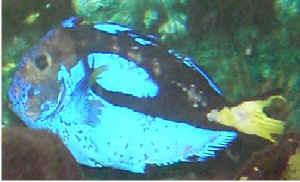
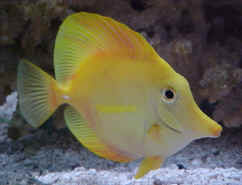
Bloody Tang Rash (12/21/2003) Happy holidays! <Thanks, same to you!> First, THANK YOU for maintaining such a wonderful and informative site! I have learned SO MUCH over the past few weeks by reading over the FAQ's. <me too> I have read other FAQ's with situations similar to mine, but I also wanted to send in a picture to get your opinion and see if you could help me identify more concretely what this "rash" is. My yellow tang has developed what almost appears to be a rash just ahead of his spines that is visible on both sides, and he's also "flashing" up against the rocks now and then. It appears that the rash is under the skin (almost looks like he could be bleeding under the skin), and it first appeared about a week and a half ago. <The rash is rather non-specific. It is some sort of subcutaneous or intracutaneous bleeding or dilated blood vessels. In Yellow Tangs, this is sometimes associated with nutritional deficiencies. The other two principal possibilities are some sort of toxin or bacterial infection.> I cannot pinpoint any event out of the ordinary that may have triggered this (water tests are stable from week to week) <need ammonia & nitrites of zero.>, and I seriously doubt that he was attacked in the tank. The tang is still eating (Nori and some Mysis, both soaked in Selcon),<you might want to add vitamins or perhaps garlic to stimulate appetite. If you could get your hands on some Gracilaria, this is great tang food -- try http:// www.ipsf.com or http:// www.inlandaquatics.com > but I can tell he's lost weight. Right now he shares a 20 gallon tank (too small, I know) with a 1.5" Ocellaris Clown (and a skunk cleaner shrimp who is still in the process of being acclimated) <how long of an acclimation?>, but they'll all be moving into a 40L (gallon, not liter, right> very soon. Ammonia and Nitrite are 0 ppm, Nitrate is 5 ppm, pH is 8.6, s.g. is 1.023, and I do 10-25% water changes every week. I have a Fluval 104 and will have a DIY skimmer up and running soon. <Could be your filtration is just not adequate yet or that something is wrong inside the Fluval. I don't like canister filters because they're too much of a pain to maintenance. For mechanical and chemical filtration, I like HOT power filters.> I am wondering a.) can you identify what might be wrong with him from the pictures? <see above> b.) in addition to adding the cleaner shrimp, feeding Nori with Selcon, and keeping up the water changes, what else can I do to help his condition improve? I was thinking maybe a freshwater dip would help, but if this is stress-related, that might only make things worse. <I doubt FW dipping would help--only beneficial for external parasites. I would recommend a few large (30-50%) water changes over the next few days in addition to running carbon (and PolyFilter if you can get it) to remove any toxins. If the fish continues to act ill, and especially if it is worsening, I would get it into a QT (Rubbermaid container, sponge filter, heater) and treat with a broad-spectrum antibiotic such as Spectrogram. See WWM articles on quarantine for details.> Just one final question - are there any books dedicated to the care of tangs/surgeons? Or a book with at least an in-depth discussion on tang/surgeon care? <Well, you got the right person on this one. I'm the bibliophilic son of a librarian. I have purchased just about every marine aquarium book published in English in the past 5 years. I am not aware of any specific Tang care book. There is a nice ID book by Rudie H. Kuiter entitled "Surgeonfishes and Rabbitfishes and Their Relatives." It's a pretty book, but contains no care info. Your best source of Tang care info is any of the top-notch general books like Bob's "The Conscientious Marine Aquarist." There's a wealth of info on WWM as well, especially in the FAQs linked to the Tang articles.> Thank you again for the time that you all put in to help others out!! <You're welcome. Hope this helps, Steve Allen>
Treating Sick Tangs... Hi guys. <Hi there! Scott F. with you today!> I believe I have Amyloodinium in my 125 gal. tank. I have already lost 3 large fish to this illness that I believe I must have gotten off some live rock I put in. I have a 7" Naso tang and a 4" yellow tang that I am worried about losing. They have both been moved to a different tank and have each had 3 30 min freshwater dips with Meth. blue and the salinity has been dropped while the temp. has been increased. <A potentially effective technique...> They are still eating but far from acting normal. The Naso has a very dark grey color to him. I seem to recall reading that tangs do not take copper sulfate very well and might be better to not use it. <That is correct. Good pickup on your part!> If this is so, is there anything else I can do to save these fish?? <I'd continue with the regimen that you have started, augmented with a Formalin-based product. This stuff is not without its drawbacks, too. Read and follow the manufacturer's directions to the letter, and DO NOT add it to the display tank. It is a highly effective medication if used properly.> Also ---my 125 is not fallow except for some crabs, snails, and shrimp -- with the temp at 85 how long do I have to wait until I can put my fish back in, and how will I know that they are not still carrying the parasite and thus re-infecting my tank again? Thanks, Diggy <Well, Diggy- I'd let the tank run without fishes for at least 4 weeks-six weeks would be even better. You've already went to the trouble of removing the fish from the display, so stay the course and wait it out. Conduct all normal tank maintenance (water changes, etc.) during the fallow period. Hang in there and you'll beat this thing! Good luck! Regards, Scott F> -Hippo develops cloudy eye...- I have a blue regal tang that
seems to have developed a cloudy eye since last night. It is swollen a
little in a couple of spots, also. <Hmm...> He appears fine
besides that. It is only one eye. He is eating voraciously and the
other fish are not picking on him or anything. <That's an
excellent sign> Water parameters are normal and all of the other
tank inhabitants seem normal. Is this something that I need to treat
immediately, or just keep an eye on? <No pun intended? This has
happened to my regal several times, each time going away on its
own.> The tank is a 75g tank with 90 lbs of live rock, a few
mushroom corals, scopas tang, false percula clown, two domino damsels,
a sand sifting starfish, a serpent starfish, a banded coral shrimp and
a tri-colored Anthias. I have a quarantine tank, but understand that
these guys are too social to desirably quarantine and I am not sure
that is even necessary at this point. <No necessity for that unless
you observe some ectoparasites or other infections.> How would I go
about treating if the situation does not improve? <You can't
effectively treat in the main tank. If everything else with the fish is
ok, the water quality is in check and stable, and the other fish are
leaving him alone, I suspect that it will go away on it's own. In
the mean time feed lots of algae based foods soaked in vitamins and
even some garlic. I hope this helps. -Kevin> As a newbie to the
marine aquarium world, I cannot tell you how much I appreciate your
help!! Thanks!
Tangs With Ich? Hello Crew, <Scott F. your Crew member today> As usual I turn to you in a time of need. I have a new 90 Gal. setup (3.5 months old, 1 month after cycle) It is a Red Sea Sand bottom of 2 inches, with 60lbs. of new cured Tonga deep LR. It has 2 small Yellow tail Damsels, a 1.5 inch Coral Beauty, a 2 inch Hippo Tang, half a dozen blue legs, and a 3 inch sand sifter starfish. I am renovating soon and had to move my larger fish to this tank out of the way while I renovate my home. After a month, since cycling and adding fish, I added my 4.5" yellow tang from the other tank. The old tank is three years old and well established (maybe too well with high Nitrates). He did great for two weeks before I moved my 8" Naso Tang last week. Both are great fish with excellent eating habits taking their daily variety of Flakes, Mysis, Daphnia, Nori, brown and green. A few days ago the yellow had a red blemish on his tail, not near his spine but mid tail, (he did not appear to damage it in transport) then he got chalky looking with a good bout of Ick all within a two day period. Meanwhile my Naso has developed a brown/red looking flake on his side, appears to be Ick'ed and has a clouding eye. I have never had a sick fish let alone an outbreak in my tanks. <Not such an unusual occurrence with touchy fishes like tangs. They don't always take well to dramatic environmental changes> Please advise my best course of action. I fear returning them to their original tank as I have plenty of other healthy stock in there, I do have a small, small quarantine tank but I am sure that such large fish will be so stressed in the 15 gallon tank that it wont be worth while. The Coral Beauty, two damsels, and Hippo are not exhibiting these symptoms but they are all darker colored so likely wont show as much. Saturday I introduced a young cleaner shrimp, which of course everyone wants attention from… Come to think of it, besides Ich on the pasty looking Yellow, they hadn't been showing any of these symptoms until he arrived. Respiration seems ok, except when Naso gets all upset at the irritation and swims around quickly. Thanks again for your help! Regards Rob Lipic <Well, Rob- it certainly sounds like a parasitic disease of some sort- quite possibly ich. I suppose the best course of action would be to utilize some freshwater dips and the administering of a formalin-based product in a large container of water, such as a Rubbermaid, if you don't have an extra tank large enough. I do use copper to treat ich, but it's not always a good idea to use with tangs, as it can potentially damage their digestive fauna. It may be a conservative approach, but you may want to treat all of the fishes in this manner, just to be on the safe side...Do consult the WWM site for much more detailed information on approaches to treating this and other parasitic diseases. Regards, Scott F> Yellow eyed-tang Hey guys, I recently bought a yellow-eye and
he seems to have splotches on him and he looks like he is bouncing on
the top of the water.... have you seen this before ? <Yes. Sometimes
just resultant stress from shipping, handling... but can be indication
of other (environmental, parasitic...) disease. Please read through
www.WetWebMedia.com re the genus Ctenochaetus tangs, Tang Disease...
and where you lead yourself through the linked files (at top, in blue).
Bob Fenner> Paul Rawlings Breathless Tang? Hi Crew, <Scott F. your Crew member
today!> I hope all is well with you. I am experiencing an
issue with my 55 gallon QT. Many of the fish in this tank
appear to be gilling rapidly. I have noticed this with a
6" Powder Blue Tang, a 2.5" Purple Tang and possibly with a
small porcupine puffer. None of these fish are breathing at
the top of the water (in fact, they nearly all stay toward the
bottom). I am most concerned about the Powder Blue Tang,
which is gilling at approximately 3 cycles / second. Is this
normal behavior? <Seems a bit fast to me, but probably acceptable if
the fish is behaving normally otherwise. High oxygenation (i.e.;
aggressive aeration of the water) will help meet the fish's
needs> Possibly I am just imagining a problem, but this seems very
fast to me. The Purple Tang's gill rate is approximately
4-5 per second but it just seems to be generally excitable and I am
unsure that this rate is consistent, whereas the Powder Blue's gill
rate never decreases. <Hmm...> I assume this is an indication of
low oxygen level in the water (or possibly gill / parasite issues) but
I have a skimmer and a dual BioWheel Penguin filter in the tank, which
significantly ripples the water surface as the water falls
approximately ?" from the filter outlet. After noticing
this rapid gilling, I performed a 25% water change, lowered the
temperature by 2 degrees and I have also added a sponge filter, a
venturi powerhead and 100 drops of Methylene blue. This did
not appear to reduce the rapid gilling. <Is the fish displaying any
other difficulties, such as swimming; any signs of mucus or other
discoloration? Is the fish feeding?> Water parameters: Salinity =
1.0235 S.G., Temp = 80 degrees F, Ammonia = 0, Nitrite = 0, Nitrate =
20 PPM. Cu++ = 2.0 PPM (Chelated - CopperSafe). What do you
think is causing this rapid gilling? What do you recommend
for correcting this problem? Greg <I like copper sulphate to cure
specific problems, such as Cryptocaryon or Amyloodinium, but I
don't think it's a good idea to use it as a prophylactic. It
can create some physiological challenges for some fishes, particularly
tangs, which may have difficulties digesting food, etc. with continued
exposure. Unless you are experiencing some diseases with these fishes,
I'd discontinue the copper use for a while. Utilize water changes
and Poly Filter to help remove some of the copper. Keep a close eye on
things, and be prepared to take action if it becomes necessary. Good
luck! Regards, Scott F> Zebrasoma stocking Thank you for the help Mike! Regarding your comment about stressing-out the Purple tang to the point it gets ich; I QT all new fish for at least four weeks before adding them to my main tank. <that is what everyone should do!> If any signs of ich are present, I add Copper or CLOUT and keep them in QT for four weeks after the last signs of ich. I cannot use copper in my main tank and I cannot catch the fish once they have been released into my main tank, so this is very necessary for me. On WetWebMedia, I have read that there very good reason to expect to never have ich in the main tank if such QT procedures are followed. <in a perfect tank this is true> This being the case, do you still feel that the Purple Tang could be at risk for developing ich? <under this strict quarantine most likely not> I ask because I had considered using copper on ALL incoming fish (regardless of signs of parasites) as a preventative measure but I was advised that 90+% of fish present signs of ich during the four week QT period if they have any Cryptocaryon on them. <ich is present all the time in your substrate when a fish become stress it's slime coat breaks down causing parasites to attach to the fish> If ich could break out at any time, then it seems it must always be present either in the water or dormant on the fish. If this is the case, allowing a tank to go fallow for four weeks to eradicate Cryptocaryon seems almost pointless (except for a near-term reduction in crypto population). <yes but this quarantine that you put these fish threw ,not only gets rid of any parasites on the fish but gives the fish time to build up his slime coat and to make sure he is feeding well, so that he will be able to feed aggressively when entered into the main tank> Please help clear this up for me as I have been struggling for the best insurance against ich. <what you are doing is right on the money. you are taking every step you can. but one thing you can not predict is how another fish will act with another good luck Mike H> Thank you, -- Greg Wyatt Powder Brown Problem? Hi, <Hi there- Scott F. here
today> I'm hoping you can help me diagnose what is affecting a
new fish of mine. I've begun the process of carefully
adding livestock now using your advice. I added a powder
brown tang to my main tank about a week ago after quarantining him for
two weeks. Very good, but I recommend a full 30 day quarantine
procedure> He appeared very healthy up until a day or two
ago. The symptoms he's showing are pale coloration on
top of the head and towards the dorsal area and a more slight paleness
overall. He darts about and thrashes around a
bit. There are no visible spots of any kind on his exterior
and I haven't really seen him scratch, so I don't think
it's ich or velvet. I've tried to see if there is
rapid gilling, but it's hard to tell with him. <That's
somewhat encouraging. If he's eating well, that's a good sign,
too.> I have a Picasso trigger in there too and he seems fine right
now, but then again that fish is seemingly bullet-proof. Do
you know what this might be or what else I should look for? < Well,
hard to say without a picture, but it could be anything from
acclimation/collection trauma, water quality or dietary issue to a
disease. In the absence of poor water quality parameters (i.e.;
detectible ammonia, nitrite, etc.), I'd suspect that this may be
the beginnings of a more serious parasitic illness...I still would not
rule out Cryptocaryon or Amyloodinium here.> And what treatment
should I use? I have the QT ready to go. Is there
anything I should do immediately, like a freshwater
dip? Thanks so much for any help. Tim <Well, Tim- I'm
inclined to recommend removing the fish to the treatment tank (I
commend you on the preparation of the "hospital facility")
for further observation. Yes, I do like the idea of a freshwater dip
here as an initial start. If other symptoms indicative of a parasitic
illness manifest, I'd begin a treatment regimen utilizing a
formalin-based product. I'm a big copper sulphate fan for many
fishes, but you do need to be careful with tangs and copper, as this
medication can damage the fish's digestive system and cause other
difficulties for the fish. If this does prove to be one of the
aforementioned parasitic illnesses, I'd consider removing all of
the fishes for observation and/or treatment. Meanwhile, you may want
the main tank to go "fallow", without fishes for about a
month, to allow the parasitic population time to "crash" for
lack of hosts. Quick action is vital here...Regards, Scott F> - Problems with New Naso Arrival - Hi WWM Crew, Two days ago I received a 2.5" Blonde Naso Tang along with a few other fish from an online fish store. All fish are doing very well in my quarantine tank -- except for the Naso. The first day in the QT it lightly picked at a piece of live rock but there is really not much life on this rock to sustain it. Since the first day, I have not noticed this fish eating anything. It appears thin to me, except for a slight bulge in its stomach. I had a similar problem with my last Naso Tang so I might just be overly-sensitive this time. My last Naso was about the same size and I watched it waste away without eating for nearly three weeks before it finally died. From what I have read on WWM and elsewhere, my best guess is that it possibly had some type of worms. This Naso is presenting nearly identical to the last one; it has no signs of external parasites, no wounds, clear eyes and appears completely well in every way except for not eating (and sometimes being dark brown / gray in color). I tried using Cravex (vitamin B12), a variety of foods, regular water changes and Paragon II with the last Naso. None of this had any effect. I am using Cravex with the current Naso and trying Formula 1 pellets, self-made food with Selcon (my other fish devour), Nori, Zooplankton and even brine shrimp (anything just to get it started eating). So far, I have not seen this fish eat. What do you suggest to entice this fish to eat? <You might try a trick taught to me by Anthony Calfo... seems to work pretty well with fish that pick. Take small pieces of live rock, preferably something that has some surface texture but not sharp. Using the Formula 2, thaw it out and press the food into the surface of the rock and then refreeze. Thaw slightly at feeding time and place in the tank. With some luck, this will allow for something close to their natural feeding habits, and it will clean off the rock. If the fish does start to eat this way, do put other foods in through the top at the same time so it will [hopefully] begin to associate the two.> It is currently in a 55 gal QT with a 5" Powder Blue Tang (no aggression issues so far), 3 Ocellaris Clowns, a Royal Gramma, a Long-nose B/F and a Lawnmower Blenny. All fish appear to be very mild mannered. Ammonia and Nitrites are zero, Nitrates are 10 PPM, Salinity = 1.0235 SG, Temp = 77 Degrees F. I am now considering moving this Naso to a 20 gallon QT and possibly trying to medicate using Clout as a kind of catch-all. <Hmm...> I do not want to just medicate indiscriminately but I also cannot stand to just watch another Naso Tang waste away. <Understood.> Please provide some suggestions. <I would hold off on treatments for the moment - do understand your desire to help this fish turn the corner, but think that the best way to do this 'right now' is to reduce stress as much as possible, and I think removal to another tank, treatment, et al. will exacerbate your problems. Try the feeding rock first... if that doesn't work, you might try more drastic action but I don't see a good end to it.> Now, following-up on a previous question -- I had asked about using Cu as a standard practice in a QT for all arrivals since I recently purchased a Purple Tang that showed no signs of parasites for the first day in the QT but looked like it had been sugar-coated on the second day. My concern is that new fish could be carriers of Cryptocaryon and have no indication of this for the entire quarantine period, only to bring the crypto into the main tank once moved. <Nine times out of ten, they will present these issues in quarantine. Most all parasitic issues are cyclic so that at some point in the two to four weeks the problems, if there are going to be any, will show up. Copper, especially with tangs can cause more problems that it's worth, so it's my opinion that it's better to hold off.> Again, I prefer to not medicate without a specific reason for doing so but, since crypto can be so elusive, my question is: "Are the potential risks associated with consistent QT use of Cu outweighed by the benefits of (nearly) guaranteeing parasite-free fish being introduced into the main aquarium?" <Varies on a case by case basis methinks. Copper, formalin, all these are toxic/poisonous in the right concentration so that you really should avoid them unless symptoms dictate the need.> Thank you for the help. I am looking forward to your response on the Naso so I can hopefully begin to do something to turn-around its appetite soon. --Greg <Cheers, J -- > Tang Post Mortem Dear Sirs, My Yellow Tang recently died. <Sorry to hear of your loss.> For about two weeks it had been suffering the following symptoms: Labored breathing (gills flapping in excess of 80 beats/min), constantly gaping mouth, lethargy, shyness and an absolute refusal to eat anything. Absolutely no other symptoms were evident to me, nor were any of the other fish displaying any symptoms themselves. Water quality was as good as ever, with pH at 8.2, Na at 5ppm, Ni and Am at 0 and Salinity at 1.024. We've had the tang for several months. My first assumption was Velvet. I did a hydrogen peroxide dip based on some research I did on previous use of the technique, the half-life of H2O2 in seawater, and the reported toxicity of H2O2 on marine life (as reported by various chemical companies). <Hmm... would have been much better to just do a straight-up freshwater dip.> After doing the dip, I became afraid that whatever was affecting the tang might spread in the main tank, and so I resolved to dose the main tank. I put in what I thought was a safe dose (100mL) for my 55gal (+20gal sump). Nothing was affected except for my 4 cleaner shrimp -- all of which died (let that be a lesson to me and to others). The tang continued to show no improvement and would not feed (tried live brine, garlic extract, Nori etc). We then began to treat with daily freshwater dips. The Tang would quickly go onto its side, making us cut the dips short, to about 2 min.s. The gill flapping *seemed* to get a little better, but he still wouldn't eat. A day or two after we ceased the freshwater dips, he laid on his side and died. After his gills had stopped moving for about an hour, I removed him and reluctantly performed a necropsy. Not being a biologist, I am unsure what I found. All the pictures of the necropsy are found here: http://www-personal.umich.edu/~skotzaba/yellowtang.htm . I feel horrid over having lost a pet, having to cut it open, and worse still, not knowing what killed it. I would appreciate it if you could comment on what you think the cause of death was, and what the necropsy pictures seem to implicate. <Hmm... well, first let me commend you for taking the brave step of performing a necropsy on your fish. I'm sure it wasn't easy. The slides are incredibly fascinating, but unfortunately I can't get a one to one match with the fish disease books that I have. It looks like it could be either Cryptocaryon [ich] or Oodinium which coincidentally are the most common marine scourges. If I were to pick one, it would probably be the Oodinium as I don't see any evidence on your fish of ich, and Oodinium has been shown to infest the gills and never show any external signs of infection.>Your help and advice has been invaluable to myself and the hobby. <Cheers, J -- > Toastyoat Tangs Hi there, I have just found your site out of desperation, you seem to know your stuff please help me!! <Sabrina here, I'll certainly try> I have had my marine tank for about 2 months now I have LR which is doing ok and everything else seems ok except the fish. I am currently buying fish, they last for about a week or so then die. I had a powder blue tang that died I never noticed any illness before hand. Then I purchased a clown tang and a vampire tang, <Yikes.... the clown I assume was Acanthurus lineatus? Or A. sohal? The former being a giant terror, the latter a giant not-so-terror. And the vampire, from what I can gather, do you mean Acanthurus olivaceus, the orange shoulder tang? Another giant terror - your two tangs would've had some serious problems with one another down the road at least, unless you have an enormous tank, so that may be part of the issue of having lost them - just pure aggression. Not to discount illness or water issues, though, just mentioning that behavior toward one another might have been a real issue, as well.> both seemed fine until in a matter of 24 hrs, <The low pH you mention below may have been the culprit here, if you hadn't seen any aggression - but then, who knows what happened after lights out.... the clown tang loss lots of weight started swimming at the surface, stopped eating then lost its balance then died. The vampire tang much fatter eating lots apparently in good condition, although I noticed even when I brought him he was rubbing him self against the rocks, not much but every now and again. <The scratching is very likely a sign of ich, to which many tangs are very susceptible.... more on this protozoan parasite here: http://www.wetwebmedia.com/ichartmar.htm Try not to purchase fish that exhibit signs of illness (including scratching), and please think about employing a quarantine tank: http://www.wetwebmedia.com/quaranti.htm http://www.wetwebmedia.com/QuarMarFishes.htm > The tang was fine until about a week after the clown and again in a matter of hours he darkened, lost lots of weight and balance and died. I am new to the marine system and I change 10% of my water every week with pre mixed ro water from my local fish shop. <You really might want to consider mixing up your own saltwater, unless you have very major benefits with the store water; it's not very difficult, and you'd have water on hand for emergencies or whatnot, and you would know exactly what's going into your water - basically, you'd have more control over your water quality.> The ammonia levels a fine the nitrite levels are fine <Fine being what? What about nitrate and salinity/specific gravity, as well?> but the ph levels are out PH are lower 7.4 I have not checked this for about 3 weeks. Is this the problem and any tips on how I can bring the PH back up. <A problem? Yes, very much so. Could even be what's been causing the fish deaths - though illness cannot be discounted, especially after such signs as the fish scratching. You should rectify the low pH, perhaps with a buffering product (many such products available), be certain not to overstock/overfeed, etc. - more on pH and alkalinity here: http://www.wetwebmedia.com/marphalk.htm . To help further and try to get you pointed in the right direction(s), more info on your system would be helpful - tank size, filtration, etc. Please do take a gander through the linked articles; there is a great deal of very, very useful information there. Also please browse through the rest of the marine articles http://www.wetwebmedia.com/marine/index.htm as you're sure to find stuff that will interest you, and help get/keep you up and running. Wishing you well with your new tank, -Sabrina> Thanks for the advice, Scott Tang Lost His Zip...And Got It Back! Hi Scott, <Hello again!> Thanks for your reply the other day. Many gallons of water changes and some Melafix doses later, my Tang is up and eating and being his usual self once again. <Glad to hear that...Surprised that Melafix did the trick, though...> I fed shrimp only for a couple of days to encourage him as well and yesterday morning he started eating and hasn't slowed down. I don't know if it was good luck or good management, whatever I'll take it. <Yep! Definitely!> Thanks again, you and the crew have been a great help several times since I set up my salt water tank. The books don't have everything in them to cover each and every possible situation. Ceil <Glad to heart that! We're always here for you! Regards, Scott F> - Mysterious Tang Death, Perhaps not so Mysterious - Hi Crew,
About three months ago I purchased a used 100 gal tank stocked with a
5" porcupine puffer, a 4" Picasso trigger, a 3" Kole
tang, a 3" flame Hawkfish, a 3" red saddled anemone fish, a
3" coral beauty angel, and a 2" Fiji devil damsel (to
pre-empt your overstocking warning, I'm getting them a larger tank
in about a year). <Then please keep in mind that until then, your
fish will be crowded - that is, they are crowded NOW - a year from now
will likely have fewer fish.> I've been fighting high nitrates,
ranging from 40 to 80ppm, since I got the aquarium and yesterday
purchased two MaxiJet 1200's to help improve
circulation. The MaxiJets were added around 2:00pm
yesterday, the tank looked great when I left at 6:00pm, but when I
returned today at 2:00pm the Kole tang was dead. There were no signs of
aggression or stress before his death and no signs of disease. The
puffer is showing some darker stress colors but everyone else seems
normal. Water parameters are all okay (see below). I have
two theories on what could have caused his death; does either one seem
possible in your expert opinions? 1) Contamination from something on
the MaxiJets, perhaps some metal or manufacturing oils? <Possible
but not very probable - these pumps are plug and play and the company
that makes them knows full well their pumps are going directly into
fish tanks.> 2) There are large wildfires north of my home and the
ground is covered in a fine layer of ash. Could the airborne
ashes have contaminated the water? <Could have, but again not very
likely unless that ash were full of other bad stuff, in which case
you'd probably have a hard time breathing.> Either way, I am
doing a large water change (20%) today and will do the same
tomorrow. Any ideas on what else I can do to save my other
fish from the same fate? <Yeah, my bet is the crowding. I'm sure
these fish were at some odd form of stasis when the tank was moved to
your location - so... stress, then the crowding, which adds more
stress, and eventually the fish least capable of dealing with the
stress dies - it doesn't need to show signs of aggression to have
suffered from the same.> tank info: 100 gal display tank, 30 gal
sump ~100 lbs LR CPR SR4 skimmer Tiny might pump (~1000gph after head)
0 ammonia, 0 nitrite, 40-80 nitrate, ph 8.2, alk 8-9 dKH temp 80-81 F
10-20 gal water change per week feed once per day a combination of
Formula 1, Formula 2, Prime reef, Mysis, krill, Nori, spectrum pellets,
Aquarian flakes top-off with RO/DI ph adjusted water only As always,
thank you for your wonderful service. David
Sick of Ich--Hippo Tang >Hi, thanks for your wonderful website, this is always a good source of knowledge!! >>Hello, you're welcome, we're glad it's of good use for yourself and others. >I have moved my 50 gal reef tank from my parents' house to my apartment 1 week ago. All my livestock are fine except my hippo tang. It was showing some sign of stress since the first day at my apartment. >>Alright, could it have gotten chilled during the move? This can bring on that ich pretty badly, especially with fish such as tangs. >It have get worst and last Friday I have found some ick on it. So I have gave to it a fresh water bath with bleu Methylene. >>Good course of action, however, it may need to be placed in a hospital tank using hyposalinity (1.010). >Since that time my tang is always hiding and don't eat anymore. What could I do for him now? I really don't want to lose him... Steve Timmons >>Set up a hospital tank with heater and some filtration, and acclimate the fish over the next two days to a specific gravity/salinity level of 1.010. Keep him there for at least two weeks at that salinity level. Once he's cleared, keep him in quarantine for 30 days. Offer him a good variety of foods, perform as many water changes as needed to keep the water quality very high, and this, hopefully, will do the trick. Marina - Tang Diarrhea - Hi Crew, I have a mildly gross question. I bought a Kole Tang last week, and am currently QTing him. I noticed this morning that his fecal matter is not the normal "string" but instead a sandy-looking "spray." Sorry to send this at lunchtime (PST). Is this anything to worry about, or is it a natural product of his grazing on the sparse sprinkling of sand on the aquarium floor and rock? <Yes... many tangs intentionally ingest sand to aid in digesting their mostly vegetative diet, much like chickens.> Or just natural for tangs? <Both.> Thanks for all of your hard work and excellent advice - it really does make a difference. Nick <Cheers, J -- > - Powder Blue Blues - Hi Crew, I know you hear this constantly but I just want to reiterate how much I appreciate the information you provide! Three days ago I purchased from my LFS the (soon to be) latest additions to my 180 gal aquarium: a ~2" Foxface Lo, a ~2" Purple Tang and a ~4" Powder Blue Tang. Currently these three fish are in my 20 gal hospital tank (Salinity=1.024 SG, Ammonia=0.25 PPM, Nitrite=0.25 PPM, Temp=81 ?F, Mardel CopperSafe Chelated CuSO4, Whisper 30 filter + sponge filter + ~15 lbs live rock). The problem is the Powder Blue Tang is beginning to develop some type of wound (lesion/abrasion/fungus?) in about three areas (photos attached). Two spots are approximately pea-sized and one is slightly smaller than a dime. These patches appear to be slightly raised or to have a few bumps within a discolored area (possibly as if a repeated abrasion). I would not describe these areas as having a "cauliflower appearance". The Powder Blue also occasionally shakes and swims in quick circles. <I wouldn't be so concerned about this as much as I would be about these 'wounds'.> My LFS suggested this is not a reason to worry as it could just be "shaking off" a parasite or minor infection that will soon be cured by the copper. <Do believe the opposite, that the shaking is just a natural behavior and the spots are a reaction to the copper. If I were you, I'd discontinue the copper treatment unless you are sure there is a good reason for it, i.e. Cryptocaryon [ich] or similar parasitic problem. Many tangs react poorly to copper and it should only be dosed at very low levels. I realize the Powder Blue is a notorious ich magnet but it would be best to observe the problem first rather than just treating the tank with something that may do more harm than good at this point.> Although I would not describe this fish as having a voracious appetite, it does appear to be eating (Spectrum Thera+A anti-parasite food, Nori and homemade food with Selcon). The three fish do not appear to be the least bit aggressive toward each other. I do not see a single ich spot on the Powder Blue but the Purple Tang appears to have a substantial case of Cryptocaryon. <I'd separate these and treat them individually - not only for the reasons I just listed, but also because a 20 gallon tank is rather small for these three fish.> Do you have any idea what is wrong with my Powder Blue Tang, if this is anything I should be concerned about and, if so, how to cure this? Could the Copper be irritating this fish? <Possibly - would be my first guess.> I noticed my (Red Sea) Copper test kit is not made for chelated Copper but I did add the recommended amount of CopperSafe to previously copper-free water so I am hoping (at least initially) the copper concentration is correct. My Copper Test kit measures 0.3 PPM Cu (exactly what the kit recommends as the "optimum copper level") but I have read that the proper ionic concentration is 0.15 PPM. Can any correlation be drawn for chelated copper concentrations when using a Copper test kit intended for measuring ionic copper? <No - wrong test.> Thanks again for the help! Greg Wyatt <Cheers, J -- > -Brown spots on hippo tang- Please HELP .. I have a juvenile hippo tang that has developed a brown spots around his face area. It has appeared over the last day or so .....I have been reading the conscientious marine aquarist to try and find out what it may be but I can't define it for sure .... <Checked out the picture, it's hard to make out what it is. Otherwise it looks like a reasonably healthy tang> There is one large spot with a cluster of other smaller spots forming around the rest of his face ..... The spots are not grouped . I have attached a picture .. sorry it is not the best --- he would not stay still ...I want to treat him but don't know where to begin ... There is about 20 lbs of live rock, 2 true clowns, one yellow tail damsel, 4 emerald crabs, and a yellow-head goby in a 5 month old 55 gallon tank which all appear to be fine ... <You wouldn't be able to treat with much in this set-up, as it is fully stocked and contains inverts. This fish needs to be moved into a quarantine tank for further observation.> Have taken the tang out of tank at the moment ... Please get back to me quickly so I can try and save the tang ... <Check out http://www.wetwebmedia.com/QuarMarFishes.htm for quarantining techniques. I would keep this fish under close scrutiny and well fed with lots of algae based foods. At this point, there really isn't much you can do besides wait, and it may just disappear if the fish is in a good environment and otherwise healthy. Let me know how things progress and if you could get a better picture. Hope this helps, -Kevin> Thanks in advance -- it is greatly appreciated ..... A new hobbyist .. White Patches...? Posted at http://wetwebfotos.com/talk/thread.jsp?nav=false&forum=31&thread=13245&start=0&msRange=50 but hadn't gotten any hits back yet so I thought to try a more direct approach. There are a couple of photos attached to the user account that logged this thread. The clown is eating well and seems otherwise unbothered. She had been in QT for ten days with no sign of infection when overnight this dot appeared at the base of the dorsal fin appeared. There is a second clown and a blue tang in QT that do not show any signs of this. The tang is still hiding much of the time so it is hard to be completely sure. Garin Walsh <Unfortunately, Garin, I was not able to see the pics, so I cannot really make an accurate assessment. Usually, such patches are the result of a localized trauma, such as an abrasion, etc. I think that you can alleviate such symptoms by maintaining excellent water conditions, and perhaps using appropriate antibacterial medications or treatments, such as Methylene blue (perhaps administered in a dip). Hope that this points you in the right direction. Regards, Scott F.> Weird White Spot on Kole Tang >Hi guys, >>And gals, Marina here. >I have a Kole Yelloweye tang that I recently got from my LFS. I have had it for a while and I noticed a spot forming on it. >>Uhh.. did you get it recently, or have you had it for a while, Rem? >It appears to be whitish on the side of the tang's body and I have also noticed other spots forming at the base of its dorsal fin. The skin under it looks a bit wrinkled. I am pretty sure that it isn't ich, and the spot seems a too big and in the wrong area to be Lymphocystis (I could be wrong though). Any help would be appreciated. My new email is XXXX. Thanks, Rem >>Rem, if you're positive it ISN'T ich or Lympho, none of us can really venture a guess with this description. Any chance you can send us a webpage size jpeg? Also, I'm really hoping you have this fish in quarantine in any event. Marina
Cloudy eye Hi There! I have a 30 gal. Marine
tank. 4 fish incl. 2 percula clowns, a coral beauty, and a
red sea Sailfin tang. Also numerous inverts. No
trouble with water parameters.<good to hear> Tank
itself is appearing healthy. So are all critters except the
tang. He has developed a cloudy eye within the last 2 days
and a small white spot on the superior aspect of the other
eye.<normally this is caused by the environment. I would check
nitrates, nitrites and ammonia a couple more times. with different test
kits might I add> No new critters have been added in
about 3 months.<good> He's kind of a goof and
likes to hide on his side under the live rock when
spooked. Thus I'm thinking possibly
injury. Any ideas or things to watch for?<I would just
check the water quality, and feed him a more varied diet, good luck,
IanB> Regards, Grant -Black spot disease on a yeller tang- I just bought a yellow tang, he is still in the store. 3.5 inches still has his "fright colors", don't know how long this will continue. <They only get "fright colors" at night or if they're under some serious stress.> Eating well, swimming well, active, curious. <Hmmm... wonder what's up with the coloration. It could just not be very vibrant do to lack of proper nutrition.> I noticed some evidence of black spot disease. <That should have been enough to keep you from buying it, especially with a fish this common.> The LFS owner said not a big deal, he is giving all his yellows a 10 - 15 min freshwater dip and that will take care of it. <That's an EXTREMELY long freshwater dip, they really shouldn't go more than 5m, and even that's a lot!> He also said the fish will be good to pick up in two days. <If you still want this fish, make sure you don't see anything on the fish for at least a week, but be prepared to treat it during quarantine.> I'm a little reluctant. Will just one dip cure him, or will he require a few. <Depends, if he does a 15m dip the black spot should be dead, but so will the tang...> How long should I leave him at the store with no evidence of the disease before I pick him up? <See how long he's willing to hang on to him and deal with any issues that come up. If it's less than a week, don't go for it.> I know that my quarantine tank will be less stressful than the LFS, but I am hesitant, because I don't want further complications. <If the quarantine is properly set-up and you know how to treat for any diseases that come up, it is a much better option than hanging out in the store. This way you can give it individualized attention.> Again thanks so much for helping us inexperienced guys out. <No prob, I hope you've got the info now to make a good decision! -Kevin> Dying Yellow Tang >Dear all, Could you please give me some emergency advice about my 2yo yellow Sailfin tang? He has been healthy but did not feed much yesterday and today is lying on his side at the bottom, but there is some eye movement. >>Oh my, whatever the problem is, it's moving FAST. >Should I give him a freshwater dip? >>Not unless he's showing external signs of parasitic infection. >Could it be connected with the loss 1 month ago of my blood shrimp, which did act as a cleaner to the tang? >>I couldn't properly venture a guess. The "lack" of a cleaning organism wouldn't be what's causing this trouble, though whatever may have caused the demise of the shrimp has now become bad enough that it's affecting the tang. >I have no other cleaners. My water parameters yesterday were normal and nothing else is showing any problems. Kindest thanks, Peter >>"Normal" parameters tells me very little, unfortunately. For some, "normal" parameters may be readable levels of ammonia or high nitrate readings--both of which can eventually cause stress and death, one faster, the other not so. This is my advice; put the fish in a hospital tank with freshly mixed water. If you haven't already, start doing some large water changes on the main display, and filter through carbon. If the tang pulls through the next day, then take a closer look and see if there's anything observable. Sorry I can't be of more help, but there is not much information to go on here. Marina
|
|
|||||||||||||||||||||

|
Features: |
|
| Featured Sponsors: |