|
|
| Home | Marine Aquariums |
Freshwater Aquariums |
Planted Aquariums |
Brackish Systems |
Ponds,
lakes & fountains |
Turtles & Amphibians |
Aquatic Business |
Aquatic Science |
Ask the WWM Crew a Question |
| Please visit our Sponsors | ||||
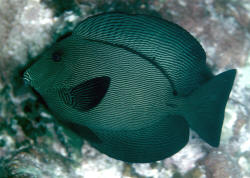
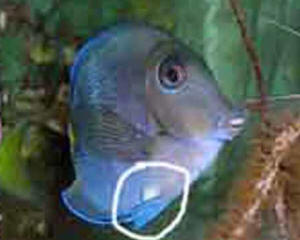
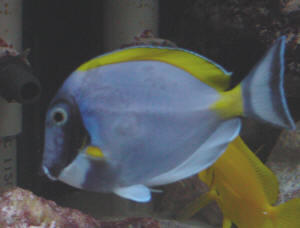
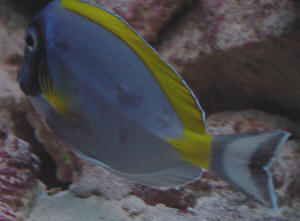
Powder Blue Eye Problem Hi, <Hello> I would be grateful for some advice regarding a recently purchased powder blue tang.<Sure, no problem> The tang has been in my reef tank for about a week now. Tank is around 100 gals, been set up about 6 months, occupants are: yellow tang, purple tang, pair of clown fish, blue damsel, mandarin fish. I purchased the powder blue about 6 weeks ago and asked the LFS to keep it for around 4 weeks so I could ensure it was feeding correctly and disease free.<note, that is not considered a quarantine tank, the fish could be a host to parasites in an uncontrolled environment> I freshwater dipped the fish before introducing it to the tank and have been feeding it on Mysis, "Marine Cuisine" and Nori. Feeding well. <Good plan.> Today I have noticed a white spot on the centre of its left eye, it has also been offering itself to my cleaner shrimp on a regular basis. Water quality seems fine following my test today. <It could be eye flukes or a fungal infection. It is hard to tell without a picture.> Would appreciate some advice on next steps please. <Here is what I would do, take the fish out and put it in a quarantine tank and treat it with the appropriate medication in regards to the sickness. Good Luck!!! MikeB> Newly-Cured Tang Is Sick Again? Hi, <Hi there! Scott F. with you tonight!> My blue tang has FINALLY gotten over ich. I am so happy! <Cool! Good job!> But now, I don't know if my tang has another disease or not. My blue tang appears to have rolled in flour and looks like he has very slight coating of it over his body. I am hoping it is not a disease but if it is will you please send me some info on how to treat it? Thanks <Hmm...this can be anything from a secondary infection to a more virulent disease, Amyloodinium ("Marine Velvet"), or even "collateral damage" to the fish's skin caused by the medication that you used to cure ich! If it is Amyloodinium, there will be other symptoms, such as difficulty breathing, loss of appetite, "scratching", etc. At this point, I wouldn't rush to medicate until you get a handle what is going on. If the fish does not appear to be in distress, I'd opt for some further observation, and high quality water conditions. If the fish appears to improve quickly, it may have simply been some "collateral damage" caused by the medication. If the fish appears to be declining, medical intervention may be necessary. Keep observing, and take action as needed! Good luck! Regards, Scott F.> Blue tang is covered in flour?!?!?!? Hi, My blue tang has FINALLY gotten over ich, I am so happy! But now, I don't know if my tang has another disease or not. My blue tang appears to have rolled in flour and looks like he has very slight coating of it over his body. I am hoping it is not a disease but if it is will you please send me some info on how to treat it? thanks Hello, It sounds like your tang has a secondary infection called Lymphocystis. I would recommend putting the fish into a quarantine tank and then treating with a formaldehyde based medication like quick cure or something along those lines. If that that does not work then try something like Quinsulfex by Aquatronics. Good Luck! Mike B. Naso With Balance Problems >Dear Crew, >>Hello Allyson. You have Marina today, with my greatest apologies, I've just received your message in my inbox today and I sincerely hope it's not too late. >I love my Naso like a child. We've had him a few years and we bought him when he was approximately 6 inches long. We were stupid. It's too big a fish even for our 125 gallon tank. He belongs in the reef. Our water parameters have been stable for several years but tonight I'll check them again. He's just looking out of sorts. He frequently has a little ick in the mornings and the cleaner shrimps jump on him and it falls off by the end of the day. He's a fussy eater and will only eat Tetra marine flakes and Caulerpa. He eats these like a pig and the little guy is fat as a house. He still eats OK. There was a period a week ago when we skipped a meal for him (were away for 1 meal-we feed him a lot twice each day by hand). The temperature dropped 3 degrees. Our refugium where we raise Caulerpa and other macroalgae smelled bad and we changed most of the water. It smells fine now. I think the Caulerpa looked a bit unstable at the time but it's not sexual. >>If in doubt, prune it back heavily, being CERTAIN to remove by the full holdfasts, not just breaking off 'leaves'. >During that time, for several days, the fish's yellow face turned dark and he did not swim as actively. He barely ate. We raised the temp to 80 and his face got yellower and he swims and eats more. What is most disturbing is that since that time I see that he has trouble keeping himself upright slightly. It's very slight but he'll swim sideways at times and I see he has his alerting colors on (he gets blotches when he's frightened). >>It seems you're taking the best care of him you can, but I believe he's simply outgrown the system and is displaying the stress (you've made no mention of his current dimensions). This could explain the little bit of ich, the stress coloration, and possibly the 'balance' issues (swim bladder, possibly? Fish have no inner ear). He's definitely not growing old, these animals can live 20 years easily. >He just seems a little clumsier. He doesn't swim as fast or as agilely lately. I'm trying to see if it's worsening but it's inconsistent. He doesn't have any skin lesions and the ick is very slight and barely and occasionally visible. I've tried hospital tanks with him but the conditions are so unstable in such a small tank, he does worse so I've given up trying to treat the ick. >>Yes, also, treating him a hospital tank will do no good whatsoever if there are still other vertebrates in the system upon which the parasite can find a host. The only way for hospitalization to be effective is for the main display to go fallow for a minimum of 6 weeks, though this often proves not to be long enough. >I've done searches here and on reef central and I have not seen balance problems listed much. The few times it was with new fish and they died soon after developing it. I'm hoping he gets better and it was just a minor trauma/infection. >>You've listed no water parameters other than the temperature drop (amount), so I can't really offer much other than a guess and a mantra - when in doubt, do a water change. This won't help him at all if the problem is simply that he's outgrown this system, but it will if, in spite of the presence of the 'fuge, there is a buildup of nitrate or other chemicals we cannot measure without a full laboratory at our disposal. Even then, you might want to have an idea of what you're testing for. You haven't mentioned how big the fish is now, but Nasos grow rather large. Water changes on a large scale will not hurt, and can both replenish lost compounds as well as remove buildups of others. >We've also been administering Joes Juice to kill Majano so I wonder if that has something neurotoxic. >>Be VERY careful with that stuff! From what I understand they do not list any ingredients (proprietary?), and I've read many posts on reefs.org of folks losing their shrimps after using Joe's Juice. I have no idea of it has any neurological effect, this is such a new product and few are regulated in any manner. If you were my customer I wouldn't have sold you this product, and I would now suggest you stop using it altogether. >Bottom line, what could cause this? A vitamin deficiency (he won't eat garlic, Selcon, or any other flake or food than that Tetra marine stuff)? >>Garlic won't provide vitamins or nutrition to fish (think about it, how often do fish get their nutrition from garlic in the wild?), but it has been proven to have a slight to moderate antibiotic effect. The food he will accept can be soaked in Selcon prior to feeding, but you MUST be persistent. Also, Nasos do like some meaty foods, have you offered him the irresistible krill? Variety, especially with such a fish, is KEY. He is behaving like a pet poodle, and you'll have to stand your ground when it comes to sampling different foodstuffs. These fish can easily go several days without feeding - if he gets hungry enough, he WILL try it (assuming he's not actually ill, which I don't believe is the case at this point). >A transient parasitic infection (maybe the ick got in his balance system)? >>Doubtful, I've not read of such mild infestations affecting an animal's balance. If this were a problem you'd see flashing and rapid gilling, not just balance problems. >What scares me is that this might be a buildup in the Caulerpa toxins. >>Possibly, but again, I do doubt this. I didn't have a problem feeding C. taxifolia to my Z. flavescens, Z. scopas, or other tangs for several years. >I give him a little bit each day as a treat. He loves it. (Won't eat any kind of Nori, broccoli, spinach, Sprung's sea veggies, lettuce, spinach, bok choy etc. for greens). >>Again, he will if he's hungry enough, and again, offer him some meaty foods. >I decided to do this because this little guy has so few pleasures in our small tank, at least he should have that. What was the toxin in Caulerpa so I can read about it? >>This I cannot answer, try searching Anthony Calfo's writings (this is off the top of my head), assuming a general Google turns up nothing. >Thanks, Allyson >>You're welcome, Allyson. At this point, my honest assessment is that the fish is demonstrating end result of too small a system. I'm curious as to whether or not this animal has grown the tail 'streamers' for which they're noted, if not, this, along with the other symptoms you mention lead me to this initial conclusion. Marina Black Spot on Fin (NASO TANG)
Hello, You have a great web site!! I have a 130 gal. salt water with a
few damsels and a large puffer and a 11" Naso tang. I noticed
yesterday a black spot on one fin. I have had him about a month and he
came from a friends tank. He shutters a lot , but no signs of anything!
<Mmm, could be "nothing"... the shuddering is natural...
some melanistic spots on Naso lituratus come and go...> I keep a low
dose of copper in the tank, however recently I removed all of it with a
carbon pad. <I would not keep copper constantly in a main/display
tank> Should I retreat with copper or formalin? <No> He eats
and looks great! Nitrates have been a little high but I do weekly water
changes and everything else looks good! He constantly
shakes a lot. It this <This animal does shake naturally
as stated (even in the ocean), but it may be shaking more due to being
in small confines... I would look into ultimately trading it in for a
smaller specimen (like half this length) in your 130... or getting a
much larger, longer system for it. Bob Fenner>
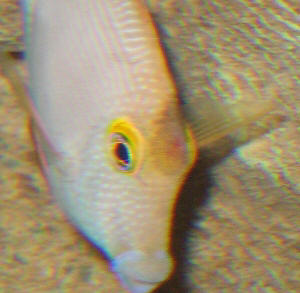
White faced tang Hello! <Hi Marylou, MacL here with you today> Just read your article on white faced powder tangs. You seem very knowledgeable! <Thank you for your compliments, I will pass them along.>We have one-- & we have a 150gal SW & a few corals and live rock, live sand. Up and running for about 18 months. Water quality pretty good--frequent water changes. Nothing really different in our water conditions or general tank conditions EXCEPT we just went through awful hurricane Ivan. We are in Pensacola Fl.--we got hit dead on . We are about 20 miles inland so we didn't get all the water damage but lots of tornado wind damage. <Glad to know you didn't have any really really severe damage though.> Anyway--we had a generator and were able to keep our tank going but there were short periods of time without any power. <Was it enough that the temperature fluctuated?> We were without regular power for 2 weeks. Prior to this we had no problems with our little guy. He ate like a horse - was fat very active and happy. Well now he is not eating - turns a pale color frequently, and swims at the top of the tank a lot by the powerheads. <That sounds like possibly he was oxygen deprived during that time. Tangs require a very heavy oxygen saturation in their water.> Does not interact with his tankmates like he did before. I do not see anything external on him and he's still a good weight. <Keep a close eye out for anything external just in case, sounds like maybe he had some stress during that time that might manifest itself in something like Ich.> He seemed to be fine through the whole hurricane thing--he ate well and acted ok. It was after he started acting funny. <Sometimes they hide the stress.> If you have any thoughts or suggestions ?? Sometimes he almost acts like he has vision problems. <He could have bumped into something and injured his eye. Its also possible that he was oxygen deprived and that has bothered his eyes. Could be something parasitic or even some type of infection that has hit him.> Any help would be greatly appreciated! Thank you so much! <I hate to just say watch him closely Marylou but please do. Also keep a close eye on your tank because it could be doing a mini cycle again. Nitrites, Nitrates might be on the rise and that would bother him. I'd check your water every couple of days just to be on the safe side. I love tangs they are some of the most amazing creatures in the world but they don't do well with stress in my experience for the most part. However they do seem to rebound if you can get and keep your tank conditions stable. Please let me know how he does and is doing. MacL> Marylou Tang Thank you so much for taking time to send a reply. <MacL here again MaryLou.> Yes we were very lucky - we did not sustain major damage. Many others did. There is still devastation all over this area. But there are a lot of people from everywhere helping to get things back to normal. We sure do appreciate all of them! As far as the water temp during that time-it stayed pretty much the same-about 78-80 degrees. We were also thinking it may have something to do with the oxygen content of the water. What should it be and can it be measured? <You can get test kits for oxygen.> My husband has increased the circulation some. <Definitely a good idea and honestly I would use a vitamin C supplement in the food, dipping it in Zo? Or Selcon would be a good idea just to help his immune system. I do know lots of people who use garlic as a preventative in these situations. For myself I say what can it hurt as long as you don't go overboard!> Well we will keep watching him and hope for the best. <Please do and please let me know how he does! MacL> Thank you again for your information! I appreciate it. Marylou Tang With Fungus? Yesterday my wife and I got a tiny Sailfin Tang from our LFS and added him to our 29g reef that was moved from Florida and has been cycling devoid of livestock for 5 months. <Please tell me that you have a MUCH larger tank available for the future? This fish gets HUGE, and needs a very large tank (minimum 6 feet long) to live happily for anything close to a normal life span...Sorry to harp- but something for everyone to think about!> We bought the tang that seemed the most active and ate the most aggressively. He has been in the tank for two days now and swims and eats like a king and seems to be doing very well. However, he has a cotton-like substance coming out of his mouth and his mouth is open all the time. As I said, he has no difficulty eating but if this is abnormal I want to treat it before it becomes a serious problem. <I agree with you there...Best to take action now.> My wife is a vet and can get any medication they have very easily so I have no restrictions (Although I doubt there would be any vet meds to treat this). Please let me know if this is something to worry about or if I am just being overcautious. Thanks, Eric Ruest <Well, Eric, it does sound like some sort of fungal issue here; you'd probably want to try a medication like Furanace or Maracyn. Administer these medications according to manufacturer's instructions, strictly in a dedicated treatment tank. Do monitor the fish carefully to verify the effectiveness of the medication. Good luck! Regards, Scott F.> Tang Problems 10/14/04 WWM Crew, I just emailed about
problems with a tang. I have read your email about the
overflow boxes that come with a sponge. I do have a skimmer
with my setup in the sump but don't know if that may have something
to do with the tang being sick. We just took the sponge off
yesterday reading about it not needing to be on there yesterday from
this website. Just wanted to add that little bit of
info. Thanks in advance. Misti <It sounds like some one
else was already helping you with your problem, so you may want to
reply again specifically to that person (just put their name at the
beginning of the message). The sponge in the overflow may
cause minor water quality issues which could stress your fish, but I
doubt this is a major issue. It is more important that you
remove the fish from the display to quarantine and treat the
disease. There is a section and FAQ on WWM about disease
treatment. If you are left with any questions about the ID
of the disease or course of treatment, please write
back. Best Regards, AdamC.> Too Late For This Tang (Disease..?> Hello crew, <Hello there! Scott F. here today!> I was writing to ask if there was any advice to save this tang, unfortunately it died in the process of composing this email. <Sorry to hear that....Here's to better days.> Maybe someone can shed some light on what went wrong and how I can prevent this from happening again. <Will try> I recently purchased a yellow tang. I went through the normal acclimation procedure when placing this fish into my quarantine tank and it seemed fine for a few hours until it's health started to decline rapidly (not moving, not alert, starting to swim poorly). In the store, this fish seemed OK for the most part. It was the best looking fish (they weren't all that great to begin with) but I thought with proper feeding and good water it would turn out to be a good fish. <Sometimes that's true, but the general rule of thumb in this instance is to pass on the purchase of any fish that is found in a tank where there are sick fishes. Quarantine, always recommended-is absolutely vital in this case, as you are aware!> I tested the QT water and preformed a water change before I went to pick up the fish from the store (the fish had arrived at the store two days earlier) knowing tangs require higher water quality, but being in the QT seemed to make it worse. The QT is a 10 gallon with crushed coral substrate that I keep cycled (just incase I need it) and a hermit crab in there that is a huge monster (I later removed it when I saw it trying to catch the tang). <Very good move> When the tang's health seemed to get worse I gave it a freshwater dip and put it into my 55 gallon tank where it seemed to be fine and happy until I turned the lights on. <Could be some sort of shock resulting from a lower pH, or some sort of environmental issue- Do monitor the pH and other parameters in the QT> In the tank I have 110 watts of 50/50 compact fluorescent lights, 20-30 lbs of live rock, 2 inches of aragonite sand, a modified Prizm protein skimmer with an air filter that actually skims, a HOT Magnum filter, the usual assortment of power heads, 2 Yellow-tailed damsels, 1 False Percula Clown, and 1 Coral Banded Shrimp. I check the water parameters every few days and they were currently at 0 ammonia, 0 nitrite, 0 nitrate or at least the levels were undetectable to my test kit. <Excellent!> Once I turned the lights on, it seemed startled for a few seconds as I expected, but then I noticed that it started batting at it's eyes with it's fins like it was trying to rub something off. I turned the lights off again and it stopped so I decided to leave them off for the night. When I woke up in the morning, I turned on the lights and all the fish came out except the tang who was hiding behind some rock "wobbling" in place. It eventually came out from behind the rock, swam to a corner and started wobbling back and forth like it was going to fall over. <Classic symptoms of some sort of problem!> Eventually it fell over onto it's side, but didn't have any unusual markings or blood spots It just looked like a healthy yellow tang except more horizontally oriented... I decided that I should build a new QT tank with completely new water except with a SG of 1.019 instead of 1.024 which my main tank has. <A lot of people like the lowered SG; I am not a big fan of this tactic myself> The tang didn't develop any blood spots until it was in the new water a few hours and it never moved from it's side until just before it died where it looks like it tried to move but didn't get far. All of my other fish are fine. Other than this fish being moved quite a bit, I can't find anything that was wrong. It even started eating right after it was placed into the 55 gallon when the lights were turned off. <Really hard to say. It is quite possible for a disease to be present without the typical heavy external symptoms, such as spots, etc. In fact, with the virulent disease Amyloodinium ("Marine Velvet"), fish are often killed before major symptoms manifest themselves.> As always, thank you for such a valuable source of information. Eric <Sorry I couldn't solve the problem, Eric. Sounds like a parasitic infection to me, but it's hard to be 100% certain. I would suggest that you carefully monitor your surviving fishes for potential symptoms of this, or other contagious diseases. Keep doing what you're doing, and keep that chin up! Good luck! Regards, Scott F.> Tang With Spots... Hello, <Hi there! Scott F. here today> My Tang has little red spots on him, do you know what this could be??? My temp is right at 80 and my water checks out fine as well. Thanx <Well, it's really hard to say without seeing the fish. It could be anything from some minor skin traumas to potential parasitic infection. I'd keep a very close eye on this fish over the next few days to see if any other potential problems or signs of illness manifest themselves. Look for lack of appetite, listlessness, difficulty breathing, etc. Let us know if further problems arise, and we can work out an appropriate course of action! Regards, Scott F.> Troubled tang? I have read through your help section and could not find a question like mine. Our Tang is new to the tank, a few days ago. He/She seemed fine until the other night when she developed "bumps" on her side. Now she has red lines leading out from the bumps. She is also paler then usual. Any thoughts are appreciated. Thank You, Ari <Well, Ari- it's hard to say what this could be without more detail. Could be some parasitic or bacterial infection, or it could be some sort of response to environmental parameters. If the environmental parameters seem in line, it certainly could be some sort of disease. Is the fish eating? Did you quarantine the fish before adding it to the tank? Any other weird behaviors, such as "scratching", excessive sloughing of body slime, rapid respiration, etc.? Keep observing your fish carefully, and do review the parasitic disease FAQs on the WWM site to see if anything you're seeing looks familiar. Try to eliminate the unlikely problems. Take action as required. sometimes, it might be as simple as just waiting it out- other times, medical intervention is necessary. Hang in there. Regards, Scott F> Tortured Tangs I just bought a Naso tang Saturday that just
past. He is being very selective to what he wants to
eat. I have recently over the past couple of days started
clipping algae in the tank 2 x a day. and its get
gone. First let me say I have a 55 gallon tank with a purple
and yellow tang. a fox, 2 yellow tail damsels and couple of
shrimps snails, star fish and dusters. It is a
reef and rock tank. he was the last thing I add... the first
day or so he was harassed by the damsels but that died
out. Now he seems to be very mild and not moving and I have
noticed today the ick spot on him.. I am treating the tank now with a
quick ick cure. But I have not seen him eat like the
others...I am talking to him every day encouraging him to eat and how
handsome he is with a very quiet tone.. hoping he will pull
thru this.. please help.. my ph is 8.0 and 0 on nitrate, ammonia/ I
have a skimmer also and strong filtration system....Please help I
don't want to lose him.. J.T. Hagans, >>>Hello Janerio,
The minimum size for even ONE of those tangs is 75 gallons if we're
speaking of the yellow of the purple tang. The Naso tang needs a 135
gallon tank or so. The Foxface, again needs a 75 gallon tank. Your tank
is overcrowded in the extreme, and frankly I'm a bit disturbed that
you've stocked your tank in such a way, clearly not doing any
research as to the needs of your animals. You need to remove the Naso
tang, the Foxface and the purple tang. The yellow tang will live for
some time in a 55 gallon, but you will have to remove it in a year or
so. You're in for nothing but trouble if you keep the things the
way they are, including disease outbreaks. Secondly, I'm not sure
what you mean by "reef and rock". Quick Cure is NOT a reef
safe medication. In fish only systems, it works just fine, however you
have to be careful with tangs as their skin is sensitive to the
formalin in that med. DO NOT overdose it. If it's a fish only
system, treating with hyposalinity is your best course of action. If
you insist on talking to your fish as a method of getting them to eat,
make sure you do so in an Arnold Schwarzenegger accent. But again, very
softly. This seems to work much faster than speaking normally. Unless
of course you want them to eat meaty foods such as shrimp, then
Christopher Walken works better. Regards Jim<<< WOBBLY TANG Hi Crew <Hi Joe, MacL here with you this evening.> I recently moved my Kole and Hippo tang from my 90 gal reef to a 200 gal FOWLR. As fate would have it, Another hurricane affected my area here in Tampa and we lost power for 48 hrs. I purchased a generator just in the nick of time so I was able to keep the pumps running almost continuously for the period the power was out. <That's good to hear.> However the temp rose to near 85 in the tank and the lighting wasn't on its usual cycle due to temperature concerns. Couple the move on Saturday and the hurricane on Sunday and the Tangs were stressed out. <I bet, you need to keep a very close eye on them for outbreaks of ich and other stress related illnesses> Everyone involved has weathered the storm just fine except for the Kole. Yesterday I noticed he was a little wobbly. He also has less of an appetite. Normally he is picking constantly on the glass, rocks etc. But now he is rarely doing any of that. today his wobbling is worse. <Possibly might be dealing with something stress related or ever worse he suffered oxygen deprivation. I hope not because that's tough to bring them back from.> He is however eating a little, but not as much as usual. Can this be stress related? <Definitely could be> Maybe temperature related? <Once again definitely> I've checked other postings and haven't seen anything conclusive on the wobbling behavior. <Watch closely for any other signs and possibly consider quarantine for him. Does it look at all like he's shimmying? Please let me know what you find out. > Help save Pooty Tang!! Wobbly tang <Hey Joe, MacL with you again.> I
wouldn't call him shimmying. listing back and forth but not really
shimmying. <Actually that might be better because the shimmy thing
could be a sign of a parasite attack.> Another topic since you
brought up quarantine. Before all this hurricane garbage I received 3
fairy wrasse and put then in a 20 gal QT. I had the BioWheel in the
sump of the 90 gal and the 20 filled with half fresh saltwater and half
water from the 90.. I had tested it before the fish arrived and ammonia
was at zero. After the wrasses were introduced I had detectable ammonia
immediately. <How immediately? The reason I ask this is because it
sounds like your quarantine tank was trying to
cycle. That's a problem most people don't think of
when they set up their quarantine systems. You need to get it cycled
and keep it cycled so when you add your quarantine fish it doesn't
attempt to do a cycle.> One of the wrasses died immediately (it was
shimmying was that o2 deprivation?)<More likely a parasite
infestation that its a good thing didn't go into your main
tank> the other 2 were fine. I tested the water twice
daily and kept 20 gal of aged saltwater at the ready at all times. I
always had detectable ammoni9a. I changed 1-2 gal of water daily,
adding water from the 90 gal reef to the QT. <Might have needed to
do a bit higher level of water changes. The problem was once the cycle
got started not much can stop it except perhaps carbon which will slow
it.> The ammonia never went away. The second wrasse, a
beautiful greenback Scott's stopped acting normal and stopped
eating and also died after a week. <Question is did it do that from
the ammonia or could it have been whatever the first fish died
from?> I am becoming scared of qt. <I understand why you would be
but remember the point of quarantine, if your fish has come in with
something better to have it break out in a tank other than your main
tank> I had previously lost 2 fairy wrasses during qt after 2 weeks
when I couldn't get ammonia down and the developed ich and died
during copper treatment. <I keep a cycled tank at all times for
quarantine, stays continually running and if I do have a fish break out
with something I leave it fallow (empty) for a month before something
else is added.> I have to say that because of these losses
of seemingly healthy fish after exposing them to poor water
quality in QT, I'm leaning towards not QT-ING next time.
<Remember its not going to hurt to do bigger water changes in the
tank to get rid of most of the ammonia.> I know it sounds foolish
but quarantine hasn't been kind to my fish <Good luck Joe and
let me know how the wobbly tang gets. MacL>
|
|
|||||||||||||||||||

|
Features: |
|
| Featured Sponsors: |