|
FAQs on Marine Ich,
Cryptocaryoniasis (and Other Protozoans) & Treating Sensitive
Fishes: Tangs &
Rabbitfishes 3
Related Articles: Marine Ich: Fighting The War On Two Fronts
Cryptocaryoniasis, Parasitic Disease,
Quarantine, Quarantine of Marine
Fishes,
Related FAQs: Tangs/Rabbits Crypt 1, Tangs/Rabbits Crypt 2, Tangs/Rabbits Crypt 4, & Tang D isease, Tang Health/Disease 2, Tang Health/Disease 4, Tang Health/Disease 5, Tang Disease 6, Tang Disease 7, Tang Disease
8, Tang Health
9, Tang
Disease 10, Rabbitfish Disease, Best
Crypt FAQs, Crypt FAQs 1,
Crypt FAQs 2, Crypt FAQs 3, Crypt
FAQs 4, Crypt FAQs 5,
Crypt FAQs 6, Crypt FAQs 7,
Crypt FAQs 8, Crypt FAQs 9, Crypt FAQs 10, Crypt FAQs 11, Crypt FAQs 12, Crypt FAQs
13, Crypt FAQs 14, Crypt FAQs 15, Crypt FAQs 16, Crypt FAQs 17,
Crypt FAQs 18, Crypt FAQs 19, Crypt FAQs 20, Crypt FAQs 21, Crypt FAQs 22, Crypt FAQs 23, Crypt FAQs 24, & FAQs on Crypt: Identification, Prevention, "Causes", Phony Cures That Don't Work, Cures That Do Work, Products That
Work By Name: Free Copper/Cupric Ion
Compounds (e.g. SeaCure), Chelated Coppers (e.g. Copper Power,
), Formalin Containing: (e.g.
Quick Cure), About: Hyposalinity & Ich, Treating for Crypt & Sensitive
Fishes: By Group: Sharks/Rays, Morays and other Eels, Mandarins/Blennies/Gobies, Wrasses, Angels and
Butterflyfishes, Puffers &
Kin... & Parasitic Marine
Tanks, Parasitic Reef Tanks,
Marine Velvet
Disease, Biological Cleaners, Treating Parasitic Disease, Using Hyposalinity to Treat Parasitic
Disease, Infectious
Disease,
|
|
Surgeonfishes: Tangs for Marine Aquariums
Diversity, Selection & Care
New eBook on Amazon: Available here
New Print Book on Create Space: Available
here
by Robert (Bob) Fenner |
 |
|
Ich Treatment, SW, Tangs, Toby...
10/7/08 Crew, I recently purchased a 125 gallon tank
from someone who was getting out of the hobby complete with fish
live rock and a few inverts. <I see your pic... very nice>
I currently also run a 180 gallon reef tank which has completely
separate nets and equipment. The 125 had been up and running for
about 3 weeks when 2 fish started showing signs of ich. Here is
the stock list of the tank as it came. 150 lbs of live rock DSB-
new when I set the tank back up, with slight seeding from the old
Skunk Cleaner Shrimp Coral Banded Shrimp Misc Large Hermits and
Huge Turbo Snails Misc Soft Corals (xenia, zoos) 2" Picasso
Trigger <Mmm, will likely eat the Hermits, Snails, perhaps
more in time> 2" Maroon Clown 2" Saddle Puffer
3" Hippo Tang 3" Yellow Tang 2.5" Powder Brown
Tang After reading over the WWM archives, I have decided on the
following plan of attack. (Please correct me on medications:-) 1.
Setup quarantine tank with salinity, temp and ph that matches the
display. 2. Catch all fish except for puffer and move to the
quarantine tank (55 gallons). 4. Move puffer into 5 gallon tank
heavily bubbled and dose with formalin for 30 minutes, <Mmm,
may well be too long... Likely ten minutes will do all the good
that can... I would definitely be in constant attendance, ready
to move this fish...> transfer to separate 10 gallon for 6
week stay. <Hard to keep such small volumes stable....> 3.
Dose OrganiCure to the 55 gallon tank, no carbon just filter
floss filtration for 6 weeks, with frequent water changes and
copper testing. <Mmmm, I'd rather go the
quinine/Chloroquine treatment route with this mix of fish
species...> 4. Return all inhabitants to the main display tank
(- the yellow tang, maroon clown and hippo tang that I may sell
off to make the quarantine period go smoother). My 180 has been a
great success from all of the information that I have read and
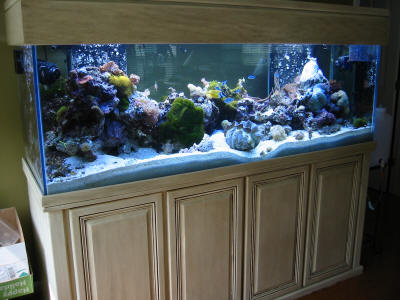
used off of your site. I included a picture to show it off.
Thanks for your help, Tim <I do think I will finally stop
putting off my minor "expose" re the use of Chloroquine
phosphate... 10 mg/l... Please do read re this, and quickly
order, start using... Much better... safer, less toxic than
copper, formalin. Bob Fenner>
|
 |
Blue hippo tang and powder brown
tang, hlth. 9/28/08 I recently noticed my blue
hippo tang scratching the left side of his face on a rock. Upon looking
at him close I notice three micro white bumps all in a exact straight
line, needle point size, <Mmm, most likely evidence of neuromast
destruction... aka HLLE> and same on my powder brown tang but he is
not scratching, what do you suggest? They are both swimming great and
eating like crazy between Green algae and brine shrimp, blood worms,
and krill. Troy <Read here:
http://wetwebmedia.com/HLLESWCauseF.htm
and the linked files above. Bob Fenner>
power brown and blue hippo tang,
dis., reading 10/1/08 I have powder brown and blue
hippo tang that were both seen scratching so I took a closer look and
saw very few salt like granules on their bodies looks like crypt but
not sure. Does crypt look anything like HLLE? <Mmm, not really...
the latter can be evidenced by small, discrete whitish dots, but is
almost always symmetrical, in a pattern, masking the "pit organ
system" of the fish> Last night looked worse than today, should
I just raise heat and lower Salinity or get them out of tank and do a
fallow as soon as possible? <... you should read> I also have a
clown tang, a porcupine puffer, and a clownfish with no problems that I
can see all fish are eating great and swimming great in a 100 gallon
tank 60 pounds live rock. <... a pic might help here... Otherwise
look at ours. Peruse here: http://wetwebmedia.com/mardisindex.htm And
reading re the species you're keeping... the Clown and Powder Brown
Tangs are very susceptible to protozoan and environmental troubles...
as you'll see, are seeing. Bob Fenner>
Re: Blue hippo tang and powder
brown tang... and other copper sensitive fishes -- 10/5/08 I
diagnosed my fish of having crypt. I have put all fish in a 35 gallon
plastic container, and letting the tank go fallow. I am treating with
copper ( Cupramine). I am having a heck of a time keeping the ammonia
down. I am using ammo lock and Kordon Amquel plus and doing daily water
changes almost need to do it twice a day. There is a blue hippo(3
inches), a powder brown(4 inches), a Porcupine puffer(5 inches), and a
Foxface(3 inches). I feed real lightly. Can you suggest any other good
ammonia remover? Also after five days of copper treatment (keeping the
level at .50) the whole inside of the black plastic container was lined
with tons of white like elongated salt like substance they are real
easy to brush off any ideas what this my be?? I will try to get a pic
if it forms again before I remove it. Troy <... wouldn't treat
these fishes with copper... read re Chloroquine... quick. BobF>
re: Blue hippo tang and powder brown tang 10/6/08
Where can I find this stuff I can't find any place on the web to
buy it? Thanks, Troy <...? I see it in many places putting in the
term: "Chloroquine for sale". B>
Ich Treatment Question - How to
Proceed From Here 6/24/08 Hi, <David> I have a standard
90g tank that is currently sitting fallow due to ich. I had an outbreak
in my tank, and all of its inhabitants were infected. My fish livestock
consists of a Kole Tang (3.5'), Purple Tang (3'), Foxface
(4.5'), Percula Clownfish (2'), and a single Chromis (1').
The ich started out on the Purple Tang (which also had the worst
infestation) and spread to the other fish in short order. Now all of my
fish are divided between 2 20g long aquariums with some PVC 3'
fittings, HOB filter, and heater. I have been treating the ich by
keeping 0.5ppm Cupramine in their water at all times. The fish are all
doing much better. They have been immersed in the copper for 10 days
now, and for the most part seem healthy. The Foxface, clown, and
Chromis are all doing great. I drop in some Brine Shrimp Plus+ and all
of them readily eat it. I also keep some Nori on a clip for the Foxface
(I should mention that these fish are together in one tank.). The other
tank houses the two tangs. They aren't doing quite as well as the
others. They don't swim around a whole lot, and the Kole hides in
the PVC 90% of the time. If I reach my hand into the tank to change put
more Nori on their clip, they dart around the tank, so I figured they
can't be that bad off. <Agreed> The biggest difficulty I have
had with this quarantine procedure is the water changes required to
keep the ammonia at bay. I did not use a sponge from the main tank as a
biofilter because I did not want to risk bringing more ich into the QT
tank (and I figured the copper would kill it anyway). This requires
lots of water changes. To make it a bit easier, I have a 35g trashcan
that I fill with my RO machine. I mix up the salt in the trashcan for
use in my DT as well as the QT tanks. Since I need to add copper to the
water for the QTs (don't want to add copper to my trashcan because
I use that water for the display tank), I have setup a 10g tank with a
heater and HOB filter to be used for mixing/aerating the QT change
water. I fill the 10g with fresh water, add copper, and allow it to
circulate overnight before adding to one of the 20s. This means that I
can change a max of 10g a day. I have been spending several hours a day
changing out QT water, but it has been worth it to help save the fish.
<Good> This morning I checked on the fish as I do everyday before
I head off to work. The tangs were huddled in the corner and the Kole
was swimming backwards in semi-circles. The Kole has done this in the
past when showing aggression to the other fish, so I figured he might
be on the mend. However, I reached my hand in the tank to change their
Nori (They don't eat much. I'm especially concerned with the
Kole having nothing to graze on) and neither of them moved. They were
sluggish enough to the point I could pet them (not good). I immediately
did a full battery of water tests thinking the last water change might
have been off (I was thinking I OD'd on the copper), and the
parameters were ok with the exception of ~1.0ppm ammonia. I really
don't know how it got this high with all the water changes, but it
is what it is. I didn't have time to do a huge water change (best I
could have managed was 50% anyway), so I transferred the two tangs to
the 10g QT tank which was filled with 'fresh' water. I had not
yet added copper to the 10g, so it only has a small amount of copper
leftover from the previous doses. I also added the carbon insert to the
HOB filter to help remove the rest of the copper. <Ok> The
question is: where do I go from here? My thinking is to tear down the
20g QT tank and refill with fresh, non-medicated water and allow them a
break from the stress. I still have 4.5 weeks left before I can add
them back to DT, and I wanted to keep them in the copper for 2 weeks,
but at this point I'm thinking the best thing for the fish would be
to stay in a non-medicated QT. <This is what I would do as well...
either going with an enroute pH adjusted freshwater dip with formalin
and aeration... or switching to Quinacrine as a medicant. Copper
exposure and tangs.... not good for too long> I've read about
ich treatment by doing a series of 100% water changes, and I'm
hoping that after 10 days the ich parasites have dropped off the fish.
<A couple times in this time frame> By switching them into a
clean tank, I will have left all the ich behind. <Perhaps> My
other concern is the eating or lack there of. Both tangs would eat
nonstop in the DT prior to this whole mess. Now, they barely touch
their Nori (loved it before...at least the purple did). The Kole is a
different matter. I'm concerned that he doesn't have anything
to graze on and is just going to starve over the next few weeks.
I've contemplated buying a small piece of live rock for him to
munch on, or putting him back in the DT early (really don't want to
do that). Any suggestions? The water changes are a big challenge, and I
don't know how I'm going to change more than 10g a day for the
next 4.5 weeks, but I'll make it work if needed. Thanks in advance.
I apologize for the excessive length. <Mmm, likely a few things will
come to mind, mainly reinforcing what you already know, to degrees of
confidence, by (re)reading the Surgeonfish areas on WWM. Bob
Fenner>
Sailfin Tang and Ich
6/19/08 Hello Bob and crew, A little over a month ago I bought a
3-3.5 inch Sailfin Tang, Zebrasoma veliferum. After 4 weeks in my 20
gallon quarantine tank he was completely healthy, at least so I
thought. I acclimated him to my 180 gallon reef tank last night and
this morning he has the classic white spots of ich. He has been
breathing rapidly but is acting calm and swimming out in the open. He
is voraciously eating sheets of Nori and formula two pellets. This
afternoon I captured him and gave him an 8 minute, ph buffered
freshwater bath. Now he is back in the quarantine tank. <Your main
system is/was infested...> I ordered some Formalin on the internet
so when that comes I will give him another bath. By the way the other
fish in the 180 gallon tank are 2 Ocellaris Clownfish, and 2
Yellow-tailed Blue Damsels. Should I take them out too? What else
should I do for the tang? Thanks! Marcus <I would likely settle on a
"balanced approach" here re your system and the Crypt. Read
here: http://wetwebmedia.com/parasittksfaqs.htm and the linked files
above till you understand. Bob Fenner>
|
Rabbitfish with velvet...treating with
formalin 6/7/08 Hello to you all! Hope your
day's been a great one thus far! As everyone always says,
thank you so much for the service you provide to those of us with
a love of all aquatic living things! <Welcome to all> I am
writing you as I am more-than-slightly-obsessed (according to my
husband) with ridding our Foxface Rabbitfish (Siganus (Lo)
vulpinis) from what we believe is marine velvet (Amyloodinium
ocellatum). Thankfully, Foxy was in one QT tank (we have 2 up and
running right now) when we observed the disease, so the fishes in
our main 125G tank have not been introduced to the disease.
<As you say, thank goodness... or more accurately, your
preparation and awareness> We took her out of the QT she was
in, did a 30 minute formalin bath, and moved her to the other
(without fish or invertebrates) QT tank. Here is the current
setup: 29G QT tank is set up with a skimmer, lighting, and is
bare-bottomed. Temperature in the tank is 82 degrees F, specific
gravity is 1.022, and levels of ammonia and nitrate are 0.
Symptoms that led us to the velvet diagnosis include: rapid
breathing, mottled coloring (though this can happen for many
other reasons, we are aware), and very fine white spots that
spread VERY rapidly over her body over the course of one day-even
over her eyes. We have seen marine ick before and the white spots
were finer and spread so much faster than with ick. <Does
sound/read as Amyloodinium> Upon making this diagnosis, we
knew what our two main options were: copper or formalin.
<Really only the two together or formalin> Seeing as we did
not have copper, and we knew we needed to act quickly, we opted
for the formalin treatment, knowing that it is a biocide and has
mixed reviews on the WWM site. We dosed the QT tank with the
recommended dosage for continuous immersion according to the
manufacturer's directions (Aquarium Product's
Formalin-37% Formaldehyde). Because formalin removes oxygen from
the water, we added a hang-on filter (carbon removed) and an air
stone for extra oxygenation of the water. <Good> This
initial dosage was added to the QT tank about 36 hours ago.
Observing Foxy throughout the day yesterday was painful, as I was
so afraid she would die (either from the velvet or the formalin).
She made it through the day, though, ate some New Life Spectrum
pellets and algae soaked in Selcon, and looks "better"
today. The white spots seem to be gone (leaving behind black
marks), her breathing is not quite so rapid, and she is not as
mottled; she did shed her mucus layer yesterday. She is still
hovering near the bottom and "hiding" under the algae
clip. The formalin seems to have chemically burned her eyes. I
hope this is enough background information for you!
<Appreciated> Now for my questions...According to Aquarium
Products' website, additional doses of the formalin should be
added to the water every 48 hours "until a cure is
achieved." Any ideas about what that means? <Mmm,
they're covering their bases/rearsides...> I read about
the life cycle of Amyloodinium ocellatum, but I don't know
how quickly the formalin will kill all stages of the parasite.
<With dipping, moving the fish... the one treatment should be
it> With ick, fish can "look" better, but a further
round of the parasite can be just around the corner; it's
deceptive, I know. Is this velvet disease similar? <Can be,
but is generally more "surface" active, removed with
formalin exposure> How long must I then treat with the
formalin to MAKE AS SURE AS POSSIBLE all stages of the parasite
have been killed? I certainly don't want to subject Foxy to
formalin unnecessarily and potentially injure her further, or
even possibly kill her, without cause. On the other hand, I want
to make sure it's GONE, too! <I do understand... due to
its toxicity... I would hold off and just observe this fish for
now> After the formalin treatment (hopefully you can give me
some ideas about WHEN that should be...), here are the options
I've thought of, and I'd like to get your opinion on
which one is most sound--or maybe you have another idea that is
better: 1) Leave Foxy in current QT tank and use water changes
and PolyFilter to remove formalin. <This is what I would
do> 2) Perform a pH adjusted freshwater/Methyl blue dip and
then place Foxy back in the first QT tank (cleaned out...see
clean-out steps in the following paragraph) filled with new mixed
saltwater/water from our 125G main tank. <Perhaps> 3) IF
the formalin has indeed killed off all stages of the parasite
during the course of treatment, could we do #1 or #2 above, watch
her for signs of the disease, and then put her in the main tank
after the initial quarantine period is up, or do we now need to
start a new 30-day count-down clock for the quarantine?
<I'd do one and start the countdown> Last question: I
was reading that the parasite is tough to rid from tanks,
equipment, etc. Yesterday, I tore down the QT tank Foxy was
initially in. I rinsed all with freshwater, and am now soaking
all in a bleach solution. <Good protocol> We would LIKE to
use this tank as the one we move her into after the fw dip
(following the formalin treatment), before we later move her into
the main tank (when that will be is based on your opinion...). Is
there anything else I could or should do with the contaminated
equipment to eradicate the little nasty parasite? <No> Or
should we, to be safe, allow the QT tank to sit dry and for
months and buy a NEW QT tank for Foxy, if putting her into the
main tank is not your recommendation? I certainly don't want
this to resurface while we're gone and our friend is taking
care of the fish. <The tank and gear used should be fine to
use post bleach-washing and rinsing> Yikes; this is so long. I
apologize for that, but I have made it my mission to cure our
Foxy of Amyloodinium ocellatum and do the best job with follow-up
that I can. I do hope this makes sense, and is not too confusing!
I appreciate any advice you have, and look forward to your input.
Thanks so much, and have a GREAT day! Beth Norman, in New Mexico
<Thank you Beth. Bob Fenner>
Re: Rabbitfish with velvet...treating with
formalin - 06/08/2007 Hello, Bob (or whomever reads this)!
Thank you for your reply. I'm glad to know we're doing
some things correctly to treat the case of velvet on our
Rabbitfish; it feels good to have confirmation, as well as some
needed advice. There is one thing I would like clarification on,
if you don't mind: the second QT tank in which Foxy is
currently residing has also had exposure to the Amyloodinium
parasite (it's a long story as to why she was in both tanks
at various times during her quarantine). As I re-read my post, I
realize that I did not explain that part. That is why I was
asking about whether or not the continuous formalin immersion
would prevent her from being re-infected and/or kill off the
other stages of the Amyloodinium. <Continuous exposure to
formalin is not suggested... very dangerous. Best to dip/bathe
and move to new water... in this case, to amend/change our prev.
corr. back to the orig. QT> If it will NOT do this with
certainty, we should perhaps then choose the 2nd of the options
we discussed in our correspondence: removing her from the QT tank
and performing a pH adjusted freshwater dip (with Methyl blue),
then placing her in the bleached/rinsed OTHER QT tank, using
water from our 125G main tank. What are your thoughts? <Yes...
with the new info. presented here, this is best> We will be
leaving on a vacation in about a week and we'd like to have
Foxy healthy (and velvet-free) in her QT tank by that point, so
our friend coming to take care of our marine buddies while
we're gone won't be stressing out about sick fish. She is
not knowledgeable about medicating fish, and we don't want to
burden her with that responsibility! Thank you again for your
input! Have a wonderful day! Beth Norman <Thank you Beth.
BobF>
Re: Rabbitfish with velvet...treating with
formalin - 06/09/2008 Hi, Bob! Thank you a second time for
your advice. Foxy was FW dipped yesterday and is now in her new
water in the other QT tank, happily eating algae off of her algae
clip. I am so relieved that she seems to be healthy after the
formalin exposure, though I suppose we're not out of the
woods for sure just yet. I cannot believe the rapidness with
which she has returned back from the almost-dead (with the
velvet); she's a tough cookie! Thanks again, and have a
wonderful day! :) WWM is just such a fantastic resource for us
all! Beth Norman <Ahh, thank you for your kind words and
update Beth. Formalin really can be a lifesaver at "whacking
off" external issues... Cheers! BobF>
|
|
Oh
No!!!!!!!!!!!!!!!!!!!!!!!!!!!!!!!!!!!!!!!!!!!!!!!!!!!!!!!!!!!!!!
Crypt... again 6/1/08 Bob, Since we discussed this
yesterday, help me with some logic. I found an ABT at a store
yesterday, the fish had been there at least 4 weeks. I saw it at
this location a while back and remembered it, and since it was
still there I decided to take a look at it. I purchased it, a
4" Specimen which looked healthy and was eating well. I took
the fish home, acclimated it, and gave it a 4 minute FW bath, PH
adjusted, prior to introducing it to the tank. It acclimated well
and was eating last night. This morning, it was covered in Ick.
<! There is very likely a resident population/infestation>
Now, from all that I have learned from here, I am making an
assumption that the ick is NOT a result of introduction from this
fish. My logic is that by giving it a FW dip, it having no prior
signs of ick, and by not introducing any water from the bag into
my tank, there is no way that this much ick could have been
introduced and show up in 12 hours on the fish... Which means
that it was present in the main system. <Yes> Now you may
recall that ick was defeated some months ago using the Quinine
Sulfate. <Mmmm, this doesn't mean it was completely
gone... the cysts could have survived the treatment> Aside
from some new live rock, there haven't been any
introductions, and certainly nothing recently. Obviously, the new
Tang, being weaker, stressed, susceptible so to speak, has ick...
but no other fish (at this time) shows any cysts at all. Those
consist of the Passer Angelfish, the Lunare Wrasse, Yellow Tang,
and a Tomato Clown. But, despite all the care I've taken, I
have this scourge in my system again. <Expressed again... was
always there> Now, unfortunately, I had to go to work this
morning (don't mention to my boss I'm more concerned
about my fish than making calls...) so I was unable to do
anything right away, but hopefully I can get home early this
afternoon to do something. The 20gallon QT tank, nor any tank of
any manageable size, is going to work as a hospital tank while
the system goes fallow, so I'm faced with using the Quinine
again. <Mmm, maybe... I'd wait out this appearance and see
if the current situation resolves (not solves permanently)
itself> I've got some live rock with fan worms, etc, that
I might can fit in the 20gallon, and of course I can pull the
snails as well. How long, after this first coating of ick, would
you guess a fish has to live? <Perhaps years...> Reason is:
If the ick has been present all this time, will the other fish
develop it now? <Not likely... sometimes a hyper infection
can/will develop... people, particularly in the West don't
understand that such parasite-host relationships are not a matter
of all or nothing... but a balance, ever-shifting...> My guess
is no, if they've been resistant all this time. If it's
too late to save this ABT ($50 flush), is it better to take the
time to formulate some other plan? My first choice is to save
this fish, of course. Thomas Roach <If it were me, mine,
I'd be patient... wait for now... boost the fish, systems
immune system... with probiotics, garlic, what have you.
Don't panic (shades of Doug Adams). Bob Fenner>
Re: Oh
No!!!!!!!!!!!!!!!!!!!!!!!!!!!!!!!!!!!!!!!!!!!!!!!!!!!!!!!!!!!!!!,
Tang, Crypt -- 06/02/08 Hey, thanks again, Mr. Fenner.
I'll give you an update... Friday AM was the day the ABT was
completely covered in 100's of the cysts... Getting home
Friday afternoon, I guess it had cycled because they were off
him. I'm feeding them a tad more now to make sure they get
energy/nutrition to fight it, soaking the food in garlic and not
adding medications. Saturday all day, no cysts were present on
any fish, including the ABT. Today, Sunday morning, there are
some cysts present on the ABT, but not hundreds, more like 8 -
10, which I think it could handle. No treatments have been done,
I held off the quinine on a gut feeling (hey, maybe some of your
knowledge transmitted through a 6th sense or something...).
Anyway, continuing along this path, and I'll send you
updates. Thanks for validating my course of action! Thomas
<Welcome Thomas. BobF>
Re: Oh
No!!!!!!!!!!!!!!!!!!!!!!!!!!!!!!!!!!!!!!!!!!!!!!!!!!!!!!!!!!!!!!
Tang, Crypt 6/3/08 Another update... No signs of
Ick anymore... assuming it's still in there, but the ABT has
survived the initial stress of introduction and has been doing
quite well. I kept expecting to find him covered in white dots,
but after that last bit of cysts there has been nothing. The only
thing I have done is soak all food in SeaChem's Garlic Guard
prior to feeding, which has been mysis shrimp or Emerald
Entrée. I've wondered about the validity of
garlic... it definitely seems to have some measurable effect,
wouldn't you think? <Yes... perhaps best described as an
immunity booster> This Crypt thing is interesting. It's
beyond my capabilities to do, but I wonder if anyone has done
some testing on it. <Oh yes> I guess the biggest mystery to
me is how it can survive in the system without showing itself on
the fish for months and so readily appear on a new addition.
<The showing is/are larger/more massive infestations...
subclinical expressions are very common> If this ABT makes it,
which all indications at this time is that it will, then my
livestock collection will be complete and it won't matter,
but it is a fascinating question. Thomas Roach <Yes... and to
try to clear up the difference between "curing" systems
or livestock therein vs. diminishing the leaning/balance of such
infestations... Many medicines do the latter (e.g. Quinines)...
not the former (more the realm of Coppers). RMF>
|
Re: twitching tang... more need
to read - 05/31/08 Ok, sorry. Let me start from the
beginning. I introduced a tang into my 75g tank. <Sans quarantine,
dip/bathing?> I have 3 chromis and a scooter blenny in here as well.
Well a couple days after I added him, spots showed up. I'm thinking
its ich, but I don't want to set up a qt, <... too late for
this> and stress them out if that's not what it is. Anyways, the
spots on my tang disappeared and he began to twitch. Not a lot but he
would twitch once or twice. Do tangs do this? <... the spots will be
back... They're off reproducing, metamorphosing... You should
read... and soon... re protozoan parasites of marine fishes. BobF>
Tang Parasite... Crypt, reading 4/25/08 Hey Guys,
Just want to let you know, just like everyone else I find this site
really helpful and it's really cool you do this to help people. OK,
I have a Sailfin tang 5-6 inches with some type of parasite. I'm
not sure exactly what it is because it doesn't really look like
ich, more of a dusting of white rather than actual white grains perhaps
velvet?. <Perhaps... there are other Protozoans, conditions...>
However, I gave him a ph-temp adjusted freshwater bath for 5-6 minutes
and a few hours after, he was covered in "Ich looking" spots
everywhere. <Oh... then likely was/is Cryptocaryon> Much more
defined and white, like grains of salt. I was inclined to dip him again
that evening simply because it seemed to me that the 5-min dip may not
have been long enough and perhaps only brought the parasite to the
surface. <And your system itself is infested...> However I
didn't dip him again and 1 day later he looks like he did again
before the dip- dusting of white. A few other things, he also seems to
have developed "small breaks" in his colouration, like small
black irregular shaped discolourations. He has also developed 1 cloudy
eye, and 1 eye with just a few blotches of murky white. <All
symptomatic...> Otherwise he seems really healthy, eats like a pig,
active, ect. <No such word> I know this is a lot of questions at
once, but some direction would be much appreciated. I guess the real
question I have from all of this is can/should I dip him again for
longer, is it possible that the dip only brought the parasites to the
surface? If I dip him again, and the white spots appear bigger, should
I dip him AGAIN for the second time in that day?.. I have been in the
hobby for about a year, 2 tanks, very keen interest. I also have a
quarantine tank but I was told by several people that It would be more
stressful to my 6 inch tang to leave him in a tank that small then It
would be to just add him to my display. So here I am with parasites. My
tanks- 1- 36 gal corner tank- 25-ish corals running for a year and
doing great.... 1- 110 gal tank (that the Tang lives in along with a
skunk clown, 3 cleaner shrimp and cleaner crews) The 110 gal has been
running for 8 weeks (the tang has been in there for 4) with 175 lbs of
live rock (all cured) I run a EuroReef rs-100 and a 30gal sump, 250w MH
and 2- 96w PC. All levels are good. Nitrates- 0 Nitrites-0 Ammonia- 0
Ph-8.0-8.2 Temp- 82-83 SG- 1.024-1.025 Calcium- 400 Sorry for the
length! Thanks again.. <... Read here:
http://wetwebmedia.com/crypttangs.htm and the linked files above where
you lead yourself... You need to formulate and act against a plan (with
knowledge)... and soon. Bob Fenner>
Purple Tang has ich, advice
needed on emergency hospital tank 4/23/08 I have a 90 gallon reef
setup that has been running well for about a year and a half. I have
great husbandry, and perform 3x 5 gallon water changes a week. Here are
my parameters: ph 8.3, nitrate 0, phosphate <1, calcium ~380, 79F,
SG 1.025. All my fish went through a 4 week quarantine in a 29 gallon,
and I haven't added any new fish in about 6 months. <Ok> I
recently added some large rocks with mushrooms - this is the only new
addition to my tank. Now my purple tang has ich. (I know he will
outgrow this tank, I have near future plans of a 220 when I move in
august). Today is the third day of his visible spots and I am hurrying
to setup a quarantine tank again as I didn't leave it running
because I considered the tank stocked. The problem is I sold off the 29
gallon equipment, and all I have left is a 10 gallon setup. Will this
be large enough for my 3" purple tang while I treat him for ich?
<I would try to go bigger, maybe a large Rubbermaid container,
usually can be had pretty cheap.> Also, how can I kick start this
system and prevent or minimize a cycle? I thought about putting a large
sponge (about 12"x4"x4") that is in my sump, dividing
the skimmer chamber from some rubble live rock, into the quarantine.
<Would work well if you can get a little water flow through it, but
will have to be discarded after use in the QT tank.> Would you
recommend this? <Best bet.> I have the bio wheel of a backpack
filter for the quarantine under the drip tray in my tank, it has been
there overnight. How long does the beneficial bacteria take to populate
this? <Would probably need at least a week if not more.> Should I
be running a skimmer on this quarantine? <Not during treatment.>
The only spare one I have is a hardly useful SeaClone 100. <Good for
after treatment to keep O2 levels up.> Livestock Purple Tang
Swissguard Basslet 3x Green Chromis Purple Firefish 2x Percula Clowns
Watchman Goby 6 Line Wrasse Neon Goby (went missing yesterday - another
story, crab suspected. Missed though as he could've helped with the
ich some) <Where are these fish going to be treated?> Pacific
Cleaner Shrimp Mithrax Crab (possible goby killer - has gotten quiet
large) On another note, I have also recently had a nasty outbreak of
Valonia bubble algae. I have attempted to scrape the rock clean with a
siphon running to gather everything up, but despite my bi-weekly or so
efforts to keep these guys at bay, they always seem to find some place
to grow. Would a uv sterilizer be beneficial at this point? <May be
of some use, but I would not spend a lot of money on it.> At least
for the moment to help control the bubble algae, and perhaps even a
little more pressure on the ich if it does get loose in my tank? <Is
already loose in your tank, just a question of how bad the other fish
are infected.> I have the pumps and hosing and my LFS has a Coralife
8w sterilizer on sale right now. <I would not bother with such a
small model, will not get your money's worth out of it.> Thanks
as always for your helpful advice! Josh <Welcome>
<Chris>
|
Re: Sailfin Tang/Health 4/23/08 Hello again, <Hi
Dave> I would like to get a pic of him but for now he staying
behind the rocks. The spots are pin sized and dusted on him
as if you blew some sprinkles on him and what's throwing me
off is that is on his fins as well. I didn't think ich would
attack the fins ...they are so transparent. It would seem to be a
bad spot to suck the blood out of a host aside from the fact the
c. irritans burrows under the scale to get to the flesh of the
fish. I also didn't get the link you wanted me to look
at for some reason. <The reason is me, forgot to paste. Here
you go. http://www.wetwebmedia.com/zebrasom.htm> This
particular tang does have large freckles all on his face which is
normal to the species or at least in comparison with some other
pics I was able to find online. In the meantime I'll keep
trying to get a pic. <This fish needs to be treated quickly.
Go for a freshwater dip first and do read here.
http://www.wetwebmedia.com/ichartmar.htm. I'm also thinking
this fish may be infected with Amyloodiniumiasis. Do read here
also. http://www.wetwebmedia.com/amylloodiniumart.htm Thank you,
<You're welcome. James (Salty Dog)> Dave
Re: Sailfin Tang/Health 4/24/08 Good morning James,
<Good morning Dave. First off, always reply with the original
content. I cannot remember everything we talked about. And, do
cap all proper nouns such as names of fish, companies, etc. and
do a spelling check. Saves me time as I have to correct/edit
before posting.> main display specs 55gal reef tank Emperor
400 Magnum 350 protein skimmer fuge combo 24watt uv sterilizer
lots of inverts and 4 coral and mushroom polyps water parameters
are all solid I was able to catch him last night and I put him a
3 gal pico QT. I think it is ich <It is.> and I am treating
the fish with Cupramine. It also had some weird fecal matter and
this concerns me. I will include some pics. <I see, the fish
is definitely stressed and will continue to be in that three
gallon jug. Should have at least a ten gallon tank, not expensive
at all. As for the fecal matter, I do not believe this fish is
getting a nutritious diet. Do read the link and linked files
therein that I sent you last time. All of the questions you are
asking can easily be found on our site, do learn to use, very
informative.> I'm just worried that some of the ich
sloughed off into my main display tank. I made the foolhardy
mistake of being in a hurry and not being patient. <Yes you
did, and I'm sure plenty of cysts are present in the main
display.> I went back to LFS and had a closer look at the
other few fish in the tank I purchased the tang from and they all
had the same spots. I should have looked before I leaped.
<Yes, would have been pretty obvious.> The only other fish
in my display are a Blue Devil Damsel and a Cleaner Wrasse. I
have had both for over a year now (fortunately the wrasse eats
flake food). <I hope you have a better diet than just flake
food, especially for the tang.> Do you think they will get
infected now as well? <The damsel is a very hardy fish and I
don't expect him to contract the disease. As for the Cleaner
Wrasse, I've never saw one pick itself clean, so there is a
very good chance this fish will inherit the disease.> I do
have UV sterilizer (24 watt) running on the display. <Will
help, at least kill all spores passing through it.> If the two
fish don't get infected and a month passes allowing the ich
cycle to run its course do you think it would be safe to add fish
that have been properly QTed? It would certainly be a pain in the
butt to catch those two guys but if it must be done it will.
<Right now, I'd concentrate on getting a larger tank for
the tang and future inhabitants of the QT. After a month,
re-evaluate the situation. Worry more about correcting the
problem at hand, not when you can add more fish. I'd keep a
close eye on the Cleaner Wrasse for signs of ich and be ready to
transfer him to a QT if you want a chance at saving him.>
Thanks, <You're welcome. James (Salty Dog)><<...
this fish and all others will be dead soon if not treated... NOT
quarantined. TREATED. Poor advice. RMF>> Dave
|
|
|
Marine Ich question 03/26/2008
Thanks so much for your great web site! <<Thanks for the kind
comments. Andrew with you today>> I recently purchased a Kole
Tang which I put into my 20 gallon quarantine tank. He broke out with
Ich about 2 weeks after purchase. I treated him with CopperSafe for 10
days after which he looked and behaved great. I then did water changes
sufficient to reduce the copper level to zero. After two more weeks he
broke out in Ich again. I again treated him with Copper for two full
weeks. He is eating great and does not seem to show ill effects from
the treatment and the Ich appears to be gone. My question is how long
should I keep him in quarantine and how can I be sure he will not get
Ich after I add him to my display tank? <<I would suggest you
stop treating with copper, and go down the hyposalinity route to
eradicate the Ich. More info on this can be found here.
http://www.wetwebmedia.com/ichart2mar.htm and linked articles and
FAQ's. Do you have anything like live rock or substrate in this QT
tank? If so, get rid. They are an ideal place to harbour the parasite.
All you need in there is heater, filter and some Plastic pipe work for
hiding holes>> If you think there is no way to be absolutely sure
he will not get Ich again, should I just take him back to my LFS since
I do not want Ich in my tank and know that Tangs are prone to get Ich?
<<Yes, tangs are very prone to Ich, however, with a good
treatment, you can overcome this issue. Use the route mentioned above,
hyposalinity>> Thanks for your help. <<Hope this helps,
thanks for the questions. A Nixon>>
Re: Fish Compatibility -
Bully Gold-Rim Tang... actually Crypt, using WWM -- 02/07/08
Hello crew!! I am writing to you and copying our previous conversations
in this email. I have run into some trouble with my 125 gallon setup
(going on 1 year with no issues). Recently my Powder Brown came up with
ICK. <Acanthurus nigricans is very susceptible> I immediately QTd
the entire livestock into my 46 bowfront. Unfortunately the Brown died
(was really fast, less than a day when I noticed and diagnosed the
problem). My two remaining fish are surviving in the QT and I am dosing
with Oodim Ex (LFS recommended). <... check the ingredients here>
Last night I came home from work and was surprised to see that the
Auriga Butterfly had turned a shade of black (not night time black).
<Poisoned> He was swimming into things and seemed out of it. I
ran a full water chemistry test and found that my Nitrates in the QT
were 100PPM. <!> I was shocked. I immediately began changing the
water. I changed close to 70%. I made sure to match the temp, PH and
salinity. Tonight I will go and see how things are progressing and
change more water. I will continue to QT the Auriga and hi remaining
tank mate the Huma Huma and fallow the main tank for at least 6 weeks.
Should I stop dosing the medicine? Will the Butterfly recover? <...
Please read...> The reason my QT nitrates were skyrocketed was
because I used water changed from the main tank. I measured my main
tank and found the Ammonia to be zero, Nitrites were high
<Toxic...> and Nitrates were high as well. I was completely
dumbfounded!!! I had gotten lazy and checked only PH,NH4 and salinity
on a regular basis. <More than I do... if all is going fine...>
Now, I am sure that the Powder Brown became sick partly due to my water
chemistry problems. <Likely so> In the future, what can I do
differently with my system to reduce/eliminate my Nitrate and Nitrite
problems? <"Groan..." All posted...> Should I consider
a DSB? My system currently has 2 overflows into a 40 Gal sump. My main
tank has around 3" of Aragonite (fine) sand. I read in your DSB
site that 6" is ideal. I am not sure that I want 6" in my
main tank. Can I use my sump (which is now bare bottom) as my DSB? The
sump is under my main tank and dark, do I need lighting? If so, what
type (fluorescent, halogen??)? Should the lighting stay on all the
time? I sand alone good enough, or do I need to put algae in the sump?
If you suggest starting a DSB in my sump, then should I take the fine
sand from my main tank, reduce its level to 1/2" adding this to
the sump? If not 6" by then, can I add new sand on top? As always
thanks for your continued support and help. Your website is a wealth of
knowledge and comfort. <Have just skipped down. The answers to the
questions you posit, and much more useful ancillary info. is posted,
over and over... please read before writing. BobF>
Achilles Tang trouble. Crypt ping
pong 2/6/08 Good evening, I had an outbreak of
ich in my 150 reef tank about two months ago. I have a sailfin tang,
green chromis, Talbot damsel, clarki clown, and just added an Achilles
tang four days ago. I have not seen any sign of ich in the last seven
weeks. When I initially had it I lost several fish but all the others
made it with no sign of ich. <No sign... you now know that this
indicates nothing> I believed it was gone so I added the Achilles
tang. Now it has ich. My tank has way too much lr and coral to catch
the fish and quarantine them. <... you'll either have to
"decide" (as in nothing's decided till it's done) to
remove all to get to the fishes, or risk trying to establish a balance
between infestation/disease-health and residence of the parasite...>
I have read numerous articles on your site on how to rid it. The
Achilles tang is eating and I do have a cleaner shrimp. My question is
what options do I have to rid my problem? <As stated.> I
don't want to lose this fish. None of the others have any signs. Is
it possible the tang will survive? Why do the others not have any?
<Yes and more susceptible> <Bob Fenner>
|
Tangs, Crypt-hlth./sel. 01/02/2008 Hi,
<<Hello, Andrew here>> I upgraded from a 65g to a
160g tank a little over 2 months ago. As soon as I transferred my
fish to the new tank, they all got ich pretty badly and a few
died. I did not have many fish to start with but now I am down to
a couple gobies and a seahorse (which lives in my macro fuge
under the main tank). <<Is it happy in the fuge?? Maybe
setup a new system to give the horse a better home??>> I
took all the fish out and placed them into a hospital tank. This,
of course, required me to take the entire tank apart. Not a fun
job. <<He he he, it's never fun, that part>>
Anyway, they have been in the hospital tank for a week now. I am
treating with hyposalinity. The tank will be left fallow for 6
weeks. <<Sounds like a good plan>> My question is
regarding tangs. I always wanted to add a regal, yellow and kole
tang but now that I've had an ich breakout, I'm really
scared to attempt keeping these fish, especially the regal, due
to their susceptibility to get ich. What do you think. With
proper maintenance and proper quarantining, should I still be
scared to try these fish? <<The majority of tangs are
susceptible to Ich. As long as you carry out proper techniques
for acclimatizing, quarantine etc you should not be scared,
no>> I would like to add 2-3 cleaner shrimps and a couple
neon gobies to help control parasites should I get another break
out even with the precautions I am taking. I also have a UV
sterilizer. It's just a 25 watt though. On a 160g tank, with
a 30 gallon sump and 25 gallon refugium, that might not do much,
right? <<No problems with the shrimp or Goby's. The UV
is not really going to be very effective on a tank that
large>> Any suggestions would be greatly appreciated. Thank
you so much! Steve Nantel <<Thanks for the questions. A
Nixon>>
Re: Tangs... 2/1/08 Thanks for the response
Andrew. You told me what I was hoping to be told. <<No
problem Steve...All the best in keeping the tangs>> The
tank that my seahorse lives in, I believe, is a great home for
him. Its a 25g hex tank that I plumbed to my main system.
It's got lights on it that are on a timer, along with a lot
of macro algae and some liverock too. I have that tank under my
main tank, completely to the right. I do not have a door on that
side of my stand so that we can view the seahorse. It looks very
neat. Thanks again! Steve <<Happy fish keeping. A
Nixon>>
|
Sailfin Tang, Pearlscale Butterfly
With Crypt -- 01/24/08 Hellllooo Eric! <<Hey there
Don!>> Ok Tang and Butterfly in QT have crypt. <<Better
there than in the display, eh>> Pick my poison for me in the
early stage. A) Copper, B) Formalin, C) Organic Ich Attack, besides the
FW dip over 5 minutes and daily water changes. <<Hmm'¦
I've seen some folks recommend Formalin-based medications over
Copper for Tangs, but I'm leery of these 'embalming fluids'
but for extreme cases. If a medicant is needed, I would likely go with
a Copper-based formula and keep a very watchful eye on the Tang. And
though I've not tried this myself'¦if the Ich is not
excessive, I might be inclined to skip the Copper and proceed with a
series of daily pH adjusted Freshwater baths (could even add some
Methylene Blue'¦just enough to turn the water deep blue).
Performing these dips for 3-4 days at a time combined with daily
siphoning/vacuuming of the tank bottom (hopefully this QT does not
contain rock/substrate), and then carefully observing the fishes for a
while to determine efficacy/the need to repeat, may take care of this
pest protozoan over a series of weeks while possibly proving easier on
the fishes than medicating (poisoning) them. But, it's hard for me
to make this call. You will have to decide how much trouble you want to
go to and/or what measures are necessary at this time>> Hope all
is well on the new room your building. <<Yes, thank
you'¦have about finished putting down the new Bamboo flooring,
cabinetry and display/book shelves to do yet'¦is a
'renovation' rather than an addition'¦though there is
a fair amount of 'building-in' involved>> Thanks, Don V.
<<Happy to help. EricR>>
Re: Sailfin Tang, Pearlscale
Butterfly With Crypt - 01/24/08 Forget it I blew it :(.
<<'¦!>> I put in formalin/quick cure and poisoned
them. <<Sorry to hear my friend. And not to be flippant, but and
in this time/culture of instant gratification, 'quick' often
means 'deadly' in this hobby. A sad and expensive
lesson'¦but the 'cure' is sometimes worse than the
illness. Okay, enough of the lecture'¦>> I am finally
giving up the formalin thing. <<Has its uses, I'm
sure'¦but you MUST know what you are doing>> It's
just I have never done copper. <<Can also be
abused/misused'¦but is my preference between the two>>
Next time I get fish I'm just going with FW bath over 5 minutes and
then QT tank him, daily dips, and clean bottom of tank (QT always bare
bottom). <<Mmm, yes'¦ And please don't misinterpret
my words/intent here'¦ I know you recently went through a bad
bout of Ich in which you lost fish'¦but it is oftentimes good
to just slow down/be less reactionary and resort to the meds only if
the fishes lives are in peril. Yeah, yeah, I know'¦easy for me
to say'¦[grin]>> I use my wet dry filter for vigorous
water movement. Does keeping SWG at .017 help? <<Creates more
stress than any good it does, in my opinion. Keep the QT at NSW levels
and rely on the freshwater baths to do their jobs>> I feel like
I'm making the same dumb mistakes. <<But hopefully learning
from same?>> This drives me crazy. <<Many have been down
this same path>> I volunteer for a wildlife reservation and
mainly keep Tigers, Lions and other big cats <<Neat'¦I
do like the big cats>> and animals and if they get sick we just
take them to a vet! <<Indeed>> Thanks again. <<As
always'¦quite welcome>> You're my only link to fish
people because all the people I know think I drive myself crazy over
this stuff, and how much it costs. <<Hmm, perhaps a few beers or
a bottle of wine are in order for tonight. For medicinal purposes only,
of course [grin]. Kidding aside'¦is obvious to me you care
about your charges and about how to properly provide for them. You
'are' learning and you 'will' get better at it.
Patience and moderation'¦ Regards, Eric Russell>>
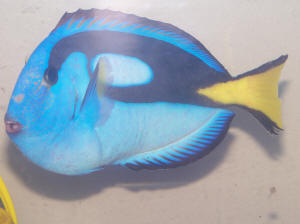
| Hippo Tang with recurrent Crypt
1/16/08 Dear WWM crew, Thank you for receiving my question!
<Welcome> I have a hippo tang (have had for 18 months) who I
treated 1 year ago for Crypt. <Looks like with copper...
resultant in the obvious neuromast destruction here (HLLE)> He
successfully had 2 weeks of copper, other fish quarantined and
display tank fallowed for 7 weeks. Despite all of this, he
intermittently 'breaks out' when stressed (change in
environment, power outage etc). Has 1 mm 'white spots' for
2 -- 3 days, then they appear to cycle off and he appears
clinically 'free'. <Mmm, yes... not atypical... Your
system is infested still> In between episodes he is lovely, with
all other fish (2 pairs of clowns and 1 mandarin) unaffected.
Display tank -- 300 litres (80 gallon), these 6 fish and various
soft corals. Sp gr 1025, temp 26C, pH 8.2, amm, nitrates, nitrites
0. His last episode, he did not so readily recover from, actually
stopped eating (amazing as he is always ravenous), and has since
been returned to a treatment tank. He has been in copper (tested
twice daily and maintained at 0.25 ppm -- never below 0.2ppm) -- he
improved after a few days, then dramatically worsened and has
remained covered. He has had 12 days of copper. I have started
freshwater/methylene blue dips, which I think are giving some
relief. He is slightly better than 7 days ago, but is still visibly
covered with white raised 1 mm diameter spots -- body and fins.
Some are larger -- up to 3 mm diameter, most are small. <Okay...
though the copper is killing this specimen... slowly> He is in a
60 litre (13 gallon) bare bottom treatment tank - too small for him
I know - am keeping ammonia down with 30 % water changes 2 - 3
times weekly, and occasional Chlor mon to neutralise the ammonia
(your opinion on these products in this situation??) <Can be
useful> His appetite is still great. RR is increased (approx
80/min) with open mouth. My LFS says it is not Crypt but continue
copper. <... Is very likely Cryptocaryon... Do they have a
scope?> I am concerned with prolonged exposure to copper with
this Tang, and also -- what am I dealing with? I would value your
input on this case. Continue copper? - <I would not...> how
long until I should expect a response? How often should I
freshwater dip? <These won't cure the resident
infestation...> Should I try formalin dips?- how often? <I
wouldn't> Should I skin scrape? (if so, how with a glass
slide, and what should I stain with? <H and E... or any other
acid fast...> Any good sites for protozoan ID? <None that I
know of... look for Ed Noga, "Fish Disease, Diagnosis and
Treatment"> I think scraping would be very
difficult/traumatic on my scatty hippo tang .. he is
crazy'¦easily freaked out'¦). <... you could
try a quinine route of treatment... but returning the fish to the
infested system...> I have included some photos -- difficult to
capture, but they may be of help. Myself and 'Big Blue' are
extremely grateful for your advise. I often and extensively utilize
your website, and am grateful for the knowledge, experience and
wisdom found within it. Thank you, Kim Newell <The best route
(of a few) would be to cure the Paracanthurus... and place it
elsewhere... and resist placing any new fishes in the infested
system... Please read here:
http://wetwebmedia.com/parasittkfaq2.htm and the linked files
above. Bob Fenner> |
|
|
Surgeonfishes: Tangs for Marine Aquariums
Diversity, Selection & Care
New eBook on Amazon: Available here
New Print Book on Create Space: Available
here
by Robert (Bob) Fenner |
|
|
|

