|
FAQs about the Diseases of Clownfishes
19
Related FAQs: Clownfish Disease 1, Diseases of Clownfishes 2, Diseases of Clownfishes 3, Clownfish Disease 4, Clownfish Disease 5, Clownfish Disease 6, Clownfish Disease 7, Clownfish Disease 8, Clownfish Disease 9, Clownfish Disease 10, Clownfish Disease 11, Clownfish Disease 12, Clownfish Disease 13, Clownfish Disease 14, Clownfish Disease 15, Clownfish Disease 16, Clownfish Disease 17, Clownfish Disease 18, Clownfish Disease 20,
Clownfish Disease 21, Clownfish Disease 22,
Clownfish Disease 24,
Clownfish Disease 25,
Clownfish Disease 26,
Clownfish Disease 27,
& FAQs on
Clownfish Disease By: Environmental
Stress, Nutrition, Social/Behavioral/Territoriality, Trauma/Mechanical Injury, & Pathogens:
Lymphocystis, Infectious Disease (Bacteria, Fungi...),
Protozoans: Cryptocaryon/Ich,
Amyloodinium/Velvet, Brooklynella (see article below), &
Mysteries/Anomalous Losses, Cure, Success Stories, & Clownfishes in General, Clownfish Identification, Clownfish Selection, Clownfish Compatibility, Clownfish Behavior, Clownfish Systems, Clownfish Feeding, Clownfishes and
Anemones, Breeding Clowns,
Related Articles: Clownfish Disease, Clownfishes, Maroon
Clowns, Marine Disease,
Brooklynellosis,
|
|
Sick clowns-please help 3/17/08 Good
afternoon, I apologize in advance for the long message, but I figure
the more information I can give you, the better. I have a 120g tank
with 2 Fluval canister filters and an inline pump on a 3/4in SeaSwirl.
The tank is divided into 3 sections and each section houses a pair of
clownfish and some snails with 2-3 inches of sand and a few live rocks
and plastic anemones. The tank is about a year old. The parameters are:
ammonia:0 Nitite:0 Nitrate:5 pH:8.0 Temp:80 florescent light-12 hour
cycle. SG:1.023 <I'd raise to NSW strength> The first pair
are maroons (tank raised) I have had them for 10 months they were
originally quarantined and have never had any problems. The second pair
are black Clarks (wild caught) quarantined and treated for rapid
respiration (mild) in a separate medicine tank with SeaChem's
ParaGuard for 8 days. The breathing returned to normal after treatment
and they were eating well so they were added to main tank after a few
weeks- they have now been in my main tank for 6 months. The third pair
are ocellaris and I purchased them from a person with a neglected tank
and they didn't know if they were tank raised or not. This pair was
quarantined and also treated with ParaGuard for slight open mouthed
respiration (very mild), they seemed to improve in a few days and they
were moved into the main tank after a few weeks. They have been in the
main tank for 3 months. During the last 3 months all 3 pairs ate well
and acted happy and healthy until a few weeks ago. A few weeks ago the
ocellaris spawned for the first time- everything seemed to be ok until
the 7th day, I noticed that my Clarks and my ocellaris were acting high
strung and sporadic. I attributed it to the eggs being ready to hatch
and that night they did hatch and the larvae were collected with the
bowl and flashlight method described in Clownfishes by Joyce Wilkerson
(I have read this great book about 25 times in preparation for
spawning). None of the larvae survived past the 48 hour mark, despite
having plenty of rotifers, parent water, rearing tank as described in
the book. They spun in circles, acted comatose, then died. At this time
I suspected parasites from the parents <Mmm, would be highly
unusual> and noticed some white feces from the female. I treated her
with raw shrimp soaked in fresh squeezed garlic juice for 3 days and
the feces returned to normal, however the male continued to act
jittery, confused and frighten and the female Clark developed 1 popeye
and some fatigue although all of them continued to eat well. I gave
garlic soaked food to the Clark as well, and her fatigue quickly
diminished- although her eye is still popped out. The male Clark and
the male ocellaris continued to get worse, they acted strangely afraid
of every movement in front of the tank which was very uncharacteristic
of them- they occasionally shuttered and twitched (but not at the
females). I started all the clowns on more raw seafood and Selcon
soaked flake food in case diet was a problem but I have not seen an
improvement. 5 days after the first clutch hatched, the ocellaris laid
a second clutch. This time, however the male is more neglectful and
fans the eggs only briefly about once an hour- he hides often now in
his cave and swims in one direction after another as though he is
confused. The eggs are 5 days old today and only about 1/2 remain,
although the color indicates that they are still viable. I considered
stray current yesterday as a possibility and added a grounding unit and
this had no visible effect on any of my fish. Currently the male Clark
acts mildly confused and jittery, the female Clark has 1 popeye, but is
swimming normally, and the male ocellaris is getting increasingly
agitated, frightened, confused, and neglectful of his eggs with only
occasional fanning and more hiding than usual. All of the clowns have
bright color and no visible spots. I can think of no major changes that
I have made to decorations, tank water, etc that would cause this
sudden behavior. I do 10% water changes every week, clean the canisters
every 2 weeks and vacuum 1/3 of the sand every time I water change. I
don't currently dose with anything since the water is changed so
frequently (Instant ocean salt). My first concern is for my adult fish-
I know they are not healthy but I don't know what to do for them.
Money is not an object- I am willing to do anything- test for anything-
to get them back to the happy, healthy fish they once were. Please
suggest anything that you think may be causing this behavior, I would
rather not have to catch them and put them in medicine tanks, but I
will if I have to. I figure I will have healthy larvae when I have
healthy adults. I love this forum and I am sure it has saved many lives
over the years. Thank you for any and all suggestions you can give me.
<Mmm, there is some sort of endogenous chemical effect at play
here... the canister filters might be involved, the grounding probe is
of no use here... One could either emphasize the "removal"
effort... by using chemical filtrants (see WWM re) or enhancing
skimming... Or making the system more complex biologically... adding a
sump/refugium, with live macro-algae, DSB, RDP lighting... or both... I
would investigate these possibilities on WWM, elsewhere... Bob
Fenner>
|
55 GALLON SALT WATER FISH TANK, Fish death,
missing shrimp 3/6/08 Hi Guys, Gals, <Hello> My name is
Gilbert and I am new to this habit. I have a 55 gallon salt water
fish tank fish only. It was given to me from a friend of mine; it
has been running for more than a year. I currently have a yellow
tang, <will need a larger home before long.> a snow flake
eel, two false Perculas, <may end up eel snacks> an urchin
and about 60 lbs of live rock. As far as filtration goes all I
have is a cpr-bak pak and two rio-600 for water flow. It seems
like everything is fine, but I see all this other fish tank that
have built in over flows and all different kinds of filtration
and I just can stop thinking that there is a lot of things that
my fish tank needs. <Not really as long as your water quality
is good and algae growth is under control. May want to add more
flow but beyond that you have the basics of what you need.> I
hate to go to my community pet store because they will say and do
anything to sell. <Far too common of a occurrence,
shortsighted by the proprietors.> I want to know if you guys
can guide me and recommend any other filtration or anything else
you think I might need. Of course in a near future I would love
to turn it around in to a reef tank. <Would definitely need
more flow and quality lighting.> I also seem to have a problem
in the water because I have bought different kinds of fish and
none survive, well except the Perculas. <Start using a QT
tank, will help determine what is going on.> I bought a coral
banded shrimp that I saw once and never again, <eel food> I
bought a fire fish that was killed god know by who or by what, a
hippo tank <tang? If so needs a much larger tank than you
have.> that also died and a cleaner wrasse. <Skip these
http://www.wetwebmedia.com/labroide.htm .> I got the water
tested and the water is fine. <Fine is too subjective, get
numbers next time or better yet learn to test yourself.> I
guess I'm doing something wrong with the acclimation.
<Hard to say without knowing your water parameters.> Any
how I hope you guys/gals can provide me with great tips just as
you always do. Thank you. Gilbert Gomez <Keep reading>
<Chris>
Re: 55 GALLON SALT WATER FISH TANK, Now clownfish health
3/6/08 Thank you for the fast response, <Welcome> Chris
my brother also has a 36 gal salt water; he has two false
Perculas and a gold stripe maroon clown. <A dangerous
combination, eventually the maroon will probably kill the Percs
if not separated.> The gold maroon spends a lot of time
playing with the sand and is been a week that all three fishes
have some sort of white dots, or something similar, very small
like the sand grains, do you think is ich? <Probably, could
also be Brooklynellosis,
http://www.wetwebmedia.com/brooklynellosisart.htm .> How long
do they usually last with ich if not treated? <Impossible to
say, but treatment should be started as soon as possible,
especially if it is Brooklynellosis.> Gilberto Gomez
<Chris>
Re: 55 GALLON SALT WATER FISH TANK, Now clownfish health
3/7/08 He has a QT but as far as the treatment, what should
he do? Gilberto Gomez <Your options can found here
http://www.wetwebmedia.com/mardisindex.htm > <Chris>
|
Suffocating fish... Clown... need data
3/2/08 Hi, I have a percula clown that appears to have its gills
and mouth covered in a blackish slime. <?!> He is trying to
scrape against the LR to get it off. Any idea what it is and what I can
do? Whatever this is has killed off the other inhabitants in the last
12 hours. Its 5 gallons w/ 3 lbs LR. Dead include 1 Nassarius snail and
a blue leg hermit, only other thing besides the clown is another
Nassarius snail. Water tests showed 5ppm nitrates 0 ammonia &
nitrites and SG is 1.023. Thanks, Riley <Uhh, not enough information
here to render any opinion, advice... Please read here:
http://wetwebmedia.com/clnfshdisart.htm and the linked files above...
to give you an idea of the sorts of data we're looking for. Bob
Fenner>
|
Re: Sick Clowns... env. 2/24/08 I don't need
advice on what tank size I need to know what I can do about my
fish they are sick and acting abnormally, I posted this because I
didn't have 2 or 3 hours to read every single article, I just
needed advice on what was wrong with them. Critiquing my tank
size doesn't help me. <Your set-up is the root/cause of
your problems... It's too small for the Clowns, an anemone...
See my original comments re... READ! BobF>
Strange clowns 2/25/08 Hello, <Skyler> This is my
second attempt at asking you guys about my clowns, I have a
"mated pair" of percula clowns that I bought from my
local pet store (trustworthy place) and I had them in a plain old
10 gallon setup with a penguin 100 filter and heater and bubbler.
I wanted them to mate so I moved then in to a 12 gallon nano cube
and they've been doing good up until recently. I purchased an
anemone bubble tip) and I've had that for about 3-4 weeks now
and the nano has had the clowns in it for 6-7 weeks. The female
seemed to accept the anemone and the male stays in one corner of
the tank and periodically will go "visit" the female.
What are they doing? are they ok? The female has been acting
slightly strange, she will "lay down" in spots and will
rest there for 10 minutes at a time. She has no swellings or any
spots or lesions, so I ruled out any time of external parasite,
but she has had a bit of color loss and her dorsal fin has been
at rest for about 3 days now. We checked the salt and it was at a
horribly high number so we went to the pet store and we changed 4
gallons of it and added a new carbon bag and got the reading to
about 1.025. She was doing slightly better today but still was at
times laying on the bottom of the tank. Occasionally she would
get up and twitch and move around. The male came over today and
swam by her a bit and she didn't seem to mind this. Could
they be possibly mating ( I had read somewhere that the female
swims horizontally over a patch to get it ready for laying her
eggs) is this true? I just really need to know what's going
on with them. Thanks again, Skyler and yes I realize the tank is
small but it's suitable for my budget and suitable for 2 fish
and an anemone <Have already answered this... What you have
system wise cannot, will not support the life you list... This is
posted. B>
|
Re: sick clownfish? Poor English, no useful data, not
following directions, no reading 2/16/08
crew, my tank is relatively new, running 10wks now, I added 2 clownfish
last Friday. Parameters are within the norm, (ammonia, nitrates,
nitrites, salinity and temp within prescribed tolerances). Today I
noticed that one of the clowns has what appears to be a veil or almost
like a clear to cloudy shedding of some sort under his top fin on both
sides of his body. The top fin is not fully extended. I tried to
research this however I could not find a match. The fish is swimming
freely and eating normally and does not appear to be gasping for air.
It does not appear to be ich. Can you shed some light? and if so
provide some suggestions for a remedy. Frank <... read here:
http://wetwebmedia.com/clnfshdisart.htm and the linked files above.
RMF>
Re: sick clownfish? Dismal... 2/19/08
Thanks for the info. It looks like this was velvet. <Not good> I
noticed this in the morning before I left for work and the fish was
dead before the next morning. <Sorry to hear> I tried a few
remedies from your sight but it was too late. This may be a little late
but is it okay to keep 2 false clown fish together, (that are not a
mated pair)? Frank <Frank, if it was indeed velvet (by my
understanding you mean Amyloodinium) then you may need to think about
treatment of remaining fish and perhaps system, before introducing more
fish. Please check the information here: http://www.wetwebmedia.com/amylloodiniumart.htm and the
linked FAQs. Following that, turning to your question, there is no
problem keeping 2 un-mated Amphiprion ocellaris clowns together,
providing they are not both female. Our archives on clownfish will help
you with pairing advice. Good luck. Mike I>
|
Clownfish Behavior 2-9-08 Good morning
all. <Hi. Just one Yunachin.> Another Saturday morning with
a reef tank puzzle. <And a beautiful day for one.>
Established a 30 gal tank over a month ago, live rock, live sand.
Parameters good : ph 8.1, temp 79, salinity 1.023, no ammonia, no
nitrite, nitrate <25mg/l. Current population: 3 snails, 6
hermits, 1 Orange Linckia, 1 Lawnmower Blenny, 1 juvenile Brown
Scopas tang, 1 Banggai Cardinal, 2 clowns (both tank-raised 1
orange, 1 black). 1 week ago, moved the orange clown (named
"Spot") and Cardinal from an established 14 gal to the
30 gal. Acclimation went well. Spot has always been spunky, and
took to his/her new black clown friend no problems (no
skirmishes, swimming together etc). <That is quite amazing
that there was no aggression at all. Is there a considerable size
difference?> Two nights ago, I spotted a change in Spot's
sleeping behavior. He would normally float up near the power head
or surface on his side or nose down and sleep. <I have one
that does the exact same thing when she sleeps.> Instead, I
found him about 1 inch from the sand bed near the glass, looking
like he's swimming faster than usual. Top fin and bottom swim
fins tucked back and maybe a little faster 'breathing'.
Next day he ate and swam fine, until sometime in the afternoon
where he adopted a different spot near the sand and went back to
this behavior. His motions are a bit jerky, and he stays fixed in
the same 2 square inches of space above the sand. <Depending
on the size of the clowns this could be a dominance issue. Where
does the other clown rest at night? I have had experiences with
happy clowns during the daytime but as soon as the lights go out
the aggression fires up. Perhaps he was chased from his favorite
sleeping spot. If this is the case I am confident to say that the
aggression will tone down in time and they will sort out their
territory differences. Basically aggression stems from the fact
that someone is fighting to become the dominant female. The
smaller and the less aggressive of the two will become the male
in the factor. Check out this link for more information on
clownfish: http://www.wetwebmedia.com/clownfis.htm;> He looks
otherwise healthy - no physical signs of disease or physical
damage. <That is good.> He's a real survivor fish
(survived a few flops out of the 14 gal nano into the reservoir).
<Bless his heart, they are hardy fish.> Any insight to this
behavior change? Advice? All other fish healthy and happy, tank
is looking good. <Get back to me about the size of the two and
we can go from there.> Thanks, <You're welcome!
---Yunachin> Rana
Re: Clownfish change in behavior 2/13/08
Hi Yunachin, Well you thought that would be the end of this chat
and somewhat happy ending.... except I now think that Spot has
some kind of disease. :( Spot has moved to yet another spot over
the sand (blowing any theories about laying eggs), and is
separate from the other clown. Spot is still continuing to
breathe heavily and tonight the gills looked spread open -
perhaps inflamed. Color seems fine, he didn't eat too much
today but attempted. No spots or slime or 'velvet'
appearance or secretions of any kind, just the distressed
breathing - wide open mouth and gills. Continued fast tail
flicking swimming in place, but not using bottom fins - both top
and bottom tucked back. Fish is facing the same way with
occasional flicks 180 degrees then back the same way. After
copious reading, it might be good to suspect internal infection
of sorts - though from what is a mystery. I don't have a
hospital tank (yet) and have never administered a freshwater dip.
I may be getting ahead of myself but my significant other seems
to concur Spot looks distressed and not 'normal'. Help
(again), I'm worried this state has progressed over 4-5 days
now... <Rana, I am terribly sorry about your loss on Spot. (I
read your other email today.) I had some problems with my PC
yesterday and was unable to get the pages to fully load. I feel
responsible for not getting to you in time. I sincerely
apologize. Regards, Yunachin> Thanks Rana Re: Clownfish
gills inflamed? Heavy breathing etc.. Too small, mis-stocked...
trouble ahead, reading 2/13/08 Hi All,
<Rana> I was on a different thread with Yunachin and was
concluding that Spot, my tank-raised false perc, was going
through dominance/pairing with the recently added black perc
(smaller). What prompted this is strange behavior a few days ago,
with Spot swimming in a fixed position a half inch above the
sand, mostly flicking his tail and swimming in one spot, facing
the same way. Top and bottom fins looked tucked in and breathing
rapid. The breathing has not improved but as of yesterday he was
eating. This morning he didn't but then he prefers mysis (and
I didn't serve that today). Now he's shifted to a higher
spot in the tank, nose a little more (rather than parallel as he
has been), his gills since this morning look spread open and
mouth open too. Tank is a 30 gal with juvie brown scopas tank,
<Much too small a volume...> lawnmower blenny, Banggai
cardinal and the black tank-raised perc - recently added orange
Linckia <A poor choice...> and a few corals, hermits,
snails. The Cardinal and Spot (false perc) were moved about 10
days ago from my 14 gal (into the new accommodations),
acclimated, everything fine. All fish are fine. Spot seems the
only one to be in distress. Chemistry - all clear, ph 8.1ish,
nitrates <25mg/l, no ammonia nitrites. I'm really
concerned he's getting worse and I'm debating a fresh
water dip but don't want to make things worse. I'm
strongly suspecting something bacterial. <... too soon, too
little information...> Time is ticking .... Would be great to
get your advice! Thanks Rana <Time for you to read:
http://wetwebmedia.com/clnfshdisart.htm and the linked files
above... and re the Systems of all the life you list. What you
have now won't work. Bob Fenner>
Re: Clownfish gills inflamed? Heavy breathing etc..
Learning 2/14/08 Thanks for trying anyway Bob.
<Welcome> I had provided all this info and exchanged emails
with Yunachin, perhaps if you had seen it from the beginning you
may have had more advice to give, or if Yunachin had read my last
email... always what if. <Such is the nature of reality>
It's exhausting but I have spent the last 4 days reading the
website exhaustively and getting various advice. <... and what
do you think?> Spot died during the night. The gill looked
inflamed - and I'm sure you too would conclude it was likely
bacterial. <Perhaps ultimately...> As for the Tang and
Linckia, from what I read this Linckia is reef-safe and hardy and
ok for 30 gal, and this Tang also. <... no my friend. See WWM
re the genus of Asteroid, all Tangs... require more space by far
than this... READ> Trial and error with Spot I guess. Rana
<Life can be, should be more than "trial and
error"... Homo sapiens sapiens... Intelligent man... Of
course we all do more than get by through learning, reading, oral
traditions... from those who have "come before"...
Don't be obstinate... read, at least on WWM re the star and
tang... and act as a human. Bob Fenner>
Re: Clownfish gills inflamed? Heavy breathing etc..
Difference with RMF's attitude, reaction... Complaints, but
as usual, no real input for improvement 2/15/08
Bob, <Rana> It's difficult not to take an email like
this personally. <?> And while I try to rise above the tone
of your emails to get to the substance, this particular email
makes it difficult. I'm not sure what you were really trying
to get across, but the condescending tone is overwhelming.
<What are you referring to?> Perhaps you truly think
I'm some ignorant obstinate insensitive "in-human"
person (per your language at the end), in which case, I'm
disappointed. Disappointed because you cannot appear to provide
the same measure of respect to ALL creatures - human in this case
- that you seem to champion on behalf of marine life. Assuming
you've read to this part of the email (like I have to wade
through the curt brusque responses to my honest questions), then
here is some feedback for you: - your website is difficult to
comprehend - it's a repository of data that is not very
clearly organized nor accessible <Do you have suggestions as
to how to improve it?> - FAQ's should be at least sorted -
rather than lumped page after page in a broad category like
"...FAQ 1" <... there is no one, no time... Note
that it's free of charge... to do this> - tone down the
curtness so readers can the see the point rather than the
attitude <As "the sweep" daily (about 3-4 hours of
my time) I do rush through the "old" (left over from
the day previous) queries... of a necessity, quickly> - the
whole WWM site needs to be overhauled (if you want it referred to
as the authority) by those who know the first thing about
organizing data and designing sites <Again, I am desirous of
your input> Lastly, be kind. To be homo sapiens and use only
our intelligence is not evolution. Evolve like other humans and
extend understanding, compassion and openness to all. <...
Please re-read your note to us... You summarily "give
up" on the life in your care with a dismissive stmt. that
"oh well"... its loss can/should be attributed to
"trial and error"... I reject this apparent defeatist,
lackadaisical attitude... Yes, did you make this statement in
jest?> Yunachin was frankly more helpful, and more importantly
empathetic. You assumed I hadn't read and was experimenting
with Spot's life. WRONG. I had done EVERYTHING I COULD DO
(reading websites - not just yours!- several books, asking LFS
people) with frankly NO HELP from you. All you offered was curt
unhelpful remarks. If I don't write to this board, nor stay
in this hobby, it will not be for my lack of intelligence nor my
ability to learn, nor for any more marine life deaths in my
tanks... it will be for the fact that I've found this
'hobby' to be full of opinionated self-declared
'experts' that rarely have consensus on the handling and
treatment of marine creatures. <Mmmm, I do concur with you
t/here... And hence, don't participate on BB's... nor
refer folks to them for wont of consistent, useful info. Instead,
I encourage you, others to read magazine articles, books (I will
admit to being an author of these... and so it may be said that
this is some sort of self-promotion) and even then, applying a
discerning mind> Everyone has an opinion and 'little
tricks' and are more than happy to flog you with it while not
showing you the alternatives in an intelligent, informed way.
Thank god the for the marine life, cause the hobbyists ruin it.
Best of luck, Rana <And to you. Bob Fenner>
Re: Clownfish gills inflamed? Heavy breathing
etc.. Difference with RMF's attitude, reaction... Complaints,
but as usual, no real input for
improvement 2/15/08 Bob, <Rana>
It's clear that you didn't receive or read all my emails
about Spot. There were several days before you responded. <I
do place all... but don't read for comprehension... I do scan
all prev. corr...> My "oh well" was due to sheer
frustration anger and sadness because I could not get timely
response from the WWM crew. Yunachin knew that and kindly
apologized. You judged me as dismissive mistaking my bitterness.
I'm pissed cause I watched one of my favorite fishes die
while waiting on a nugget from someone. <I see> I will
forward you my last email from Yunachin. Your response to me came
late and added insult to injury with its tone. <Is possible
you mistake, mistook my "tone"... Understand me here...
I am the common progenitor of this site/tool... it represents
thousands of hours of my labour, hundreds of articles, tens of
thousands of my images, sections of books... ALL for free... for
the sake, edification of other aquarists... I am for all intents
"tone-free" other than my desire to help others... You
of course included... Have just reviewed your prev. msg.s to us
(WWM)... they are posted/archived on/under Clownfishes subfaqs
files on Behavior and Disease... Have you read where you were
directed re the other livestock?> What I was dismissive about
was the assistance from this crew <... My friend... go
elsewhere for your help...> NOT the life in my care. Spot had
died before I got an answer back. I don't blame any of you,
but please understand the situation before you judge. Read my
other emails. I don't deserve that kind of harsh
characterization. Rana <To ask that you be what you are...
"intelligent man"? I do regret the lack of/poor
communication between us. Wishing you and your hobby well,
BobF>
|
|
Black Spots on Clownfish 2-12-08 Hi Team,
<Yunachin.> My girlfriend and I purchased a 12 Gallon Nano
tank about 3 months ago. As beginners we took what we believed to
be all of the necessary steps. We began with live sand and rock,
waited about 8 weeks where the tank went through an algae bloom
and the levels dropped back to normal. After the levels had
settled out we waited about a week and added the standard Nano
cleaning crew of Hermit Crabs and Snails. From the beginning the
tank has shown good signs of life. There are multiple feather
dusters that have sprouted out of the rocks, there is purple
mushroom coral, and what looks like zoanthid polyps that have
grown from some of the rocks as well. Before we introduced fish
there was also an abundance of tiny shrimp in the tank (I'm
unsure of the name); <Mysis Shrimp> in addition we have
noticed that there is a healthy population of Bristle worms in
the tank. <Live rock and sand carries a number of little
surprises with it.> Approximately a week ago we decided, with
ammonia, nitrite, nitrate, ph, salinity, and temperature all
constant, to add fish and corals. We purchased two Percula
Clownfish and a Hammerhead Branch Coral. My concern is with the
Clownfish, both are very active and eager to eat. <Sounds good
so far.> However, the slightly larger one developed a black
spot on its tail about two days ago and now is developing another
on its midsection. <Do you happen to have any pictures if
these spots?> The other looks like it may be developing
something near one of its gills, there appears to be a very small
white dot on the edge. I read about the black spots that
Tang's develop and the natural black spots that occur with
age on clownfish and neither of these seemed like they fit the
description. <Pictures would definitely help identify the
problem.> As for the possible white spot developing on the
other clown I have no idea what it could be. Please help, my
girlfriend would be very upset if either of the two got sick. Do
you have any ideas what these symptoms could be and if there is
any solution? <If you cannot get a picture, check this link
and see if any of these look familiar to you:
http://www.wetwebmedia.com/clnfshdisart.htm; > Thanks so much,
<No problem--Yunachin> Carl
Re: Black Spots on my Clownfish
2/15/08 I have tried multiple times to get a picture of the
spots with my digital camera with no success. From the link you
sent me I think the black spots most resemble the first picture
and the white spot on the other Clownfish, the second picture.
Both fish still look very healthy, the only change in behavior
that I have observed is the larger Clownfish being more
aggressive with the smaller one. <Natural behavior> The
suggested treatment for both appears to be an improved water
quality and environment. We have been conducting one water change
per week and topping off the water when necessary. We have also
been using a little bacteria boost once per week. <Mmm, this
should not be necessary> Should we add other water
supplements? Improve water circulation? <... no way to tell
from the data presented. I suggest continuing your reading... Bob
Fenner>
|
Help. Clownfish... just being a
clown? 2/8/08 Hi Bob, <Christina> You are
my last best hope, and I sincerely hope that you can help me! I have
read through page after page of the FAQ on WetWebMedia.com and
can't relate the problems I'm noticing to what is being
described by everyone else. I am a receptionist on day 4 at this job
and I sit very near to a large fish tank. One of the clowns yesterday
started swimming sideways, with his belly to the glass up near the
surface. <Mmm, well... bear in mind that these are
"clowns" behaviorally... as well as color/markings> So
close that one of his fins occasionally crests the water. These guys
are like my roommates! I have to sit here all day and I just can't
stand seeing one of them uncomfortable! This all started about 10am
yesterday, so around 2pm when he hadn't moved much beyond swimming
in that same current that he had found, I started researching. At first
I just came up with a lot of 'clown fish do weird things'
answers. Then I started considering a swim bladder infection, but he
doesn't seem to have any trouble swimming downwards, just an
overwhelming desire not to. He does have one eye protruding his
head'¦ <Very far, relatively? Could you send a digital
pic?> I just want to know if there is any way I can help him! This
being an office I don't think there is much I can do as far as
quarantine or hospitalization, but if I can tell someone higher up what
I think is wrong perhaps I can get something done. It is now 10:30am
and he's been at this for more than 24 hours. He looks exhausted,
and goes through periods of gasping for breath. I'm not even sure
he's gonna live through this email, much less waiting for a reply
but I can't justify not even trying. Any ideas? Thanks for your
time, Christina <Mmm... might be "nothing"... Perhaps the
fish is reacting to its reflection (happens all the time)... I would
ask you in turn to contact whoever does the maintenance on this system,
ask them re your concerns. Is another animal/fish bullying this
specimen? Bob Fenner>
Re: help? Clown dis., Popeye 2/9/08 Hello
again, In the two days that I knew this fish before him starting this
behavior I had never seen him bullied, he and his friend pretty much
just hung out in their little corner together. I've heard from
people around the office that he is a couple of years old now and never
acted this way before. He has since been removed from the main tank to
a smaller, darker tank to rest but we cannot medicate as that feeds the
main tank. <Still a good idea not to medicate> I don't have
access to a camera to send you a picture, but yes, his eye is really
far out of his head. He looks like one of those bug-eyed goldfish, but
only on one side. <Fancy term, unilateral exophthalmia... Likely
from a physical trauma> He is still alive today, but has very little
energy. He looks like he's having very small seizures more than he
does like he's swimming.... I do apologize for my lack of
knowledge/resources on this matter, I don't have fish for a reason
and that is because I know they take a lot of knowledge and work. I
just can't stand to see this little guy's suffering and will do
anything I can to help him. I never dreamed I'd be starting a new
job and becoming a fishy caretaker too! Thanks so much for your time.
Christina <No worries. Perhaps a bit of reading here:
http://wetwebmedia.com/Popeyetrauma.htm Bob Fenner>
|
Black spots on a clown... using, not abusing
WWM 2/6/08 Hi, I am fairly new to your
website, but I do have a question. I have searched your site
before but it's so hard to find the answer to my question!
<Try simply placing your above subject title in the search
tool...> Recently my 4 ocellaris clowns have shown these black
spots on their bodies. These spots are about 1/16 of an inch wide
by my guess. I am worried that it might be black ich. <If so,
easily cured> My tank is a 24 gallon JBJ nano cube. <Need
more room than this> My parameters are: SG 1.026, ammonia 0,
nitrite 0, nitrate 0 and temps on average between 78 and 80
Fahrenheit. Tank mates are a green emerald, brittle star, pom pom
crab, 10 Nassarius (small and large) snails, 3 margarita snails,
3 blue hermits, 4 red tip and yellow tip hermits. <Not for
long...> I also have some corals; a yellow gorgonian,
zooanthids and silver pumping xenia. I didn't quarantine any
of the animals. Yes, I know I should have because before this
happened I got an outbreak of white ich. (I am currently treating
them all with STOP parasites <Worthless> and waiting out
their 30 day life cycle). What could this be instead? Thanks so
much. I am so worried about the little fish because I am already
very attached to them! Regards, Jami <Try the above insertion,
use of the search tool here:
http://wetwebmedia.com/WWMAdminSubWebIndex/question_page.htm and
read the cached views... as directed before writing us. Bob
Fenner>
Re: black spots on a clown... not reading, nor
following directions, easy lessons -02/06/08 To
whom it may concern, I sincerely apologize for bothering you. If
you were too busy to answer my question, you didn't have to.
I am sorry that I didn't search through the web pages to find
if my answer was there and that I didn't follow the
instructions to the letter. The web pages make my eyes hurt
sometimes because it's hard to read between what you respond
and what they write sometimes. <How would you like to read it
all in order to respond? Esp. when folks don't follow
directions... looking for free help...> Also, I was very
worried about these fish. If this is not how a response was meant
to sound, I apologize, but to me, the response to my email
sounded very curt and I don't appreciate it. <Do apologize
for this... my writing "style" (if one can label such)
is purposely short, to the point... as there is much more to
life...> I asked if they had might be black ich. I didn't
ask if I over-stocked my tank <... is a factor...> or if
what I was using to treat white ich was going to work. <Is
pertinent> I didn't even get an answer on how you would
treat it if it was black ich. You know what? If my tank crashes,
the fish kill each other for space or they get white ich again
that's fine. I can learn my lesson and start over. <Is not
fine... to me... the universe is larger than your ego...>
Telling me everything I'm doing wrong isn't helpful.
Don't worry, I won't be emailing you again. Thanks.
<Goodbye, good luck, good riddance. BobF>
|
Tomato Clownfish - black spots/blotches developing
near top fin 2/2/08 Hi, I have a Tomato Clownfish
(about 3-3.5") that I've had for several weeks now. He's
in a 55 gallon FO aquarium with 2 yellowtail damsels that I bought a
while before the clownfish (I didn't use them to cycle, I used raw
shrimp instead), and a few crabs and snails. The aquarium is well
established. I bought the clownfish at an LFS and he seemed to be very
healthy and active then. Within the past couple weeks, I've been
noticing several black "blotches" appearing on his sides...
I'm really sorry I don't have a picture, I'll just have to
describe it as best as I can. The spots are fairly big, not small and
salt-like. It doesn't look like any disease that I know about,
definitely not ich because the spots are big and black, and I'm
pretty sure it's not velvet, clownfish disease, etc. The blotches
aren't extremely dark, a couple of them are almost see-through a
little bit. They are mostly on his sides near the top of him (near the
top fin), but recently I noticed a very little bit at the rear near
where the tail starts. They have been spreading fairly gradually, when
I first got the clownfish none of them are there. Then a couple days
later I noticed just a very, very little bit of them starting to
appear, and now there are a few on each side. I have searched through
most of the Clownfish Disease FAQ's on the site, and couldn't
find anything too similar, although the closest I could find were 2
pictures on one of the FAQ pages... the link is
http://wetwebmedia.com/clnfshdisfaq5.htm. Scroll down until you see the
3 clownfish pictures in a row, then look at the middle and bottom
picture... that looks a lot like my Clownfish, except most of the spots
are near the top, and near the white band (on the side opposite his
face). There aren't quite that many spots yet and they're not
that big, but it still looks really similar. None of the other fish
(the 2 damsels) have shown any signs of anything yet, they have been
acting perfectly normal and eating. The clownfish is also acting
normal, I haven't seen any really weird behavior yet. He is alert
and active, and is eating well... he's such a pig! I feed marine
flakes most of the time, as well as freeze-dried krill and some other
foods. The only thing that I have noticed is that he normally just
stays near the surface and sometimes gasps for air at the surface,
which I'm pretty sure isn't normal, so is that a major cause
for concern? <Mmm, no> That could just be because I need to have
more sources of oxygen and better water movement, this may be part of
the problem?? <The real problem/issue is that this is a large
specimen (A. frenatus or melanopus likely) that is highly stressed...
from being pulled from its anemone, the sea... and the subsequent
processing... the dark spots are indicative of this stress... not
zoonotic> Main filtration is a big Tetra Whisper power filter. I
also have 2 airstones in the tank... I know they don't help a lot
in marine tanks, but I just like to see the bubbles, so I want to keep
them unless I find out that they are downright bad. Are they actually
harmful in marine aquariums, or are they just not particularly
helpful?? <More helpful> Water parameters are mostly good -
ammonia is 0 and nitrite is 0... nitrates are at about 50, I know that
is really high, but I am trying hard to get it down and I'm doing a
lot of water changes to help. Temp. is about 78° and pH is
about 8.3. Hope that you can help me identify this or give me some good
advice! Thank you! If you need any more information then email me and
let me know! -Jesse <Well... my usual/stock advice re buying captive
produced Clownfishes, avoiding large wild-collected ones as you have
here... If this one adapts to captivity... it will likely prove to be a
"bruiser"... Aggressive toward all fishes in its territory...
which is larger than a 4 ft. long tank. Bob Fenner>
Re: Tomato Clownfish - black spots/blotches developing
near top fin 2/3/08 Hi Bob, it's me again. Thanks
for answering. Then will the spots eventually go away if they're
just from stress, instead of an actual disease that needs to be
treated? <The former> Also, I asked about this on a saltwater
fish message board and some people there said they thought it was
something called Hyper-Melanization. Have you heard of that before, and
if so, do you think that's what it could be? <This IS what
"it" is... but the cause? Stress... alone...> The people
on the message board said that the marks are caused from the clownfish
being stung by the tentacles of an anemone or coral and that it's
completely harmless... all it does is change the pigment coloration.
<Can be> I then told them that my tank is a FO tank with no
corals or anemones in it, and then somebody replied that the marks just
take a long time to appear, so he was stung a while ago before I bought
it. <Mmm, doubtful> Is it possible that that's what the spots
are (which would explain why he is acting perfectly normal and the
damsels haven't shown any signs yet), or are you pretty sure that
it is stress-related? <Am very sure> I know it might be hard to
tell without any pictures, sorry about that. Thanks, Jesse
<Bob Fenner>
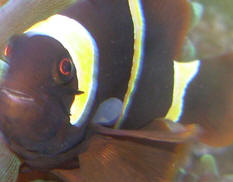
| Maroon Clown with air sac coming out of
gill? 2/2/08 Hi guys! I'm a bit stumped on
this as I have never seen anything like it. I searched all over and
the only info I could find on air bubbles seemed to deal with
puffers. I woke up this morning to find my male Gold Stripe Maroon
clown had what appeared to be an air sac coming out of his gill!
<I see this> I have no idea what it is or what to do so I
came to you guys for help. I have checked all of my water
parameters and nothing seems out of whack. The other fish all seem
fine. He seems to be breathing normally and acting normally, but
didn't want to eat large pieces of flake food. He only ate a
few small pieces. I have attached some pictures. Any ideas? Thanks,
Crystal <Might be a neoplasm... perhaps a zoonoses... In either
case, I would do nothing re at this point. If it is a tumour,
perhaps it will spontaneously remit... if a "worm" et
al., maybe it has a complex life cycle... will degenerate or age,
not be able to complete reproduction w/o intermediates... Thank you
for sharing. Bob Fenner> |
|
|
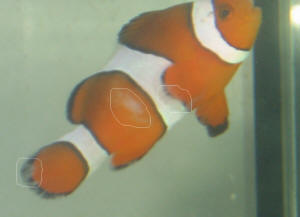
| Help With Diagnosis, clownfish, trauma/stress
2/2/08 Hi there, <Rich> I have a juvenile
ocellaris clown who is not too well. Tank parameters are ammonia,
0, nitrites 0, nitrates 0, gravity 1024, ph 8.4, temp around 26. He
shares a 30 gallon tank with a percula Amphiprion (also juvenile).
They are relatively peaceful together. <Mmm> I noticed one
fin was frayed yesterday and also that tail has some fraying. There
is also a small white mark on one side of the body behind the
pectoral fin and also a small white mark on the head. The percula
shows no signs of ill health and in fact has never looked better.
Although ruling out bullying, I have already moved sick fish to a
hospital tank with same parameters. <Good> I have attached a
couple of photos (apologies for poor quality) I suppose one good
sign is it took a while to capture a picture as the fish is still
moving around a lot and eating and very alert. <Good> I would
appreciate any advice you could give as regards possible illness
and also what I should do:- <How long have you had this fish? I
take it this animal was wild-collected (not tank bred,
reared)....> 1) Freshwater dip 2) Gradual drop in salinity in
hospital tank 3) Cupramin or methylene blue treatment. Not so keen
on these two, if they can be avoided. Does Cupramin affect fish
fertility? Does it contain copper? The name suggests so but it
lists the active ingredient as Formaldehyde. I think that whatever
the problem is it is getting worse, as it started off on one fin,
but now affects both pectoral fins and also tail. Rich <I would
not try any of the above... as the root problem will not be
addressed by such... This fish is "breaking down", being
digested microbially... as a consequence of "stress",
likely bullying from the other Clown... arresting the decline may
be impossible... Please read here re:
http://wetwebmedia.com/clndistrauma.htm and the linked files above.
Bob Fenner> |
|
 .JPG)
|
|
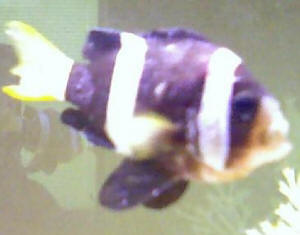
my poor lil clown fish... too little reading --
1/26/08 Ok crew you all are life savers. I chatted with you
bout my lionfish a couple days ago, nothing has changed with my
tank, but yesterday I noticed my black clownfish has a problem
going on here. <I'll say!> I have searched your
clownfish database, and couldn't figure out what is wrong
with him. I am attaching a pic, if you could help me out id be
very appreciative. I just did a water change on Sunday, and my
test kit says everything is fine. Don't want to loose the
little one. Help me please. <... it's likely dead by
now... Looks like Brooklynellosis, but could well be another
protozoan, a combination... You need to READ re... Bob Fenner>
Re: my poor lil clown fish 1/27/08 Hey crew thanks for
the answer on that. Krusty was dead when we got home from her
grandmas funeral on Friday. I read what you wanted me to, and I
am pretty sure that it was Brooklynellosis. <I think so
too> My maroon clown looks like he is got it also. He's in
quarantine right now, and is kind of shaky. I was told to use
KanaPlex, <... no... Ridiculous advice> I have treated the
maroon once, and plan on doing daily water changes as well. How
well will that help? My other question is, can I use that to
treat my main tank, and will the Brooklynellosis affect my lion
and ccs? They both look fine and don't show no signs of it.
Thanks again you are appreciated. <... read:
http://wetwebmedia.com/brooklynellosisart.htm and the linked
files above. BobF>
|
|
|
Possible sick Clown... Please help I have had them for
more than 3 years... -- 1/26/08 I have a 10gallon tank with two
clown fish. <... need more room than this> I have had them for a
little over 3 years. They are the only occupants in the tank. When I
was doing a water change I noticed on the Larger clown, a bump on its
side and when I looked closer, or tried to anyway it seemed like a
scrap at first. I thought maybe he just scraped himself on a rock or
something, <May be> then 2 days later I saw a white threadlike
thing coming from the site. It did not seem like it was ich, I have
seen many cases of that and it did not look familiar. Do you have any
idea what this is and what I should do? <Mmm, better setting> I
just noticed this and have not really had a chance to monitor his
eating pattern but all else seems normal. Please help!! I love these
fish and have grown quite attached in the past 3 years. Kerry <A
photo? Can only roughly guess given what is presented here... Perhaps a
latent parasite, tumour of some sort... the "string", likely
some component of the fish itself... mucus formed as a thread... The
stress of being in such a small, vacillating condition system... likely
has taken its toll here. You have read:
http://wetwebmedia.com/clndisenv.htm and the linked files, particularly
the article, above I take it? Bob Fenner>
| Sick ocellaris picture, no data
1/25/08 I am new to this hobby and was wondering if you may
have an idea of what may> be wrong. The blob is whiter than the
picture shows <... perhaps Lymphocystis... Please read here:
http://wetwebmedia.com/clnfshdisart.htm and the linked files above
where you lead yourself. Bob Fenner> |
|
|
Perc clown worries... Induced problems
1/20/08 Hi! A bit concerned about my false perc clownfish whose
<who's> acting strangely. Read all the FAQs <!> &
much on diseases but still baffled. The 25gallon tanks been running for
2 & half years without many issues. Currently, I only have a yellow
tang, <... needs more room> 1 blenny & a false perc clown, 1
turbo snails & 1 shrimp (& live rock). All water tests (ph,
nitrites, salinity) temp are as should be. <Need data...> I do
regular small water changes (10% or less) & use a ph buffer.
<How? What?> The clown shows no signs of disease or parasites
& looks puzzlingly healthy with no colour loss. He/she's always
has been quite small & not a great feeder but today instead of his
usual swimming around happily, he's lethargic & virtually
stationary at the surface of the water in the far corner of the tank
seemingly having trouble swimming & staying upright, seems to be
swimming sideways alot. <No such word> He doesn't seem to be
finding it hard to breathe but this is hard to tell & he didn't
appear to have any slimy film but I'm especially worried as he
didn't feed at all today. The only time I've seen this before
is when a fish has been over fed. This can't be possible as I'm
only feeding them 2 small cubes or 1 large one a day. <Of?> Do
you know what might be the problem? <Crowding, & water quality
likely> I changed carbon filters 2 days ago <Bingo> & did
all tests & small water change then. Have an issue with green/brown
algae covering my rock over recent couple of months which I don't
know how to solve but don't think this is a factor. <Is
actually... at least a clue as to the lack of balance here...> Have
kept marines for about 8yrs, tend to feed with a mixture of frozen,
live & flake food. Please help, I detest loosing <Or losing?>
a living creature, Thanks for your attention. Bianca x <Please
answer the questions posited here... re water quality tests... You need
to place the Tang elsewhere... learn/practice modifying your water
quality before/in advance of using... Study up re algae control through
natural means... all covered on WWM... Bob Fenner>
|
Urgent question about clownfish... many
errors... time to read, past time 1/14/08 We have
a newly established 10 gallon saltwater tank. Our filtration are
bioballs in the back of the tank. <... please see WWM re their
removal> There is a lid that goes atop the tank with about 3-4
inches of clearance and is open in the back the length of the
lid. There is a fabric atop the bioballs that collects particles
from the runoff. <Needs to be cleaned at least weekly> We
let the tank cycle for almost 2 weeks with cured liverock.
<Did it actually cycle?> During this time we've
monitored our levels and were given the "ok" by our
fish store to get a fish. We introduced a percula clownfish
<Needs more room than this> a few days ago. He did well
(ate and swam well) until that first night our heater seemed to
malfunction and the temperature dropped from 78 to 74. I woke in
the middle of the night to check on him and he was frantically
swimming back and forth bumping into rocks with his nose almost
as if he was disoriented and scared. <Mmm, not from the temp.
drop> I assumed it was because he was cold so I turned on the
light to try and warm the water up. The next morning he had
stopped the crazy swimming and since then has gradually stopped
eating and swimming. We got a new heater and have had to adjust
it a few times ranging from 82 to 78. It's back at 78 now. I
worry the temperature inconsistency started his downward spiral.
He's interested in food but will suck it into his mouth and
spit it out. <...> He'll come and swim around if
we're collecting water from the tank to do testing and
he'll occasionally take a lap around the tank but for the
most part he just hovers off the bottom and swims just enough to
keep from sinking. <What they do> His breathing seems rapid
to me and he doesn't ever shut his mouth like he's
gasping. <Likely parasitized, and this system not really
cycled> He doesn't appear to have any spots or disease on
him although I suspect his color may be fading a little. Our
levels in our tank are as follows: salinity 1.020. <Too
low> I was told by a fish store this was too low and he
advised me to add salt right away. (could the change in salinity
have caused this?) <Define "this"> I added 1/2
cup and it raised the level between 1.020 and 1.025 approx...
<... too much too soon> I read it's best to do it
gradually. Do you think this is still too low? <I think you
should read> Alkalinity is 300 PH is a little low at 7.8
<... this is way low... the pH scale is a base 10 log...>
we were given a white rock substance to place in the tank to
slowly raise the ph but it hasn't risen in 2 days thus far.
Nitrates are at 20 Ammonia is .25 <Toxic...> Nitrites are 0
We're very careful about washing our hands and rinsing items
before they go in the tank. If you can help us figure out
what's wrong I'd be grateful, I hate seeing him suffer.
Thanks. Kimberly <Kimberly... I do wish someone had sold you a
decent book to read, or encouraged you to borrow one from the
library, and read it ahead of the gratuitous errors you've
made, are making... See the above comments I've made?
Investigate them... at least on WWM. Maybe in terms of survey
reading, start here: http://wetwebmedia.com/clownfis.htm and the
linked files above. Bob Fenner>
Part 2 to original clown question
1/14/08 Hi. I wanted to add to my previous question that we
have a orange/brown algae in our tank. Is this a bad algae and
could this be making our clown sick? Is it too soon to do a water
change since our tank has only been up for a couple of weeks?
<... the presence of such algae is indicative of the cycling,
and pollution process (see the prev. email re the bioballs,
mechanical filter media, cycling...> Also...the store we
purchased him from has had him for quite a while (long enough to
give him a name) anyway...he is assumed to have come to us
healthy. He is the only fish in the tank. Thanks. <Read on my
friend, read on. BobF>
Re: False Percula Update... hlth., still not
reading 1/14/08 Hi and thanks for your response.
There is some good news... I got some garlic drops and my fish is
swimming much more than he was and is eating again BUT, I'm
noticing 3 pinhead white spots on his sides that are more visible
when he's facing me or swimming away from me. They're
harder to see direct on. He doesn't appear to have the
"velvet look" to him but he's definitely lost color
and he's still breathing fast. Do you think it's ich?
<Not likely... you should read...> His overall health seems
a lot better than the past couple of days after I did a water
change and the garlic, but I fear for him and want to get him
treated. Do you think copper is best for him or is there
something I could put in my tank that wouldn't hurt my
liverock? <... reading...> My fish store said I can bring
him there to have him quarantined. Would it be too hard on my
fish coming from my low PH of 7.8 and going to a fish store's
proper PH in the same day? <...> I'd like to clean my
tank while he's away and get the conditions better for him.
You recommend removing bioballs from my tank....it's a 10
gallon tank (he's the only fish in it) we have about 10+ lbs
of liverock. Is that enough liverock to sustain the aquarium?
I'd like to start gradually removing the bioballs. Also I
noticed a very small white worm in the bottom of the sand/shells,
about the thickness of a fingernail and about 1/8th of an inch
long. Any idea what this is? Also our diatom algae is slowly
going away so I guess our tank wasn't fully cycled. Gosh I
have a lot to learn. I'm sure you're shaking your head at
me but I really want to save my fish and will do anything to help
him. I'd really appreciate your thoughts. Thanks, Kimberly
<Don't write... read. Your answers and much more ancillary
information are posted... on WWM. RMF>
|
Sick and dead clownfish... No data or
reading 1/9/08 I've had my tank set up for
just a little over a month now <Mmm, how large a system? How
set-up?> and have added two ocellaris clownfish to it. One an adult,
the other a juvenile. <Best to start with all small individuals...
allow one to develop into the alpha/female individual> They were
doing just fine, swimming along, eating, everything was normal. Then
after 8 days they started to just hang out near the bottom by a little
"log tunnel" for about 4 days. They both rarely ate and then
stopped eating all together. I asked a local petstore employee if they
were ok and he said they were probably pairing up. The next thing I
know, 2 days later the juvenile was dead. Now my larger one still wont
eat and 'she' has some loss of color (just slightly faded) and
thin white fecal matter. 'She' keeps swimming in a circle in
the area where she and the smaller one were staying (im only assuming
its a she). I don't know what to do for her. I've tested my
tank time and again and everything is turning up normal. <... what
does this mean? This is a subjective evaluation... we need actual test
data to help you> I make food available to her about 2x a day but
she's not eating. What are the possibilities? Thank you Meg
<Likely your system is at fault here... just not established...
Though these Clowns could be (very common) parasite laden... Please
read here: http://wetwebmedia.com/clnfshdisart.htm and the linked files
above. Bob Fenner>
|
|