|
|
| Home | Marine Aquariums |
Freshwater Aquariums |
Planted Aquariums |
Brackish Systems |
Ponds,
lakes & fountains |
Turtles & Amphibians |
Aquatic Business |
Aquatic Science |
Ask the WWM Crew a Question |
| Please visit our Sponsors | ||||
|
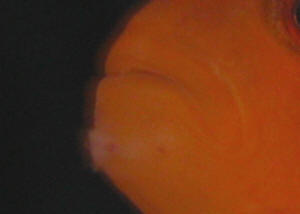
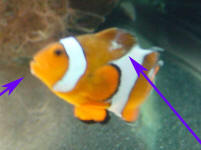
Saddleback Clown Injury 5/4/07 I recently started stocking my newly plumbed 125 gal. tank. One of the first to go in was my saddleback clown. For the first three weeks she seemed happy as a clam, although I did notice some slight cloudiness to her eyes which I attributed to the lighting in the holding tank I had her in previous. That seemed to clear up rather quickly though and three weeks later I deemed it time for her apparent friend (a blue regal tang) to come out of ich rehab. Now it's been two days since the Tang's re-introduction, and now the saddleback has a nice gash in her head (flap of skin and all), <they are called surgeonfish for a reason> a vertical white streak below one of her pectoral fins and a small patch of grey-white on the front tip of her dorsal fin. The marks don't particularly look like ich to me, and I've not seen any scratching against the rocks, but she does dive into the same area of sand somewhat often and has created a nice crater which she seems to enjoy spending most of her time. <Digging is normal for clowns.> I also recently added three emerald crabs, which she tried carrying off the second each one started floating down. Before I write a novel; my question is this: Do these symptoms resemble a disease or infection, or is it more likely that she's just got some scrapes from "horsing around"? <Not horsing around, getting beat up by the tang and it "scalpel".> Any insight would be tremendous. Thank you, Jules <Need to watch this very closely. If the tang's aggression continues the fish will need to be separated. The tang can do serious injury with their tail spines.> <Chris> Clownfish Stressed... 4/26/07 Here's what's going on... <Uh-oh, you sound like one of my Training Officers....am I in trouble?> We have two false Percs one seems fine while the other appears to be hiding. <How long have you had them? Mated pair?> It also looks to have a cut above it's lip with a white spot on it, he/she also has what looks like twine hanging off the under side. <Sounds like an abrasion that may be inflamed...I would not worry just yet, maintain pristine water quality and feed a varied diet.> The eyes look a little larger than normal and the lips look to be a lighter shade of orange. <Sounds like am environmental/ water quality issue.> The fish does seem to be eating a little but not like it use to. I had the water tested and everything was in great shape. <That is good but in the future we prefer specifics...we may see something you do not.> What led up to this is we moved the tank and of course drained off the water about 30% and added new water to the tank from a reliable LFS that we always get our water from. I'm not sure if I poured the water in too fast and stirred things up or what but I just want my clown back. <With such a large/recent move I doubt that the nutrient levels are optimal...and I'm sure the ordeal has the little bugger stressed. Can you move him/her to a quarantine in the meantime while he/she recovers?> One other thought is a couple of days before I found this same fish had jumped from the main part of the tank into the filtration part of the back of the tank. We got him out and everything seemed normal though.... Thanks for your help on this.... <Of course, Adam J.> Clownfish Color Loss question - 4/26/07 Hello there! <Hi there!> I emailed you a few days ago about the odd behaviour occurring between my two clownfish. I found out that they were fighting because of the fact that they are now deciding which one is female and male. However, I have a new issue that has recently occurred. It seems that the male who is hiding from the female has begun to somewhat lose his color. The female is a vibrant orange color while the male is becoming less vibrant, and a little paler. He is still orange and white however he is not nearly as vibrant as my female clownfish. I was wondering if this is a problem or if this totally normal! <Sounds like he may be a bit stressed (and who can blame him!). Other than being a little paler, is he eating okay, swimming and breathing normally? If everything's fine there, I'd just keep an eye on him, offer nutritious foods and keep his water in tip top shape. Let us know if there are any changes.> Thx for all your help guys! You've helped me with a lot of situations!! Much love! <You're very welcome! Take care --Lynn> Re: Clownfish color loss question - 4/27/07 Thank you for replying so quickly! Unfortunately, I lost him tonight. <I'm so sorry.> When I came back home from work, the female was attempting to eat him, as he had already died:(. I was wondering if you could tell me what was wrong with him? He was eating perfectly fine before, he was active whenever the female wasn't chasing him. However, since the female started chasing him, he began to hide constantly, only coming out to feed. He started to lose color, but he never accumulated any white spots, or bumps. <Good> He was breathing fine, although I found that he would breathe a little faster after the female would have stopped chasing him. <Normal> So I was wondering if you could give me a little insight on what happened to him? <Could have been a number of things, but my guess is that it was stress related.> Also I would like some advice on what to do next. <I'd keep an eye on the other fish, continue good husbandry.> I have a female clownfish now, so should I go buy another clownfish for a mate? <You can if you like. Just make sure it's the same species, smaller than the one you have, and quarantine it for the requisite 4 weeks. I'd make sure he's well fed and in good shape before adding him to the tank.> Please help me! Thx for all your help!! <You're very welcome and again, I'm sorry to hear about your fish. -Lynn> Blind Clownfish? - 4/26/07 Hello, <Hi Kathy> A have a 10-gallon tank with 2 clownfish. About 2 weeks ago, my father cleaned the tank completely (walls, rocks, plants, etc.) and bought about 10 snails and crabs <Hermit crabs?> (they all add 10). A few days after the tank was cleaned and the snails and crabs were added, <Too many inhabitants in such a small tank. Ideally, the snails and crabs should have been QT'd as well -- lots of information at WWM on this.> one of my clownfish started acting very weird. He would swim on his side, he spent a lot of time at the bottom of the tank and he seemed to be blind because he does not chase the food any more when I feed him. Now he spends a lot of time in the surface of the tank, and still doesn't chase the food, it seems like he has gone blind, sometimes he swims from the top to the bottom of the tank and he crashes when he touches the bottom. The only way he can eat is when I feed him and he bumps into the food. I give them frozen shrimp. <Need a varied diet. Please see the information at this link: http://www.wetwebmedia.com/nemoproart.htm > What can I do? What could have caused my fish to get blind? <Could be related to water quality, nutrition, infection, any number of things. Do the eyes appear clear, or cloudy, etc? Please read FAQ's available at WWM through Google's search engine. Just type in 'blind clownfish': http://www.wetwebmedia.com/Googlesearch.htm > Could this blindness be a temporary problem? <Could be.> My other fish is good and healthy. Any advice on how to help my blind fish would be greatly appreciated. <What are your water parameters (ammonia, nitrites, nitrates, pH, specific gravity, etc)? The first thing I would do is check those numbers. Ammonia and nitrites should be zero and nitrates shouldn't be over 40ppm. If anything is amiss, then a water change, possibly several, is called for. Unfortunately, a ten gallon tank is really too small for all of these inhabitants. Consider that the rule of thumb is one cubic inch of fish/life to every five gallons of water and you'll start to see what I mean. You also have to factor in the existing rock and substrate. You may only have 8 or so actual gallons of water in there. Small, "nano" tanks can be wonderful, but they can be a big challenge to keep stable. Please read the information at these links: http://www.wetwebmedia.com/clnsysfaqs.htm. http://www.wetwebmedia.com/smmarsys.htm > Thanks Kathy <You're most welcome and I hope your little fishie gets better! -Lynn> Clownfish with Pimples 4/26/07 Hello. <Brian.> I am having a problem with my pair of Percula Clowns. <I'm here to help.> My tank is a 92g reef with about 115 lbs. of LR. I am currently running a octopus skimmer and carbon occasionally. Basically my clowns have a few large white lumps on their bodies. I have had ich in the past and this does not look like any ich I have ever seen. <Sounds like possibly a bacterial infection, perhaps stemming from a physical wound, common with clowns. See WWM re: clown disease.> The white lumps are rather large, about a centimeter or so in size, and there is only 1 or two of them on each clown. They have had this problem for about 1-2 months now. The lumps seem to be well rooted in their skin, and somewhat resemble a large pimple. Whenever the lumps pop (I am not sure they pop, but eventually they will no longer be there) they leave behind a nice torn section of skin. It looks like the fish had a small explosion on their bodies. No other fish are affected by this problem, even my desjardinii is free of spots. I have never even seen a trace of a spot on another fish. The clowns are happy as usual, feeding just as voraciously as usual, and show no signs of fatigue or discoloration. Do you have any idea what could be affecting my clowns? <What are you water parameters? Can you provide a pic by chance? This usually stems from environmental issues, perform a water change, feed a varied diet...and please resend with test results. Read here as well: http://www.wetwebmedia.com/clndisfaqs.htm . (There are many more linked at the top).> I greatly appreciate any help you can provide me. Thanks. <Good luck.> Brian <Adam J.> Re: True Percula Clownfish - Info doesn't go much past this! 4/25/07 That is as many fish as I am going to put in it. LOL The clownfish is now lying on his side. <I'm hoping that this 'lol' is subtle irony and that you actually don't find this situation amusing -- if you do then maybe this hobby isn't for you, I hear taxidermy is on the revival -- 'lol'> He was swimming around like normal now he is on the bottom of the tank lying down. Is that normal? <I would test all levels again, especially ammonia. Hopefully he is just recovering from the earlier stress but it would definitely be worth placing him back in your quarantine tank alone for prospective treatment. Olly>
Sick/Dying Clownfish... Cerianthus!? 4/23/07 Hey guys, I tried to post a question in the forum but for the past 2 months I have not been able to register as a new member (says it's temporarily down) <I have repeatedly sent a note to the "sysop" (Lorenzo) re these notes... will do again here. We/WWM does NOT "run" WWF...> I've searched and searched your archives but am still unsure as to what I should do. I have a 40G SW tank with 30Lbs LR. 3 corals, 1 mushroom and 2 tube anemones. <These last, Cerianthids... are problematical with other species... fishes and invertebrates of many kinds... Please read here: http://wetwebmedia.com/tubeanem.htm and the linked FAQs file above> My water quality is Nitrites 0, Nitrates .15, Ammonia .1. (Have been struggling to get my #'s to 0 ) I do weekly 15% water changes with deionized water. I am currently waiting on my 200G setup. I have 1 Tang, <Not enough room for one here> 1 Fire fish, 1 yellow Goby and 1 clownfish. Truth be told, this is my fourth clownfish. I've bought them all from the same place over the course of a few months. All have died, and I'm waiting on the outcome of this last one. <... small doubt THE reason could/likely is the Cerianthus> The first pair I bought, one died the day after I brought him home. Next one I added had Brooklynella, I tried FW dip and Formalin dip, but he died in the QT tank. Last but not least was my love, Nemo, he was the original and lasted 5 months until a sick anemone fell on him. Now is the last of my clownies. He has been gallantly hanging on for the past 4 days. White spot on his side, no stringing feces like the last one, mouth gaping wide open with labored breathing. Stays in one spot, under a coral. Darts out when fed but will not eat. Since I had trouble with my anemone I did a 50% water change (2 weeks ago) and put the anemone into a QT tank. EVERYTHING else is doing fabulous. My question to you is should I attempt the FW dip? Or help him out of his misery? (bag in freezer) Or just leave him to his agony? <Do you have another tank/system to use for treatment?> Whatever happens, this will have to be my last clowny until I get my new setup. Clowns are my absolute favorite fish and this is just making me heartsick. Any advice (or berating) would be ever so appreciated. Thank you in advance, and thank you for having a site where people can go to for help in this mysterious fishy world. Karley <Mmm... no need (or desire) for mystery here. Do read re the Anemones... they are likely the source of the nitrogenous anomaly as well. Bob Fenner> Re: Sick/Dying Clownfish 4/23/07 Just an update, I couldn't take it anymore so I gave him a FW dip. (same temp, same PH, with a air fizzy stone) He only lasted in there 3 minutes, due to the thrashing about I took him out. The white "thingy" came off of his body and now it looks like a red gouge in his side. His mouth is still open, breathing still laboured. I have formalin but since the last one died after that dip I hesitate to use it unless you think it is what he needs. Thank you! Karley <... no way to tell from here... and you didn't attach/include prev. corr., so I don't know/recall your circumstances... Bob Fenner> Missing Clownfish. - 04/17/07 Hello again, <Hi Sarah, Mich with you again.> My 55 gallon saltwater tank currently houses live rock, a handful of snails, 2 true perc. clown fish and a mandarin goby. Last night around 8 pm my tank was perfectly fine, 3 hours later one of my clowns was missing! <Uh-oh!> I looked around the outside of the tank and I didn't find anything, so I looked around my tank some more but didn't see anything. I woke up this morning and continued to look once the lights came on and again, I'm down to 1 clown and one mandarin and that's all I see. Everything else seems to be normal (water included). The equipment is working properly. I do have covers on my tank, but there is a 2 inch gap along the back because of the equipment, but still, no fish on the ground. <Fish can flip themselves a surprisingly far distance away from the tank.> Now, I know you can't tell me what happened to my fish, but what are some things that could have happened? I don't see it outside my tank at all and I don't see a clown carcass inside my tank at all, so I am really dumbfounded. I don't know if this matters or not, but the clown that is missing was the larger of the two (presumably the female) so could she have hidden to lay eggs or could the mandarin goby have eaten it (doesn't seem likely at all since it really just eats the "bugs" in my tank). Any help or speculation would be greatly appreciated. <All are possibilities, though it would be highly unlikely that the Mandarin would eat the carcass.> Also, I know clowns like to be in pairs, should I get one more clown to make a pair again, or would the size difference become a problem or the fact that they weren't purchased together? <You could get another, though I would get one that is significantly smaller than you remaining fish. You may want to consider picking up a copy of Joyce Wilkerson's book titled "Clownfish". -Mich> Re: Missing Clownfish. 4/19/07 <Hi Sarah, Mich with you again.> Now, a really stupid question, how far could the clown have jumped out of my tank, if that's what happened? <Mmm, would not likely jump very far.> Are we talking inches, feet or yards? <However, after it launched itself, it could have flipped around on the floor and traveled quite a large distance...possibly several of yards, even more if there are any 4 legged critters in your home.> Now if it were hiding to lay eggs or something, which I don't even know if that's what they do, the fish would reappear after 2 days, wouldn't it? <One would think... but stranger things have happened.> My gut is telling me it jumped, unfortunately, but I really can't find it! <Carpet surfing hide and seek? I do hope the clown emerges alive and well in you tank, but the more time that passes the less likely this is to occur. Do you have a sump? Did you check there? If it were me, I would be checking in a large arc around the tank.> Thanks for the tip on the book, I'll have to take a trip to the bookstore this week. <Excellent! -Mich> Clown Sick, Water Quality Issues...
4/11/07 Hello crew! <Hi Stacey.> Our false percula clownfish
has been acting strange for at least two weeks now.
<Uh-oh, let's see if I can help.> We've had her over a
year now. For a few days, she lays on the sand behind the
rocks, and breaths rapidly, and then for a day, she'll start
swimming at the surface. <Have you tested the water? What are the
results?> She hasn't eaten in over 2 weeks, and one day we think
she's taking her last breath, and the next day she's swimming
again. She does have a single white spot on her rear left
side, but we think it's from abrasion. She looks very
thin, but again, I think this is because she hasn't been
eating. We recently started 10% water changes every day, but
that's more for our red slime algae. Do you have any ideas of what
she might have, or how we can help? <Well you mentioned red-slime
algae, Cyanobacteria. This means you have some water quality/nutrient
issues. I would suspect some high nitrate levels at the
least, and perhaps oxygen levels that are too low. I'd
like to see water test results before I advise you any further but a
some extra water changes wouldn't hurt. If you have a
quarantine tank it might not be a bad idea to move the clown
there.> Thanks for your time! <No problem.>
Stacey
Everyone Poops! Uhh, Clownfish hlth. mostly, env. 4/8/07 Hey guys (and gals) Great informative (addictive) site! <Gracias> I'm a newbie just starting a new 55 gal fish only tank, CPR192 sump, Rio1700 return, and am cycling with 2 Percs. <Better by far not to use fish/es during cycling> Were <We're> at week 1 of the cycle. Don't have any measurements yet (haven't gotten my kit yet) <... not smart> but lets <... let's> assume some ammonia, but with the size of the tank and two little fish I assume nothing too bad. Temp=80, sg=1.021. <... your specific gravity... Please read on WWM re> Both my Percs eat a ton and are highly active, but they rarely leave the surface of the tank and have never gone deeper than about 1/2 down. I've read that that's relatively normal so I'm not too concerned, but I've also noticed some stringy poop lately. A pictures worth a thousand words so here's what I'm talking about: _ http://www.youtube.com/watch?v=YYnKoFBHvrs_ ( http://www.youtube.com/watch?v=YYnKoFBHvrs) Cause for concern or no? If this sounds like some sort of parasite Id like to deal with it early while they are still eating. <... it's the environment...> Also, when I add water from evap I'm adding some "Stress Coat" to de-chlorinate which is causing my skimmer to bubble up more water than I'm even putting in which is negating the purpose. Any suggestions here .. <Pre-mix, store... per what is posted on... WWM> I may go RO in the future, but for now I'm gonna have to use tap. Should I turn off the skimmer for a time being after adding the water, can I add say a liter of tap daily without treating, or is there some other product I should use which wont cause the extra bubbling out of the water. Thanx again for the great site!!! Bob <Please use/read it. Bob Fenner> Floaty clownfish 4/4/07 Heyhey, <Whatcha say?> I have a clownfish with a bizarre problem, it seems to eat too voraciously and then spends the rest of the night either struggling to swim downwards or pretending to be dead floating on the surface..... <Mmmm> It has a swollen abdomen and I have seen white stringy faeces a few times, do I have anything to be worried about? <Maybe...> FYI It is in a very healthy 260 litre reef tank. Thanks a bunch will <Is this the end of your missal? Need to know what you're feeding, possibly how... water quality tests, history, make-up of this system, the tankmates... Please read here: http://wetwebmedia.com/clndisfaqs.htm and the linked files above... Maybe this exposure will help you to understand the kinds of information we are looking for. Bob Fenner>
Re: Clown ok? 3/28/07 Bob: <Michael> Thanks again for the reply. <Welcome> I went to college for Mathematics and have minors in Physics and Computer Science. So, your explanations of the copper molecules don't totally escape me. <Ah, good... I try to practice my "simple explanations" on my poor friends, associates... Our field (ornamental aquatics) is absolutely HUGE...> Chemistry was my weak point + it is has been 15 years since I graduated. Your analogy of a stabilizer in a pool brought it home. <Ahh! Great! I actually met the daughter of the gentleman who "invented" this fabulously useful product...> Please make sure I understand what you/your website recommends: Just to clarify, all fish are to be treated per the copper dosage on the medication. I use a test to kit to make sure I'm giving the proper dosage. Putting five small fish in a 10 gallon quarantine tank for 30 days is fine (I just have to keep up with water changes). However, clownfish don't handle the copper well and need to have a smaller dosage of the medication. What dosage do you recommend for the chelated, "CopperSafe" product? <The lower end... as stated on WWM... no less than 0.15 ppm, no more if poss. than 0.20... but again... I suspect this is Amyloodinium... not Crypt., Brooklynella, other protozoan complaint... It would be best treated with the anti-malarial... Next best by successive formalin dips/baths and being moved to novel settings each time afterward... NOT copper> I didn't pick up on that in the links you sent or the e-mail. Unless I can find something else, CopperSafe is what I will have to use. Also, I had previously read your "Coral Reef or Velvet Disease" article. I thought I had printed it but didn't. Thanks for the link and reminder. <Real good> Forgive me if I'm asking a lot of questions or being redundant. I just want to make sure that I'm getting it all right. I work a stressful job for 10-12 hours a day (I'm in sales). I like to spend time with my family when I come home. Lately, I've been spending time with the fish. ;) <No worries... hard at times to prioritize... harder still to find... or one of my faves, "make" time>> I'll think of some suggestions for the web site flow and e-mail you when I get a chance on that separately. Michael <BobF> Fireworm question, source/LS? Clown Dis., Comp. 3/20/07 Hi Crew, <Jennifer> Thanks for all of the help you've given me thus far! I had a question which I couldn't exactly find an answer to in your FAQ's, but I apologize if I'm asking something you've already answered. I recently discovered that I have some kind of fireworm/bristleworm in my fish only tank. I have no live rock so I'm not sure how it got into the tank, unless it came from the live sand. The one(s) that I've seen have been at least an inch and a half long, bright orangey red and very thin. <Easily possible> I'm not sure how long they are because I always only catch a glimpse of them just as they are creeping into an empty shell (which I have around for the hermit crabs) or disappearing into the sand. I haven't been able to identify them exactly beyond the fact that they are polychaetes of some sort. They look a lot like the 4th, 6th and 7th pictures under "errant polychaetes" on this website http://www.petsforum.com/personal/trevor-jones/hitchhikerworms.html (a link I got from your FAQ's). <Mmm, thousands of species... you've likely read re their possible compatibility...> Now to the question. Last week one of my ocellaris clownfish had a white spot on the side of it's face. It didn't look like ich or anything like that, just a bump. Almost like a white pimple. It was behaving normally and eating and everything so I thought I'd leave it for a day or two and see what happens. Two days later it was complete gone and he seems just fine. Today my other clownfish has a similar white spot in the front of it's face, near it's right eye. I read that the "fire" in fireworm comes from the effect the bristles have when dislodged into an unsuspecting victim. Is it possible that the bumps on the fish are a result from an interaction with the fireworm? <Yes> (They like to nose around in the sand to make sure they haven't missed any food after feeding time.) Do the worms pose a danger to my fish? <Can, definitely... Some even to humans> I also have two Nassarius vibex snails who spend most of their days buried in the sand (until feeding time of course). Do the worms pose a threat to them? <Again, a possibility> Should I be worried? Would you recommend trapping them and getting rid of them? <Mmm, no, not necessarily...> If they aren't a threat then having them as detritivores is always good, right? <Likely so> Will they get to a size that I need to be worried about? <Can't tell from here, yet...> Thanks so much in advance! Jen <Best to keep an eye on them... monitor the Clowns' recovery... consider control measures... Posted on WWM. Bob Fenner> Sick Clown 3/20/07 Hi everyone, <Hello> I'm sorry to bother you, but I'm at my wits' end. <No bother, that's what we are here for.> I have a 30 gallon FOWLR tank, 35lbs LR, Ammonia and nitrites are at 0, nitrates are at around 20ppm. SG is 1.023-1.024, pH is never below 8.3, temp is around 78 degrees F. <Good> On Thursday I added a false percula clown without quarantine (I know, my first mistake) He was doing great, eating, getting along great with everyone including my other clown. On Saturday night he stopped eating and looked like he lost all of his color, he was gone by Sunday morning, unfortunately by that point the other clownfish started acting the same way and I lost him that night. Right now in the tank I have 1 flame angel, 1 strawberry Pseudochromis, 1 algae blenny and a cleaner wrasse (I know, I know). When I went to the fish store to ask if they had any suggestions they said he would help). Unfortunately now the Flame angel and Pseudochromis have both stopped eating (which is very different for both, both are usually excellent eaters!) <Never a good sign> and the flame has lost some color around it's mouth. The algae blenny seems unaffected and the wrasse is eating and seems to be fine. My water tests and the tests at 2 fish stores (specializing in salt water) have said my water looks great. I feed 2x/day in the morning they get any variety of frozen food, Mysis (soaked in Selcon) an omnivore formula, squid, krill, etc. At night I offer a good quality flake food. I do a 5g water change weekly. I have a BioWheel filter running and a protein skimmer good for a 60g tank running 24/7. Everyone was fine until I added that clown (I learned my lesson, don't worry) but I can't figure out what the disease/parasite/problem is! If you could shed any light I would greatly appreciate it. Thank you, Barbara <Do you know if this was a wild caught clown? Assuming it was Brooklynellosis, aka Clownfish disease, would be my first guess. This disease is quite treatable but action needs to be taken quickly. Freshwater dips and formalin are the preferred treatments here, and of course QTing the fish. Please see here for more http://www.wetwebmedia.com/brooklynellosisart.htm and here for more on FW dips http://www.wetwebmedia.com/dips_baths.htm .> <Chris> Sick Clown Part II 3/20/07 Thank you very
much for your time. <Sure> The Clownfish was said to be tank
bred. <Uncommon in tank bred clowns, but not unheard
of.> If it is Brooklynellosis I know I need to treat the
Angel, what about the wrasse and the algae blenny? <I would dip them
too, properly done there is no down side.> Also, what should I do
for the main tank? Will it clear up once the fish are treated or do I
need to let it lay fallow, etc before it is back to normal? <Fallow
would be best, besides it will be much easier to see and catch the fish
should they need to be treated again in a QT tank.> Thanks again!
Barbara
|
|

|
Features: |
|
| Featured Sponsors: |