Featured
Sponsor


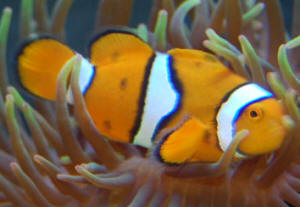
FAQs about the Diseases of Clownfishes 17

Related FAQs: Clownfish Disease 1, Diseases of Clownfishes 2, Diseases of Clownfishes 3, Clownfish Disease 4, Clownfish Disease 5, Clownfish Disease 6, Clownfish Disease 7, Clownfish Disease 8, Clownfish Disease 9, Clownfish Disease 10, Clownfish Disease 11, Clownfish Disease 12, Clownfish Disease 13, Clownfish Disease 14, Clownfish Disease 15, Clownfish Disease 16, Clownfish Disease 18, Clownfish Disease 19, Clownfish Disease 20, & FAQs on Clownfish Disease By: Environmental Stress, Nutrition, Social/Behavioral/Territoriality, Trauma/Mechanical Injury, & Pathogens: Lymphocystis, Infectious Disease (Bacteria, Fungi...), Protozoans: Cryptocaryon/Ich, Amyloodinium/Velvet, Brooklynella (see article below), & Mysteries/Anomalous Losses, Cure, Success Stories, & Clownfishes in General, Clownfish Identification, Clownfish Selection, Clownfish Compatibility, Clownfish Behavior, Clownfish Systems, Clownfish Feeding, Clownfishes and AnemonesBreeding Clowns

Related Articles: Clownfish Disease, Clownfishes, Maroon Clowns, Marine DiseaseBrooklynellosis


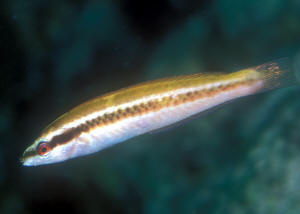
Other, fast moving fishes being present may over-stress your clowns if the system is too small.
Halichoeres pictus (Steindachner 1867), the Rainbow Wrasse.

Desperate Newbies - Sick Clownfish   8/12/08
Hello
<Brenda... my oldest sisters name as well>
I don't know where else to turn and I'm losing faith in my dealer . being brand new at this, we are hoping you can help. My husband and I set up a 14g BioCube to serve as a quarantine tank once our 90g arrives in a few weeks. In the meantime we got the small tank started and my husband was doing full water checks everyday and still is even a month later.
Everything happened as expected - nitrogen cycle, all numbers became perfect as time went on. The tank has aragonite substrate, "tufa" rock
<Mmm, some of this has proven problematical in saltwater aquarium use... I'd pull it... read re on WWM, elsewhere.>
to create places to hide, and that is it. After 2 weeks we added 2 cleaner shrimp and 2 hermit crabs. Three weeks in we added 2 Ocellaris clownfish after drip acclimation over an hour. We searched for tank bred with no luck. Our dealer said we would have a hard time finding captive bred (hmm)
<... No... are you in the United States?>
and that the one's we bought are wild caught. In the first week of having them we noticed the larger one had white stringy feces -
<Mmm, often indicative of lumenal parasites.>
we did a partial water change, kept doing daily water checks, etc. After feeding I would watch them for about 20-25 min. to make sure feces were fine. We only saw the white feces the once and so deduced it was stress related.
<Could be>
They both were eating and behaving well. We have had them almost 2 weeks now and we noticed yesterday that the larger one again had white stringy feces and was somewhat bloated by the anus. She still ate however. We read info from "The Conscientious Aquarist" again and surfed your site, and decided to get Flagyl/Metronidazole as we believed it was parasites.
<This anti-protozoal and either at the same time or sequentially, a vermifuge/anti-worm compound should be used>
We spoke to our dealer who agreed. So, late last night we treated by adding the medication to frozen brine shrimp until it dissolved. She ate well and really perked up.
We thought let's give the medication time to do it's thing, repeat it every other day over this week as directed,
<... Too much... three days maximum is what I prescribe. Flagyl can kill fishes' kidneys with too much exposure>
and see what happens. Unfortunately, this morning we found her lying at the bottom of the tank and she seems to be breathing hard - the bloating is down. We turned on the day lights and she perked up a bit, swimming around the bottom as opposed to laying on the bottom, but still not herself. I tried to feed with pellets and she made an attempt to come to the top but didn't eat anything. We are terribly worried. The numbers last night were Termp-24.5 C, SG 1.024, pH 8.2, Ammonia
0, Nitrate 10, Phosphates 0, Calcium 300, Carbon Hardness 9dkH, Nitrites 0.
We haven't been able to get our hands on a Dissolved Oxygen kit yet as the entire city is sold out (how does that happen in a city of a million people?????).
<Doubtful that DO has anything to do... in a system of this volume, make-up...>
The numbers have been stable for 2 weeks now. My questions:
1. Do any of our numbers seem out of whack?
<No>
2. What might be wrong with her given the symptoms (first stringy white feces, then bloating, then laying at bottom, breathing hard, not eating)
<"Cumulative stress", likely internal parasite faunal activity...>
3. Should we continue with the Metronidazole? Treating the entire system or just in the food?
<The food, three times max., the addn. of a dewormer (Prazi...)>
4. Is there anything else we can do? Did we overlook something?
It's 7:30 in the morning and none of the stores are open for a while, and we don't know what to do next. Help!
Brenda and Jim
<Mmm, perhaps reading will grant you insight, solace... Start here: http://wetwebmedia.com/clnfshdisart.htm
and perused the many linked files above. Bob Fenner>

Clown fish with mouth open    8/8/08
Hi Crew,
<Sara>
I have a problem and was diligently searching the FAQ's when I found what might be the answer and I thought I would ask you to confirm. I know you've heard it a thousand times, but your site is awesome and the help that you provide us is much appreciated. To make a long story short, 3 weeks ago lost my entire livestock (tank was FOWLR) due to a ich outbreak that I didn't manage very well.
The saddest part was losing my mated false Perc's who I had for 4 years. I let the tank sit empty for 2 weeks.
<Mmmm, need to run fallow longer than this...>
My tank is 75g, Salinity is 1.021,
<Too low...>
temp is around 78, ammonia & Nitrite = 0, Nitrate = 0.20 ppm (I change 10g per week, feed once per day, never seem to get this number to 0) I have a Rena XP3 canister filter
<Mmm, not my choice in marine system filtration types>
which I modded to work with BIOwheels, and an AquaC Remora Skimmer (HOT kind). I came across a tank full of juvenile black false Perc's at a LFS that is regarded as one of the better in southern Ontario, Canada.
<A very nice town... for humans, LFS>
I purchased a pair, they are about 1 1/4 inches. I 'dripped' them and added them to my tank (my poor cats had to stay locked up in the bathroom for this procedure :) ) They appeared to be doing great and ate some pellet food the next day. While admiring them swimming about the tank, swimming closer and closer to my skimmer intake I realized it was possible for them to get sucked up into the skimmer (probably both at once they are so small)... so in a panic I unplugged it. The next day one of the two started behaving oddly. When the lights are on, 4 x 65w PC's (2 10k's, 2 actinics) it swims near the surface, sort of hovering, not really doing the clown fish waggle, just sitting there. And his mouth is staying open. He doesn't seem to be breathing overly hard, but it looks funny cause his mouth won't close.
<Mmm, likely genetic... a common defect in some lines of tank-bred clowns. Go back to the store and look at their remaining stock>
Also he is not eating (my biggest concern of course). Then I read in one of the FAQ's where someone else had a clown with his mouth perma open, not eating, that I could be a sign of lack of oxygen... that would make sense in my case as I unplugged the skimmer in fear.
He also seems to do better at night, is this because the amount of oxygen in the tank increases at night (I believe I read that somewhere)?
<Mmm, doubtful. Just less stressful with the light off>
Also I noticed that the only little piece of coral I have, some green polyps, don't seem to be happy either. Does that sound plausible to you.
<Yes... with the skimmer off, water quality will suffer, mal-affecting all>
What would happen if I take a small peace of foam or screen and use an elastic band to attach it to my skimmer intake?
<Need less restriction than this... I'd find/fashion a strainer of sorts... contact AquaC re>
Do you think this would do harm to the skimmer, or decrease its performance?
<Yes>
I do wish while I had my tank all apart that I had added a refugium.
<Ah, great!>
I have been in the hobby for 5 years with pretty much the same setup and it works for me, but every now and again I really wish I had a refugium, this is one of those moments.
Thanks so so much for any advice you can give me.
Sara Machen
<I do hope your new Clowns don't contract the protozoan problem from the previous batch of fishes... Bob Fenner>

Re: Clown fish with mouth open    8/8/08
Thanks Bob, I hope they don't get the ich either. I was told/misinformed by a LFS that it would only take 2 weeks for the parasite to die off with no hosts.
<Mmm, incorrect>
I did turn the skimmer back on last night and also hooked up a new power head.
<Good>
However, the fish doesn't seem to be doing any better today.
<Mmm, no... won't, if this is a heritable characteristic>
I was reading a little more on here, and when I get home I will check to see if maybe there is a tiny isopod in his mouth?
<Oh! Yes, another possibility>
Wondering if I should try a freshwater dip?
<I might>
It is now 4 days since he has eaten. I figure he will die soon from starvation if I can't get him to eat. When I first put him in the tank I am sure his mouth was not deformed, it is something that has occurred since adding him to the tank. I will try to bring my salinity up slowly over the next few weeks with my water changes.
Thanks,
Sara Machen
<Do ask the shop re the source of these fish please... and whether they're in a system mixed with wild-caught clowns. Bob Fenner>

Re: Clown fish with mouth open   8/9/08
Well, I came home and checked very carefully and there is nothing in the mouth of the fish. I soaked some brine and mysis shrimp in Garlic but he still didn't eat. He is not even interested in food, more like a hunger strike than can't eat. I have inspected him carefully and see no sign of Ich, but I will keep a close eye out for it.
<Good>
His swimming pattern does seem much better today.
I spoke to the shop who told me they are tank bred fish and, of course, all the ones in his store are eating and he has suffered no losses. His fish are kept in a huge system that houses many fish including other wild caught fish but there
are no wild clowns in his system right now. He claims to not sell cyanide caught fish, but how do you guarantee this??
<That's a/the bazillion dollar question in our industry... There is no way really... folks can, should do their best, but anyone dealing with more than a handful of specimens of fishes that can/do hail from cyanide-practice areas assuredly receives poisoned specimens periodically>
Thanks
Sara Machen
<Thank you for this update. Again, I would keep offering food, try to be patient. Bob Fenner>

Possibly Sick Clown?  8/7/08
Hello!
<Steph>
I have searched through your site and much as possible, among other sites, and I have found nothing!
<?>
We bought two True Percula Clownfish about two and a half weeks ago.
<Mmm, were these tank-bred or wild-collected?>
We quarantined the little guys, and noticed no problems in their behavior or health. We checked the parameters of the main tank, and added them in. They both still seem to be acting fine, but the larger of the two seems to have a clear circle on her back tail fin where the color is almost completely washed out. I'd say it's 1/3 the size of her little round back fin. I stare at these little suckers for a few hours every night, checking their health and for Brooklynella, and I haven't noticed it until tonight. She still eats, swims, and I haven't noticed any heavy breathing. I looked for all the signs of Brooklynella, and compared them to this, but I haven't found any pictures or descriptions that match.
<... these are on WWM>
There is no peeling at the spot that has lost the color and the tail fin is completely intact. It's strange because the color loss is an immediate change, as if you drew a circle on her
fine and it went from bright orange to translucent beige.
<Have seen this... most all cases are due to "touching" of the fish, the wiping away of body slime... will/should "go away" in a few weeks>
All our parameters (PH, Alkalinity, Nitrates, Ammonia, Nitrites) are all fine, as compared with all the advice on your site and elsewhere, with the exception of the calcium being a bit lower than I like (it is around 340.) The only supplement I add is liquid calcium, and so far it hasn't adversely affected any of the other chemical elements of the tank. Everything has been stable for about two months now.
They are both hanging out with our Torch Coral. They were juveniles when we got them and very small. Could it be that their bodies are adjusting to the stinging from the torch?
<Ah, yes>
I am new at this, but constantly do my research, and this has been a confusing surprise.
Any suggestions?
<Really, just to be patient at this time, perhaps keep reading>
Thank you so much for taking the time and I comb your site daily!
Stephanie
<Here: http://wetwebmedia.com/marine/fishes/SWFishindex2.htm
the last tray... Bob Fenner>

Swollen abdomen...both my false clowns 7/23/09
Hi there...have read everything on your site that I thought was applicable to my quarry...but the picture is still a bit ambiguous.
<Ok>
I noticed about a week ago that one of my clowns (my largest) ab was swollen. My first impression was pregnancy. However, I believe it was the next morning, the ab was back down to normal size. A few days later...both clowns abs were swollen....next day or so, back to normal. Which brings us to. today...I noticed that they are both swollen again. Several things confuse me here. One. if I am dealing with some parasite. are they that coordinated that swelling/bloating occurs at the same time?
<Seems unlikely.>
Two. why would both be swollen, then go back to normal?
<Something effecting them both, what are they being fed?>
Three. have I just never noticed that this is what clowns do before they poop? So...really odd question. as I have never seen either of them poop...do their abs swell before they poop?
<Not really usually.>
Other than this...they are unremarkable. Have had them for almost 2 years.
I have a 30 gal reef tank. Tested water this past weekend. All water qualities are excellent. Salinity 1.021.
Blue tang, Cardinal are both excellent.
<That tang needs a bigger home.>
Thanks in advance for your thoughts.
Mike
<I would guess this is diet related, have you changed what you feed them recently?>
<Chris>

Swollen abdomen...both my false clowns 7/23/08
I am looking to dbl up the size of the tank...unfortunately that has been put on hold for a bit.
<Even then I would still stick with one, double is still pretty small.>
I am feeding them Spirulina brine shrimp/mysis.
<Drop the brine, worthless. Get a high quality pellet like New Life Spectrum, will be better off.>
I am feeding 1/2 block every other day.
<Probably too much for two small fish.>
I have a feeling it should be more than every other day.
<Is fine.>
I am doing so b/c a worker at local saltwater store suggested it to get rid of the Cyano-bacteria. Now that it's gone, should I increase feedings?
<Could, but less per feeding.>
Thanks
mike
<Chris>

Re: Swollen abdomen...both my false clowns 7/23/08
I will check out the food this afternoon.
<Good>
I have been feeding 1/2 block b/c all 4 fish eat the 1/2 block. Will the clowns, tang and cardinal all eat the New Life Spectrum?
<Most likely.>
Thx
mk
<Welcome>
<Chris>

Sick Clownfish 7/6/08
Please help! We have a saltwater tank that has been running over 2 months now and is successful with hermit crabs, turbo snails and cleaner shrimp. We have introduced clownfish and our first 3 have died and it appears our 4th one is going too.
<!?>
We have a 45 gallon tank and all our levels are in spec per our testing kit. The last 2 clownfish that died started by having breathing trouble (rapid/gasping) and the last one developed a black splotch above his left eye which grew bigger and he eventually died. This last fish seemed perfectly healthy and has been doing fine, but started gasping a few days ago and has now developed the same blackish splotch above his left eye. We have been oxygenating the water every week. We don't want to lose any more fish. Can you please help us determine what's wrong with him?
<Mmm, yes... assuredly. This will take a bit of reading on your part. Some going back and forth twixt ourselves... But we can/will solve>
We also have chromis and a watcher goby that seem to be fine. Another clownfish is also in the tank and doesn't seem to exhibit any of these issues, but neither did this sick one, until now.
Thanks,
Diana
<"Something" is amiss here... perhaps chemical (though the invert.s living is testimony in many ways otherwise...), or biological/pathogenic. Are these Clownfish wild-caught? Or, tank bred and reared? Please ask your dealer re... and begin perusing here: http://wetwebmedia.com/marine/fishes/part2.htm
The last tray at the bottom. Bob Fenner>

Re: Sick Clownfish  7/7/08
Thanks for your response. My husband has said that these have been wild-caught Clownfish as per the store.
<A poor choice... as you're learning>
We got them at a reputable dealer called Big Al's here in Toronto. I have attached 2 pictures (the best I could get of the little guy as he tends to stay there and not really move). The splotch is over his left eye and slowly grows bigger. On the last one that had a similar splotch, it grew over the whole left side of his head while he had more and more trouble breathing (bigger gasping/labouring). I have read a lot on your site, but nothing seems to match the issues we are experiencing.
<Au contraire! Likely this is Brooklynellosis and gill flukes... too common...>
It almost appears to be some sort of hemorrhaging. Any additional help you can offer would be greatly appreciated. Losing these little guys is breaking my heart and we can't figure out why!
<Read on. BobF>

Urgent very worried about clowns, need data   6/30/08
Sorry to email you again but I'm desperately worried about my two false Percs. This morning they are shooting round the tank, swimming mostly at the surface and one is pale (they're black/white colour morphs). I tested ammonia etc last night and all came back fine (ammonia and nitrite 0, nitrate <5ppm, dKH 12.5-12.8).
<There is more to water quality, habitat suitability than these for sure>
I've done an emergency water change
<Good>
(they are in a 70l nano with moonlights on for a few hours morning and evening) and have changed approx. 5% of the water, they seem to be a little less stressed but I'm really worried what has caused this and what I must do now to help them.
<Me too>
Any help and advice you can give would be great, I've had these little guys for a few months with no problems and I can't bear to lose them.
Carolyn
<... need to know more re the system, history, maint., other livestock to begin guessing here... Bob Fenner>

Re: urgent very worried about clowns  6/30/08
HI Bob,
<Carolyn>
Many thanks for the reply. The system is a 70l nano running a skimmer (on all the time) and 20x total tank volume circulated every hour. The tank's occupants are the two clowns, a mandarin, one skunk cleaner shrimp and assorted sort corals and Zoas (all frags). The system has been running since new year 2008, first livestock added after 8 weeks cycling (no detectable ammonia or nitrite for 3 weeks prior to adding any livestock).
I do a 5% water change every 4 days making sure the water is temp/pH matched to the tank water before adding, ammonia nitrite and nitrate are measured every 3 days (am aware this is still a young system), calcium and magnesium are checked weekly. The only addition I use is the Salifert all in one and only then when calcium/dKH or magnesium need replenishing. Prior to today the clowns have had T5 lights on from 10am to 8pm, moonlights going on at 8pm-12am, then again 8-10am, however this morning my partner turned them on manually at 5.30am (!) - could this shock have upset them?
<Mmm, a bit... if it was otherwise very dark outside their system>
The only other factor I can think may be involved is that I've noticed an algae bloom on the glass which returns almost as soon as its cleaned away and spots of Cyanobacteria appearing which we haven't seen since the tank cycled.
<This, these can definitely be problematic... toxic>
Not sure if this is the cause or simply a symptom of the problem, however the T5's are due to be replaced so am doing that today.
Sorry for the long message - we're currently in the process of moving house so the clowns will be moved to their new permanent home (a 110 gallon system) in the next couple of weeks but I want to sort this before the move for obvious reasons.
Many many thanks,
Carolyn
<Let's hope all settles in/down. Bob Fenner>

Sick Baby Clown, reading  6/25/08
I brought two baby clowns (false Perculas) three days ago. Each are about 4 weeks to 6 weeks old.
<? Very young>
Unfortunately, when I brought them home and started acclimating them to quarantine I noticed the bigger one had something weird covering its tail. Like some sort of white slime. The tip of the tail was split into little strands. His body is darker than the other clown fish and has a dark spot around the head. As for behavior, he stays pretty much in a corner in the tank near the ground.
<Bad signs>
Never goes away from the ground. He seems as if he was eating from the ground but he is not (at least not to my knowledge.) This makes feeding him a lot harder. What could be wrong with him and what kind of medication can I give him? Any particular foods that baby clowns will eat?
<Live baby brine at this size... Read here: http://wetwebmedia.com/marine/fishes/part2.htm
toward the bottom... Bob Fenner>

White stringy feces. Clown dis., Flagyl use  6/25/08
I got another question for the experts.
<Got? Experts?>
I have a 75 gallon FOWLR with the following livestock: yellow tang, asfur angel,
<Needs MUCH more room than this>
blue flasher wrasse, 2 clownfish, and some snails. The clownfish has recently shown to have white stringy feces.
<Mmm, how long have you had this fish? Was it wild-collected (vs. captive produced)?>
I have tried Prazi-pro but it has not resolved the issue. It is safe to use Metronidazole soaked foods or a product like Jungle's Anti-Parasite Medicated Fish Food in the main tank?
<Mmm, yes... safe enough IMO. Please read re this symptom in Clownfishes, the use of Metronidazole on WWM for further input, cautionary remarks. Bob Fenner>
thanks, L

Black Spots on Clown Diagnosis – 06/02/08
Good Morning/Afternoon/Evening,
<And to you>
I have a False Perc in a 29G All-In-One. Heıs been hanging out for over a year and a half and has had excellent health. He is the only fish inhabitant. He took a liking to the Candy Cane LPS I put in around a year ago and generally sleeps between one of the heads and the rock every night along with just buzzing around the tank most of the day and occasionally, rubbing the CC. He really enjoys swimming in the jet of the powerhead. His diet consists of mysis and Formula-2 flake food. I give him mysis twice a week and Forumla-2 twice a week. I have attached a picture of some black ³dirt² spots that have shown up more recently. I always remember him having some small spots but they seem to have gotten more numerous. I cannot find any exact match of the spots on any search other than it could be ³Black Ich²
<Mmm, no>
but he doesnıt really display any of the symptoms (he has been and continues to be perfectly normal). Should I attempt to follow any treatment for him at this point or continue on unless he starts showing any other symptoms? Other tank inhabitants are various Corallimorphs, GSP, some hermits, a fighting conch (yeah I know but he sure is cool to watch), and various snails, and a sand flea (filter feeder under the sand, very fascinating). 
<Neat!>
Water is changed 20% every 10 days with distilled water and Oceanic sand. I run carbon and Phosban to assist the biological filtration.
I attached a pic but I donıt believe it is of much use. They are very tiny spots.
Thanks
Chris
<I don't think these markings are anything to really worry re... they're very likely melanophores (color cells) showing/expressing from contact with the stony coral. I do want to mention that if it were mine, I'd add another Percula... Bob Fenner>

Re: Black Spots on Clown Diagnosis – 06/02/08
Thank you for answering my question and the format in which you provide
knowledge to everyone. It is a great service for all who want to learn
versus being told. We all have a fiduciary responsibility to all that we
keep.
Chris
<Ah, welcome Chris. We are in agreement. Cheers, BobF>

Growths on clowns   5/4/08
Hey guys,
<Albert>
Long time reader - first time writer. These pages are actually what gave me the confidence to move from freshwater to saltwater. Thank you all so much for what you do.
<Welcome>
Now a little background: 110 gallon display with 120 #s live rock and 1" live sand, 20 gallon sump with EuroReef skimmer, 20 gallon fuge with ~6" live sand. Total flow is around 2000 gallons/hour. 6 40watt NO tubes on the display, 1 60watt CF on fuge with a 12/12 lighting period. I have a half-dozen hermits, about 50 assorted snails and two tank-raised percula clowns in the display. In the fuge is Caulerpa
<Mmm, I'd move this out (freeze, toss it) or at least keep it trimmed down to an absolute minimum>
and another handful of red macro that I grabbed from the LFS without identifying. SG:1.025, PH:8.2, Ammonia, Trites, Trates: 0.
The larger of the two clowns has a growth on its anal fin that it has had since I brought it home from the LFS a month ago (I know, I know - I just missed it). It looks like a very small cluster of 3-4 white bumps. After reading through these pages, my best guess was lymph so I decided to do nothing.
<Is what I would do as well>
Since I brought the fish home, they have been eating like pigs and seem to enjoy their new home. The white cluster has not grown so I thought everything would be OK. About a week ago, I noticed a white pimple on the gill of the other smaller clown. At first I thought it might be the same thing that the larger clown has, but it didn't cluster and just started to grow larger. I decided that I should try to do something. I gave them both a freshwater dip (just temperature adjusted RODI water and baking soda) for about 5 minutes each. They both seemed to deal with the treatment well. I saw no change in the larger clown. The cluster remained.
The pimple on the smaller clown separated from the gill and hung, but I could not get it all the way off. After a day back in the display tank, the pimple on the smaller clown reattached although it was smaller. A day later, I decided to try the same treatment again on the smaller pimpled clown. The same thing happened, the pimple separated but it would not come completely off. I even stuck my hand in the dip dish to try and physically remove it. The fish and the pimple are both so small, I was unsuccessful. The pimple has reattached for a second time.
The fish have gone from completely calm and happy to mildly frantic.
The larger clown is beginning to settle but the smaller one that I dipped twice is racing around the tank. Neither of them are eating as much as before. I seemed to have stressed them out. I feel like I have done more bad than good.
Can you help to identify their conditions and recommend a course of action?
Thanks,
Al Conti
<Not able to determine what the material may be from the description... could be protozoan, other pathogen... But I would try a purposeful cleaner... likely a Lysmata sp. shrimp or two here. Bob Fenner>

Fin problem, Clown, no data of use, "Fix", reading  – 5/3/08
I bought a clown fish recently, actually today is the fourth day we have had him, and he has a large white growth no one of his fins. He also has a smaller white spot on his other fin. I am attaching a picture I don't know if this will help to know what I am talking about. I'm not sure what the growth is and I'm not sure if you can help me diagnose it. I bought Melafix, which is an antibacterial medicine,
<... see WWM re... is a placebo at best>
today and added that to the tank
<An exceedingly poor idea. Learn to/use the search tool on WWM re>
hoping that it might help. Any suggestions would be appreciated. Thank you.
<Read here: http://wetwebmedia.com/clnfshdisart.htm
and the linked files above. Bob Fenner<

Clownfish - possible fungus, Lined Wrasse comp.  5/1/08
Hello!
I have a fairly new 29 gal FOWLR tank (4 weeks). Water parameters are great. I incorporated a small Ocellaris clown initially, then two weeks later a 6 line wrasse. I noticed almost immediately after I got the clownfish some white spots on his fin. Could have been there when I got him but it was hardly noticeable. Originally I thought it was a stress-induced secondary infection, or perhaps that he had been picked on in the LFS tank. Upon closer inspection, the bottom of the fin is feathered and ragged and there are some white, almost fuzzy areas. There has been little change over the past 4 weeks but it definitely isn't going away... maybe getting a tad worse. The fish seems totally healthy otherwise, eats, swims, sleeps normally and is energetic. I wondered if the wrasse was harassing it
<Could well be... in such a small volume... this species can be a terror>
however I have never noticed that type of behavior. I thought of treating with some MelaFix
<Worse than worthless... may well upset the cycling of the system, alter pH... of no medicine value>
but I am afraid of harming my beneficial bacterial.
<You are wise here>
Any suggestions?
<Patience, observation... possibly the removal of the Wrasse. Bob Fenner>
Melissa L. Hetzer

Sick Clownfish: 4-28-08
Hello,
I am in need of some advice.
<Allright.>
I have a 20 gallon fish only tank containing only a pair of clown fish. When I first brought these fish home they behaved normally for about a week. Then the larger one (the female I assume) stopped eating, was breathing rapidly and would occasionally lie on the bottom of the tank. Even though there were no other symptoms I guessed that it was either ich or velvet and I had caught it early.
<Ich or velvet would produce other symptoms like increased mucus or white specks along the body. If these were not present I doubt it was either of the two.>
I did not plan on ever having any coral or other reef creatures so I decided to treat the whole display tank with CopperSafe according to the instructions. After another two weeks went by, the larger clown was doing very well. It stopped the rapid breathing and started eating normally. (The smaller clown always looked and behaved normally, and that never changed) It has been about a month since the start of the copper treatment and the large clown has had a large appetite and is relatively active.
<Have you done any water changes since then? Let me stress that treating in the main display is never recommended. As you subjected the other healthy clown to medication that it did not need. That can cause adverse side effects in the long run. Always medicate in a quarantine tank. >
But three things still bother me. First, when the large clown first became sick, it lost its color. The color never returned to normal. It is pale compared to the smaller clown.
<Pale color can be a lack of nutrition and poor water quality. What kind of foods are you feeding?>
Second, the large fish will still sometimes lie on the bottom of the tank (especially at night), but immediately wakes up when anyone goes near the tank.
<This may be it’s sleeping spot. Are you providing any shelters for it? Ie: rocks, pipes. Also are the male and female sleeping together or separately?>
Third, recently very, very faint spots have appeared on the body of the fish. There are three of these spots and they are faint enough that they can only be seen in the right lighting. I have been watching these spots for about a week now and they have not changed.
<Raised spots? Let me ask this…Do you notice any aggression between the two fish? Were they bought as a mated pair? Perhaps these can be injuries from fighting.>
My question is, should I continue copper treatment until the large fish behaves and looks completely normal? Or is the odd behavior and spots caused by something else like a fungus or bacteria that copper cannot treat? I have been testing the water quality constantly during the whole process. The ammonia/nitrites both have been zero, and the nitrates have been very low <0.5 ppm.
<I would stop the copper as soon as possible and do a good water change on the tank. I think that pristine water and a good nutritional menu will help the clown get back on the right track.>
Another quick question I just thought of. The pair of clownfish will "vibrate" at one another. Is this normal behavior for a clown fish?
<Yes, it is not too abnormal. When this occurs, do you witness any submissiveness from either of the two? Is this a mated pair?>
Thanks for your help.
<Not a problem. –Yunachin>
-Ethan


Sick Clownfish? 04/28/2008
Hello, I am in need of some advice.
<<Hello, Andrew today>>
I have a 20 gallon fish only tank containing only a pair of clown fish. When I first brought these fish home they behaved normally for about a week. Then the larger one (the female I assume) stopped eating, was breathing rapidly and would occasionally lay on the bottom of the tank. Even though there were no other symptoms I guessed that it was either ich or velvet and I had caught it early. I did not plan on ever having any coral or other reef creatures so I decided to treat the whole display tank with CopperSafe according to the instructions.
<<Ok>>
After another two weeks went by, the larger clown was doing very well. It stopped the rapid breathing and started eating normally. (The smaller clown always looked and behaved normally, and that never changed). It has been about a month since the start of the copper treatment and the large clown has had a large appetite and is relatively active. But three things still bother me. First, when the large clown first became sick, it lost its color. The color never returned to normal. It is pale compared to the smaller clown.
<<Should return in time given a staple diet>>
Second, the large fish will still sometimes lay on the bottom of the tank (especially at night), but immediately wakes up when anyone goes near the tank.
<<Quite normal, most clowns will act "odd" sometimes>>
Third, recently very, very faint spots have appeared on the body of the fish. There are three of these spots and they are faint enough that they can only be seen in the right lighting. I have been watching these spots for about a week now and they have not changed. My question is, should I continue copper treatment until the large fish behaves and looks completely normal?
<<Could be either really. try taking a look at the following page including linked articles and FAQ's. http://www.wetwebmedia.com/clnfshdisart.htm >>
Or is the odd behavior and spots caused by something else like a fungus or bacteria that copper can not treat? I have been testing the water quality constantly during the whole process. The ammonia/nitrites both have been zero, and the nitrates have been very low <0.5 ppm.
<<Do please read the above linked article to pin point your clown fish "spots". >>
Another quick question I just thought of. The pair of clownfish will "vibrate" at one another. Is this normal behavior for a clown fish? Thanks for your help. -Ethan
<<Yes, very normal indeed>>
<<Thanks for the questions Ethan, hope this helps. A Nixon>.

Urgently need help - unidentified clown fish problem. Env.   4/7/08
Hi Guys,
<Carolyn>
Really need your help - my 70l (18 gallon) tank has been set up since February 2008 with live rock, and has been fully cycled for 5 weeks. Current readings are ammonia 0ppm, nitrite 0ppm, nitrate 3ppm.Temp is 25-26 Celsius (77-78.8F), SG is 1.024. The tank is a mixed system with a clean up crew (hermits, snails, one skunk cleaner shrimp), zoas, 1x Duncan coral, 1x branching hammer coral,
<... all this disparate Cnidarian life cannot be introduced into such a small volume this quickly...>
1x pussy coral, 1x Sinularia and some mushies.
<...>
Fish-wise, we added our first fish, a Randall's Shrimp Goby 4 weeks ago and he is absolutely fine, is a tad timid (he lives in the live rock and comes out to feed). Addition number 2 was a coral beauty, she's also fine and was added 3 weeks ago.
The readings were monitored daily to ensure all was fine, all readings were 0 (nitrate only gone up this week). We then added two small (about 1") ocellaris clowns, from a different LFS as they were the only ones we could find that were tank bred. They'd been in the shop, in quarantine for 3 weeks, before being put on sale. Both looked fine, but there was a larger clown looking a bit ropey
<Ropey? Am not familiar with this term>
(I know, at that point I should've walked away).
We acclimatised the fish as before, dripping tank water into the bag over 1.5hrs once the water temp had reached that of the tank.
<Mmm, better by far to isolate/quarantine for a few weeks>
Both fish immediately chose the branching hammer coral as "home"!
<Not atypical... and not likely tank-bred...>
They were fine until 3 days later, when we noticed a coating of mucus on both fish but on one side only - mostly on their dorsal fins, which weren't held up as normal, their flanks and some on their faces. One was more badly affected than the other, so I did some reading and researching, coming to the conclusion it could be either Brooklynella or that they were being stung by the coral.
<Much more likely the influence of the latter>
As we had no formalin we did an emergency freshwater bath on both clowns, for 20mins. Both were fine and were clear of mucus for another 3 days, then the mucus was back but worse, one of the clowns looked like its gills might be ragged/inflamed, hard to tell as he was swimming round and seemed to be more agitated than normal. Both were eating fine.
We did a second FW bath, 20mins, however the fish seemed a lot more stressed this time - on returning them to the tank both flopped to the bottom, breathing rapidly and looking very unsteady. After about 30mins the least poorly fish was swimming round (albeit a bit wobbly still), but the second was gasping and not swimming. Another 30mins passed and the first fish was now ok, but the second one was dead.
Having asked yet more questions of LFS's, the web and forums, I'm wondering if this could be velvet?
<Mmm, no>
The remaining clown is in QT again, raised the temp to 27-28 Celsius (80-82.4 F) and dropped SG to 1.019. She's looking better this morning and is easting and swimming fine. Both remaining fish in the main tank look fine, no symptoms at all (although catching the goby would be impossible, am considering a FW bath for the coral beauty as a precaution?).
<... I would not and a Centropyge (bispinosus or otherwise) cannot live/well in such a small volume>
If you think it is velvet, will copper treatment in QT help, or is it enough to use hyposalinity and raised temp?
<... This issue is very likely almost to entirely environmental... the stinging-celled life...>
Next..! We want to add a new clown,
<Mmm, no>
however don't know when's best. One suggestion is to add him to the QT with the other, treat both with copper to eradicate an ich/velvet etc, then do a formalin dip on both immediately prior to adding to the main tank, although this seems very stressful for them? Alternative is to keep fish 1 in QT for 2-3 weeks, treat with copper, then add her back to the display tank (how do you make sure no copper is inadvertently added to the main tank?!), adding fish 2 to QT for 4 weeks before adding that one to the main tank. Am concerned about them fighting as fish 1 would have made a territory. It's still very small (about 1"), so any new addition would most likely be larger. Really don't know what to do for the best?
<Best to just wait at this point... for your present organisms to mature, learn to live with each other for a few to several months>
Any help you can give would be gratefully received - I have learned the hard way about how vital a QT is, even if its only a small one like mine (13 litres!).
Many thanks,
Carolyn
<Please read here: http://wetwebmedia.com/cnidcompppt.htm
re Cnid. comp.... reduction of negative interactions, their effects. Bob Fenner>

Re: Urgently need help - unidentified clown fish problem... env.   4/7/08
Dear Bob,
<Carolyn>
Thanks for the reply and advice - much less-than-accurate info had been given, I shall now be avoiding that LFS in the future.
<Best to vote with ones shoes... walk on that is... Now if we could only do this with the confiscatory practices of our gov't...>
Have taken your advice on board and are <am>
leaving the tank as it stands - the plan is to upgrade in the next 6 months to a much bigger tank (approx 200-300L), using our current one as a QT (hence why I was happy to add a dwarf angel, knowing she'll be going to a much more suitable size tank in the very near future).
<I'd hold off till the new tank is well in-place, established>
Thanks again for the help and the site - intend to spread the word about WWM to friends who also keep fish :)
<Ahhh! A pleasure to share. BobF>

No clowning around (like I'm sure I'm the first to come up with that) 03/30/2008
Hi crew,
<<Hello, Andrew here>
On a serious note. I've been trying to match what my clown is sick with on WWMedia and the rest of the web. And I figure it's Brooklynellosis. The fish cannot stay balanced (fish's nose is down and tail up, he can't stay horizontal) and white stringy feces, which typically lead me to believe bacterial (although could be secondary infection). I have attached 2 pictures. Hopefully they are clear enough.
Water parameters in quarantine (hence the bare bottom tank):
NH4, NO2, NO3 all undetectable, pH 8, salinity 1.024, temp 78F, tested everyday and 10% water change everyday up until antibiotic treatment (read further).
He's been in quarantine for 5 days. Freshwater dip prior to QT for 10 minutes.
Day 2 laboured breathing, never ate, just picked and spat out. Lethargic day 4, day 5 swimming head down (lost balanced), and few hours ago the white speckles (perhaps peeling slim coat, not really sure). Also, I haven't seen any sort of flashing.
I'm not really a fan of organic chemicals (or anything poisonous) for what should be a non-toxic hobby for all (animals and humans). As a geneticist, I am well aware of the hazards and would be fully be protected in my own lab (gloves, fume hood? etc). Contrary to my beliefs, after seeing his condition, I gave him a formalin bath as per WWMedia recipe (1 minute); Along with maracyn2 in quarantine tank. I'm at my wits end and hopefully I haven't caused more damage.
I'm hoping you could positively ID his condition and course of treatment, as I'm sure he's a goner (but I won't give up). I'll at least be able to recognize it again and treat sooner. If he is still alive in the morning I'll be hopeful of a positive outcome.
<<Unfortunately, I really cannot make much out from the attached pictures to make a diagnosis. Either submit in focus photo's or have a read of this page and attached articles and FAQ's http://www.wetwebmedia.com/clnfshdisart.htm >>
Thanks in advance.
<<Thanks for the questions, hope this helps. A Nixon>>

Re: No clowning around (like I'm sure I'm the first to come up with that), Dimilin in dips  – 04/1/08
I had looked at that link (many times), couldn't make any inferences. Unfortunately the clown died the day before yesterday. He had no tail left, think he suffered too long and was beyond return.
<Agreed>
Just before he died I dosed the QT with Jungle Parasite clear (Praziquantel, Dimilin, Metronidazole, Acriflavine). I really wanted just Metronidazole but I couldn't get any at the time and picked up the mentioned out of desperation. Which leads me to my question. In the dip/baths section, Bob is completely against using Dimilin in marine systems.
<Mmm, not efficacious as a dip ingredient>
Why is this so (especially if there are no inverts ie.. QT. I figure its just as bad as Cu++ meds, formalin...etc.)?
<... bad? No... just that acetylcholinesterase inhibitors in low concentration don't do any good in short exposure>
I could have sworn I also saw a post with Bob recommending it for marine (although I can't find it anymore). Could you explain the contradiction (that is if there was, did his opinion change over time?).
<Not w/o ref. to where this is stated, no>
Lastly, I assumed I had a parasitic infection as upon dosing the QT, the clown moved erratically. Presumably because the parasites were affected.
<... what parasites? Do you have microscopic evidence?>
It could have been just from the clown reacting to the meds but something (which I can't articulate...you had to see the clown) seemed the parasites were moving to get away and burrowing in him further.
Thanks
<... BobF>

Re: No clowning around (like I'm sure I'm the first to come up with that) – 04/02/08
I do not have microscopic evidence. It was just an inference on an observation with out proof - merely a feeling (true, not scientific at all).
<I see... do know this sort of guessing is not altogether accurate. There are symptoms that "mimic" pathological disease... with non-infectious/parasitic etiologies... Too often "marks", abrasions, "odd" behavior are rooted in social, environmental, nutritional, genetic... causes>
I just like to know if you would recommend/use Dimilin in marine QT (not dip but in the QT) and under what circumstance? If not, why?
Thanks
<I have used, and suggested such use for arthropod zoonoses... on bony fishes (not cartilaginous). IF one was sure of a copepod infestation let's say, Dimilin might be a good choice. BobF>

Red Spot on Clownfish, using WWM  – 03/18/08
Hello Crew. I will make this fast. I cannot find this anywhere in the faq's. I have two tank raised clowns and the one seems to have a red spot on the side of its mouth. It almost looks like blood. It is raised also. It is about in the area where a white spot once was and has disappeared. My param.s are:
pH = 8.2
Ammonia = 0
Nitrites = 0
Nitrates = 20ppm (just did a water change 30 min.s ago)
<Too high...>
phosphates = 1.0 ppm
<Ditto>
What in the world could this be? Should i be concerned? The fish is still eating by the way. Thanks a million for all of your help
Matt
<Go here: http://wetwebmedia.com/WWMAdminSubWebIndex/question_page.htm
insert your title: "Red Spot on Clownfish"; read the cached views. RMF>

Black patches on clownfish pair  9/20/07
Hi - it's a pleasure to rediscover this site.
<Welcome back>
I have a pair of percula clownfish who have developed black patches during the past year. They show no symptoms of distress. Indeed, for a long time I assumed that this was just a pigment issue (the black areas on the female have gradually expanded over the years).
<Some such marks come and go on Amphiprionines>
Now, after a plumbing problem two weeks ago, emptying the main tank and housing my four fish in three small tanks during reconstruction, I have been looking more closely. I have searched your site and elsewhere on the web but have found nothing specific. One message mentioned black patches but it was not followed up.
Any ideas?
<From your pic, these look like random spots of melanization... I don't think they're pathogenic, nor do I know a means of "treating", eliminating them>
The clowns are now in an AquaPod (24g) with their two Entacmaea quadricolor anemones (one that cloned)
<Yikes... these anemones need much more room than this>
and plenty of tiny worms and brittle stars.
The old system was a 125g with an ecosystem type sump and about 100 pounds of live rock. Ammonia and nitrates have long been undetectable but nitrates were getting high in that tank.
In six years, there was no disease in that tank, which was always underpopulated (five small fish, a couple of soft corals, zoanthids, etc.).
Everybody either came with the rock or was quarantined before going in. The critters that were in the tank at the beginning are all still there, nobody has been added but some snails about three years ago.
Any ideas?
<Could be that the Bubble tips are somehow stressing the Clowns...>
And thanks again for your superb efforts.
Malcolm
<Thank you for your kind words and sharing. Bob Fenner>

Clown fish problem ID - please help. Growth on a Clown 9/20/07
Hello Crew,
<Hi>
I am very new to the hobby - only 7 weeks into it so far. I've been reading the WWM quite a bit in the past week - lots of great information, thank you! Unfortunately I've discovered it a bit too late - several of my purchases/decisions weren't too great :(
<You are not alone here I assure you.>
Tank parameters:
RedSea Max Nano, 34g, 3-3.5" Aragalive Live Sand bed, 31 lb of live rock
Temperature: 80 F
SG: 1.025 (refractometer-measured)
pH - 8.0
Alkalinity - 2.4 Meq/l
Calcium - 440
Ammonia, nitrite, nitrate, phosphate - undetectable
15% water change weekly
<Sounds nice.>
I set it up, let it cycle for about 3 weeks until ammonia/nitrite/nitrate went to 0, added snails (6 Astrea, 6 Trochus, 3 Cerith) and hermits (8 blue-legged). My only loss so far was one Astrea - I found one hermit wearing his shell one day.
<Common end for many snails in captivity.>
About 10 days ago I've purchased my first fish - two clowns (A. Ocellaris, I believe) from the LFS. Not understanding the virtues of the QT at the time, I've added them in right after acclimating.
<Learned this lesson I bet.>
About 5 days later I've noticed whitish spots on both. But time went on (10 days now) and the only change is that spots grew and became larger, my understanding is that the ich would've gone though its cycle by now.
<Yes, doubtful Ich is the culprit here.>
Can you please help ID the problem and recommend treatment? I am attaching pictures - hopefully they're large enough.
<Tough to say, my first guess would be Lymphocystis, check out here and see if you think it fits. http://www.wetwebmedia.com/lymphfaqs.htm .>
Everyone is doing great so far - swimming, eating with gusto and colors seem ok. Water seems fine - I am seeing a wide variety of tiny tube worms - they are open all the way and seem to be enjoying themselves.
<The variety of life in an aquarium is staggering.>
Please help!
Thank you!
<Might want to try a cleaner shrimp here, although often clowns do not actually let the shrimp clean them.>
<Chris>

True Percula question, hlth. mostly   8/23/07
Hi! Thanks for all the great info on your site, It has helped me alot
<No such word>
in my experience with Reefing!
<Ah, good>
Here is my situation, I recently bought a pair of mated true percula clowns. I had initially placed these fish on hold in the LFS due to my leaving town and that I had no room for a QT tank. So they spent a week there in the LFS system (they claim to run a low level of copper to treat ich).
<Mmm, such "low levels" (less than a constant physiological dose... let's say under 0.15 ppm free cupric ion or equivalent) do naught but poison livestock>
So I thought this was a preventative measure.
<Ah, no... only serve/s to weaken hosts... but does keep more fishes alive to sell, pass on their parasites...>
I then came in to pick up the clowns and the male would not eat very well. So they said they would treat them for 5 days with an antibiotic dip.
<? No.>
Treatment over, I watched them both eat like pigs, so I brought them home and now they are happy in my tank....
Here is my question, I have noticed on the male, that a couple of his fins, have streaks of missing color, and this is new. I do occasionally notice the female nipping at the male, but I don't want to miss read an illness and lose a nice pair of clowns. Am I missing something?
<Doesn't seem like it, no>
There are no spots on the clowns, no heavy breathing, eating well. All parameters are within normal limits (pH, temp, ammonia, Nitrite, nitrate, Ca, and Alk). They are in a 20H tank with approx 20 lbs of LR and a 20L sump.
<Wild Percula Clowns need more room than this... and frequently have "residual" health issues as you relate>
Thanks again for all the help!
Seth
<Please re-read here: http://www.wetwebmedia.com/marine/fishes/part2.htm
the bottom of the page... Bob Fenner>

Sick Clownfish?   8/22/07
Hi Crew,
<Annie>
Just a quick but urgent question for you tonight. One of my ocellaris of 6 years developed two white spots: one just behind the first white bar and the other just behind the second white bar. That was two days ago. Today/this morning, the white "spots" weren't there but I noticed that area turned a fuzzy whitish and has migrated over the top/back of the ocellaris as well as toward the middle area. I've gone thru some of your FAQ and it's not ich.
<Agreed... likely equivalent to an "owee" or pimple in humans...>
Please advise as to whether I should remove it to a quarantine tank and treat immediately and with what?
<I would spiff up the system where it is... water change, add carbon, clean the skimmer... and leave the animal where it is>
My tank params as follows: 60 gal, SG 1.025, pH
8.0, temp 76.5 - 78.5 degrees, KH 11.0, Alk. 4.0. I have a skimmer going 27/7. Thank you for your help.
Annie
<Welcome. BobF>

Black Clownfish has "mouth rot"?   8/22/07
I posted this on the forum but can't post the pictures there.
<... on WWF? Unusual>
I have two black clownfish in our 120 gal reef aquarium. Other fish we have are firefish, blue tang, coral beauty, royal Gramma, Mandarin dragonet, a purple filefish (I don't remember what its called.) a bunch of turbo snails, an Anenome (I think its a Sebae) See pictures.
<Mmm, read here: http://www.wetwebmedia.com/marine/inverts/cnidaria/anthozoa/anemones.htm>
We just had our water professionally tested and its all fine. We even tested our calcium levels, which are perfect.
<This subjective evaluation means nothing to me...>
My problem is this: one of my clownfish's lips appear to be rotting off. Its mouth is always open and it can't feed. It pretty much always stays near the Anenome, (which the clownfish just discovered two days ago) The other one seems to be protecting it from the other fish, but we've never seen any other fish attack it. We've had the fish for only two weeks, they are tank raised.
<Mmmm>
I thought that maybe the clownfish are fighting for dominance, because they are very close in size, about 2", but the one seems to be protecting the injured one.
<... I wonder.>
I took some pictures, but I don't know how well they turned out being at the injured fish stays close to the Anenome, which is in the back of the tank. I didn't know how to make them smaller, but they are in jpg format.
Any advice would be appreciated on this matter.
<Please read here: http://www.wetwebmedia.com/clnfshdisart.htm
and the linked files above. Bob Fenner>

Re: Black Clownfish has "mouth rot"?  9/1/07
Thank you for your answer, but I had already read both of those articles prior to asking this question, and neither had an answer to my dilemma.
It's been a few days and although my second clown died (not the one with the mouth rot) the one with the mouth rot has healed and is doing fine. I've come to my own conclusion that because they were both so large and of similar size, they were fighting for dominance (and who would in the end, become female) and the dominant one killed the other one.
<Could be>
We've ordered 4 smaller false Percs to add to the tank. The clownfish is ecstatic in her Anenome and wouldn't remove it for the world.
Thanks again.
<Welcome... In future, I strongly encourage you to avoid wild-collected Amphiprionines... the captive-produced ones are much hardier, and easy-going. Bob Fenner>

Looks like a genetic deformity to RMF.
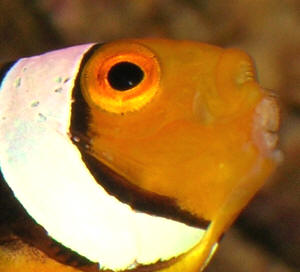
Clown Fish disease URGENT  8/6/07
HI BOB: Thanks again for all your help. I have reviewed all your pages
<Wowzah!>
and want to be sure I am treating my clownfish correctly. I have 2 black clown fish in my 55 gallon tank.
<Wild-collected? Quarantined? Treated how thus far?>
I also have 2 Anthias, 5 snails, 12 hermits, live rock and a live sand bed and several corals. My water is good (ph 8.1, ammonia O, nitrates 0, alk 9.0, phosphates 0). I am running a chiller that keeps the temp stable at around 78 degrees. My clownfish have each developed small (less than 1mm) white patches on the front of their dorsal fin and the underlying tissue seems to disappearing. One of them has also developed a very small white patch on its underbelly. Behaviourally, they seem as energetic as ever and seem to be eating fine. They have had the spots for about one week. It does not look to me like Ich, the white is not in specks and is not all over the fish, just these distinct areas. In addition to your site, I visited the national fish pharmacy site and based on both, was wondering if this could be some type of fin rot?
<?... is a symptom... not a cause... Like your having a "cough"... many probable etiologies>
I have set up a hospital tank following your guidelines and am hoping you could advise me as to treatment? NFP has a product called Fungus Pro I was thinking of using -do you have any other suggestions?
<Yes, but all are posted>
I really like these little guys and I don't want to lose them. Please can you help? Much appreciated...
BTW, my anthias do not seem to be at all infected. Thanks again - Lindsey.
<Please (re) read here: http://wetwebmedia.com/clnfshdisart.htm
and the linked files above and in place where you lead yourself. Bob Fenner>

Clown Fish disease URGENT Part 2  8/6/07
Hi Bob: I have been scanning WWM all day for help with the problem I emailed you about earlier - namely, the fact that I am incapable of identifying what is causing the spotting/rotting on my 2 black clowns. There are many LFS here in Los Angeles (but I would love to have a local recommendation/endorsement, if you have one) so I visited the one that has consistently given me the least inaccurate advice. They advised a combination of Mardel's Coppersafe and Mardel's Maracyn-Two, so I have started on that program. I still need to get a copper test kit, but the store had closed by the time I remembered, so I'll pick one up tomorrow, but I did follow the directions pretty slavishly.
<Good>
My hospital tank is a 12 gallon Eclipse (with the carbon removed from the filter) and the clowns seem fine in there and are active and eating. In the stark light of the empty tank, I can clearly see how their dorsals have been eaten away where the white spots were, and there is another white spot I hadn't noticed previously on one of the fish's side fins. A couple of things I failed to mention in my last post: I feed them twice daily with frozen mysis and some brine shrimp, as well as a product called arcti-pods from Reef Nutrition. Also, before I put the chiller on the tank, there was a period of about one week where the tank temp exceeded 84 degrees. There were no wild fluctuations, because it didn't cool off much at night, but the tank was too hot for the corals so I put a chiller on it.
I didn't quarantine the fish and am always always ALWAYS going to quarantine in future - they had been in the main tank for one month without any problems. So some questions?
- am I on the right track with the Coppersafe/Maracyn?
<Is one of a series of "shotgun" approaches... But a good one... and w/o microscopic exam....>
- how long do I keep them in the QT?
<Not quarantine, but trtmt. now... Depending on what you think you may be treating for, two weeks...>
- the Coppersafe says it is a one time treatment,
<Really?>
but do I add more with water changes?
<Please... see WWM re copper use... http://wetwebmedia.com/curatuse.htm
and the linked files above>
or do I start to take it out of the water with carbon, and, if so, when?
I have read tons and tons of stuff, but it is still confusing to a beginner - and since you have denied me my Mandarin (heh heh) I must be able to hang on to my clowns.
Please help!!!! Thanks so much. BTW -Is there a donation or something I can make? It seems that you give a lot of great advice for free, and if you have a charity or cause I would love to donate in appreciation. Lindsey.
<Our Amazon "begging bowl" is at the bottom of each page. RMF>

Percula Clown with Lip Deterioration, great pix...   8/4/07
My Percula has been experiencing some trouble with his bottom lip. He was the first fish put into a new reef tank two weeks ago. The tank was set up and the live rock cycled before putting him in: Ammonia, Nitrites, Nitrates - all 0. These are currently at the same levels, as well as Specific Gravity - 1.024 and pH 8.1-8.2. When I brought him home from the store I noticed a small white spot on his bottom lip after putting him into the tank, it may have been there before but this was the first time I noticed it. The white spot enlarged over the next few days and then seemed to get smaller over the next week. I thought he was getting better, but yesterday I noticed that it was getting worse again. Now it seems that his bottom lip has deteriorated somewhat. I have attached two photos that were taken today. He only eats live or frozen brine and while seeming to show interest, he is somewhat finicky about it. He did not eat more than about 4 shrimp each day both yesterday and today. He sometimes has stringy feces as well. I have become very attached to this fish and would like to do anything possible to save him.
Thank you for your time and attention,
Mark
<Does look like an expanding erosive area... perhaps bacterially mediated... though it could be the expression of an idiopathic tumour... Please read here re: http://wetwebmedia.com/clnfshdisart.htm
and the linked files above where you lead yourself. I might try applying a poultice of a Furan compound here, or an immersion bath of the same at concentration... If the fish is eating still there are specific recommendations posted... Bob Fenner>

Spitting clownfish... fdg., hlth.   7/31/07
Dear WWM Crew,
<Shannon>
Well, I started my first marine tank about 8 weeks ago, after reading everything on the subject I could lay eyes on. The tank has cycled, with ammonia, nitrites, and nitrate all back down to 0, and my SG at 1.024. I figured I was ready for my first fish. I bought a percula clown fish on 7/14/07. To date, the fish hasn't eaten. I've tried frozen mysis shrimp, live bloodworms, Cyclop-Eeze, and Nori on a clip. I've also tried all of those plus fresh garlic juice, and all of those plus something called Entice. Nada.
<Mmm, not good... Was this a wild-collected specimen?>
When the clown's feces was white and stringy and she still wasn't eating at the end 9 days, I guessed internal parasites based on your FAQs.
<Possibly>
I put her in a QT dosed with General Cure.
<Mmmm, "GENERAL CURE contains 125 mg Metronidazole, 13 mg Copper Sulfate, and 8 mg Trichlorofon." Is VERY general and quite toxic.>
Your FAQ recommends Hex-out,
<Just Metronidazole...>
but I couldn't find that anywhere. After a cycle of the General Cure, no more white poop, but she still won't eat.
<May be off-feed due to the effects of the copper, organophosphate...>
She'll suck up mysis shrimp or Cyclop-Eeze, but she'll immediately spit them back out. She'll chase down the same mysis shrimp over and over trying to eat it, but each time she sucks it up, she spits it out immediately after. Help! It's got to be a terribly bad sign if my first fish dies. What do I do? Does she need dentures? Pureed shrimp? A straw? Any ideas would be greatly appreciated!
Thanks!
Shannon
<Mmm, the easiest, most likely chance for improvement here overall is to suggest you get, place a piece/quantity of cured live rock... to improve water quality, add ready food items. Do please read here: http://wetwebmedia.com/clnfshdisart.htm
And the linked files above. Bob Fenner>

Nano Tank. On The Watch for Illness...  – 07/03/07
Hello again,
<Hi there! Scott F. with you today!>
Here's an update..... I went away this past weekend, and during that time there was a power loss, and my fish went w/o filter, heater, skimmer, power head for about 4-5 hours time.
<Why is it that these disasters only occur when we aren't home?>
I'd say the tank went down to about 74 degrees. Obviously this is stressful... Luckily, my friend was there to assist my fish, and fixed the electrical problem.
<Can't put a price on friends, huh?>
That was Saturday. On Monday morning, I came back and fixed the skimmer (the friend who was still in town is only familiar w/ freshwater)...
My question is this. All my fish and inverts are fine, healthy, and eating great except for one of my clowns. He swims toward the top of the tank,
almost on his side. Breathing and fin movement seem normal. (Except that he's on his side, almost) (I've been watching him closely)... From time to time, it almost looks like he's trying to eat something on the surface but can't really do it. His buddy sticks closely by him and doesn't bother him
at all. He typically stays in one exact location for a few hours, then slowly moves to another location. I know he's a new fish, relatively speaking.
I have been reading and can't really find the symptoms out.
If I saw white feces, (I'm not sure this was the case) In any event, it seems as if it was white, there may be a bacterial infection, correct?
<Not always. If the fish is not eating, there are lots of possibilities. I'd keep sharp and for anything resembling a symptom of a stress-related illness (parasitic or otherwise. Otherwise, I'd keep trying to get the fish to eat. Monitor water quality, etc. to assure that no additional stressors arise.>
If it turns out there was no white feces, what should I do? Thank you again for time and help!
Eric
<Man...if you would have asked me 10 years ago if I was gonna be writing about fish poop in front of 10,000 people a day, I would have thought you were nuts...Guess it's just all in a day's work here at WWM! Shows how much life changes, huh?? Seriously, I would not be overly concerned...yet. I'm more concerned with getting the fish to eat again. Stay on top of things, and be prepared to take actions if necessary. Feel free to let me know if you have any more questions! Regards, Scott F.>

Re: On The Watch For Illness- Part 2  – 07/03/07
I definitely didn't suspect such a quick response, but thanks!
<Glad to help!>
And I was thinking the same thing, why do these things happen when I'm gone?
<Someone's idea of a joke against us fish nerds!>
And yes, friends are extremely helpful.
After writing last night I watched my fish more extensively, did some more research, and found that he is now breathing rapidly (I read on the site that more than 60 times per minute is rapid... well, it's definitely more
than that. More than 1 breath per second. I'd say about 1.5 er so, not quite 2... but it's sort of hard to gauge.
<Hmmm...>
Also, his fins are somewhat slower in movement than the other clown. I read over the clown fish disease section and he isn't showing any signs or anything from the other possible diseases/stresses. The one good (great) sign is that when I fed the rest of the fish some Mysis shrimp last night, he (momentarily) came back and started to swim a bit faster and eat, (90% sure he was actually eating, not just biting and spitting out) only to retreat to the top of the tank when done, and show the same symptoms.
So, my question is this: does this change your recommendations?
Thanks again,
Eric
<Well, Eric, the continuous rapid breathing is a cause for concern, and can point to several possible problems, ranging from environmental (ie; metabolic poisoning, etc.) to parasitic diseases, such as Amyloodinium, Brooklynella, etc. If the other fishes are not affected, and assuming you're getting no detectible ammonia or nitrite in your water tests, I'd be inclined to rule out an environmental issue for now. Even though the fish may not be demonstrating the other "classic" symptoms of he aforementioned parasitic diseases, I would consider them a serious possibility. Usually, thick, whitish mucous and the fish "gaping" are signs of Brooklynella...It's more common in wild-caught Clownfish these days, but still a possibility. Amyloodinium ("Velvet"), has similar symptoms in terms of loss of appetite, lethargic behavior, and rapid respiration. Eventually, very fine spots may show on the fish (although sometimes not) as the protozoa that cause the disease feed by liquefying parts of the fish (I know, sounds gross- it is)
.Often, the first stop for these despicable protozoa is the fish's gills, which can account for the rapid respiration. You will eventually see "blemishes" on the fish's skin, and it may "scratch" itself on objects in the aquarium in an effort to remove the irritant. Many times, however, this disease can kill fishes before these other outward signs manifest. Rapid intervention is necessary. One good thing is that your fish is still eating. I would remove this fish to a separate aquarium with water from the display for further observation and possible treatment. If these symptoms do not subside fairly quickly (like within hours), I'd operate under the assumption that you may be dealing with Amyloodinium. Note that I did say "assumption"...you need to verify this to the best of your ability with the resources here on WWM and elsewhere. It's a very deadly disease, so once you're convinced that you're dealing with it, action is necessary. You can start with freshwater dips for 3-5 minutes duration, which may or may not be effective, but could cause some of the trophonts (if present on the fish) to drop off in a response to some osmotic shock. Next, a course of treatment with copper sulphate (a brand such as Copper Safe is good) should be undertaken. Copper can be harsh, but it works for me. Follow the manufacturer's recommendation to the letter when using this, or any medication, never treat in the display aquarium, and test for copper to assure that you are achieving a proper therapeutic dose. Copper is not everyone's favorite (some prefer Formalin-based products), but it has worked for me in the past and I would use it again. There is always some risk in treating a fish when you're not 100% certain what the disease is, and it's tough to diagnose a fish without being there to see with one's own eyes, so I'm giving you my best guess based on what I hear so far. You have to confirm this for yourself, and sometimes a bit of a guess is necessary. You need to prepare yourself for the possibility that you might lose the fish. However, if you intervene rapidly, and are correct in your "diagnosis", this disease can be defeated. Unfortunately, because this disease is parasitic in nature, there is the possibility that it is in your display tank, and may affect other fishes in there. Observe the fishes in the display aquarium carefully and prepare to take further action, if necessary. Good luck! Regards, Scott F.>

Clownfish ? Lumenal parasite?  - 06/27/07
Hello,
<Hi there!>
We have a salt water tank that was given to us. It included one clownfish and one blue damsel. We do weekly water changes and test the water. The tank has been doing very well. It has been here for several months. We are new to aquariums.
A few weeks ago we added a second clownfish. The second clownfish didn't eat much which we attributed to the change. But then it started to have a long white string hanging from its backend and stopped eating all together.
It also sits on the bottom in the back hiding behind a rock.
<The long white fecal material could mean nothing...>
I did research your site, excellent site by the way, and it seems a lumen parasite is the most probable.
<Possible>
On the advice of a pet store we were already treating with Clout (hydroxyethyl & nitromidazole) for 4 days. We did 1 tab/1 liter of water for 20 minutes and then 1 tab/1 gal of water for 2 days and then a 50% water change and repeated the process for a total of 4 days.
(In a quarantine tank) No change.
<Mmmm>
A week later we notice our original clownfish doing the same thing. It starts with a change in breathing then no eating and the white string. The breathing is the mouth opens and closes all the time.
<Well... I would try a one-time use of Flagyl/Metronidazole... and a follow-up treatment regimen with an anthelminthic... Likely Prazi/quantel... See WWM re dosages, protocol>
A week after our original clownfish started the blue damsel started with the
change in breathing and not eating. No white string yet.
It seems that the second clown fish had this and passed it on to the others.
What is it and how do we treat it?
<Perhaps a protozoan... could be a worm of some sort...>
We have separated both clownfish. Is it also contagious to star fish, etc.?
<Could be>
We have several polyps, feather dusters, etc. in the tank as well.
Thank you for your help,
Gwen
<These will not be parasitized, nor likely mal-affected by the proscribed compounds. Bob Fenner>

hey!! A tutorial on writing to WWM 6/14/07
Hey again WWM guys!
<Greetings, Ahmad. >
i <I> waked <Woke> up today i <I> found my smaller clown is dead !!!!!
yesterday <Yesterday> i <I> changed the filter because it was making some sounds! cuz <...> it was closing it's upper and lower fins and when i <I> swich <Switch> the filter off it releases them!
<And you think the sound was the cause of the apparent discomfort?>
my <My> new filter doesn't make turbans <Turbulence?> in water that much!
plus <Plus> there is another thing<:> it was not eating that much but i <I> used to her <hear> it
pooing "am feeing them blood worms"
<Not sure what you mean, bud.>
i <I> don't know what is the problem my water conditions are ok!!
thanks again!! :(
<I'm sorry I can't more helpful here, friend. I don't make a lot of sense of your email, to be honest. You may notice that there are a lot of inserts in angle brackets (<>) in your message. These are all of the corrections you would have me/us do here at WWM before replying to you. We can't have it this way, sorry. Look over your email before sending, and reflect: "Is this what I want to say? Is this how I want to say it? Can someone make sense of this?". Please consider this and by all means reply and I'll be more than happy to lend a hand. No offense is intended, but our minimal requirement for our help/support is that you respect our time and "pay" us in proper grammar, punctuation, spelling etc.>
By Ahmad Zein
<-GrahamT>
<<Graham... not to make allowances out of hand... but this fellow may well be a non-native speaker/writer of English... I often remind myself that my responses in turn would not be too spiffy if I tried to write back in other folks native script... RMF>>

My clown is dead :'( NO useful info.  – 06/15/07
Hey again WWM guys!
I woke up today I found my smaller clown is dead !!!!!
Yesterday I changed the filter because it was making some sounds! Because it was closing it's upper and lower fins and when I switch the filter off it releases them!
My new filter doesn't make turbulence in water that much!
Plus it was not eating that much but I used to see it pooing "am feeding them blood worms"
I don't know what is the problem, I tested my water conditions and the are OK !!
thanks again!! :(
--
By Ahmad Zein
<... No water quality test results? No mention of system, maintenance, feeding, tankmates... Please read here: http://www.wetwebmedia.com/clnfshdisart.htm
and the linked files at top. RMF>

Sick Clown 6/12/07
My tank as just finished cycling a couple of days ago and I decided to purchase some livestock. I purchased a ocellaris clown, star polyp, some snails and hermits. After one day I lost a hermit followed by another that night, others are doing fine. <Might be an acclimation problem here. Also, no QT tank?> Coral is doing well also. My big concern is that my clown started acting really strange after my water change. He had a white stringy substance trailing him ( came off , maybe parasite or feces ) and he has been at the top of the tank alot. <Could be nothing, but need to monitor closely.> He also seems to be having fun swimming into the powerhead current and getting pushed around the tank. <Normal> I don't now what normal breathing is, but it seems awful fast to me. All of my water parameters are in the safe ranges. <Numbers please, safe range is too subjective.> Do I need to worry and is he just lonely cause he has no one to play with? <Not lonely, but may be harboring something, hard too say. QTing a fish is important for just this reason, allows you to monitor and treat if necessary much more easily.> He is still swimming upright.
Thank you
Tim
<I would not do anything yet other than observe closely, look for signs of parasitic infection which can be common in clowns. Please check out or marine disease section for more. http://www.wetwebmedia.com/mardisindex.htm .>

Clowns Dying 6/1/07
Hi
<Hello>
I keep losing my clown fish and I don't know why. The first pair I brought after my tank had cycled for 5 weeks, and I had the water tested and all was fine. One of the pair was not right from the moment it went into the tank and I fort he recovered, but then it died after 3 days. <Need to QT new fish, now if their death was caused by some pathogen it is in the main tank.> The second one lasted 2 weeks and then was fine in the morning then by the afternoon just died. I went to a different shop a week later and had the water checked a second time and every think again was fine, so I brought two more clowns. <"Fine" is not really specific enough to help, actual test numbers are much more helpful.> They seemed perfectly fine much more healthy than the other two and were fine for almost a week. But last night one just started to act funny, it was lying around the thermometer and then swimming away and doing it over again and lying for a while. I looked for advice on your website and I fort it was just resting playing or whatever, but then it hid in a hole in the rock it never uses and I fort it had just found a new hiding place. Then it seemed to be back to its self I went to bed, woke up turned the light on and it was dead in the corner. The other clown seems fine just sort of alone. It was eating fine and everything before it died and I don't know what's wrong with them. I'm now thinking its something I'm doing wrong rather than the fish. My tank is 25 gallons it has a internal lee's protein skimmer <dubious reputation>, a coral sand (more like gravel) base around 2inchs deep, 3 pieces of ocean rock, 2 pieces of live rock, a external filter , heater , 2 high power t5 compact lighting bulbs 36w each in a over hanging housing. I've had the water tested and its fine so I don't know what I'm doing wrong. I hope you can help as I don't want to buy any more fish until I know what's wrong
Thanks Toby
<Unfortunately there is not much to go on here. The problem could be either environmental or pathological in nature. In this situation I would let the tank run fallow (no fish) for at least 6 weeks to hopefully rule out most parasites and making sure your water parameters are Ammonia 0, Nitrite 0, and nitrate >20. pH should be 8.3 and the SG at 1.025. Also please read through the marine disease section and see if any of the diseases match what you saw. http://www.wetwebmedia.com/mardisindex.htm .>
<Chris>

Clown Fish Health, Post-Traumatic Water Chem. Issue  – 05/08/07
Please help me WWM Crew,
<Yes sir…I’m going to try.>
After a recently added a Sally Lightfoot Crab To my 29 gal tank with my 2 Amphiprion Ocellaris.
<Careful with the crab. Some folks have good experiences….others, like myself, did not. Can become quite predatory.>
The wife gave the crab a cooked shrimp while I was at work.
<Uh-oh.>
She removed it after a while but she missed part of the shrimp that he had ripped off. This lead to a nitrate spike that got to 160ppm.
<To say that’s bad would be an understatement.>
After 2; 5 gal water changes and a dose of  Seachem prime. The water level went back down to 20 ppm nitrate 0 nitrites and the gravity is  1.022.
<Nitrates till need to come down to about >10 and S.G. needs to come up as well to be acceptable to your inverts…but much better than it was before obviously.>
( it has been holding this for 48 hrs) My crab and one of my clown seem to have made it threw the mishap just fine.
<Good. Keep up on the water changes and run some carbon as well.>
The other clown is losing color and hanging around the filter outlet.
<Lingering effects from the toxic state the tank was in.>
He is still eating and at times swims like his normal self but most of the time he hangs around.
<A good sign that he is eating though. At this point I would just continue to care in a normal manor and offer a variety of foods. Keep the tank aerated well and ensure the water chemistry remains stable (i.e. have a conversation with your wife and do more eater changes.>
Also when we 1st got him he a red sore that went away with in two days this sore has since reemerged.
<Sounds like environmental induced trauma, follow the advice above for mow. If it makes you feel better you could move him into QT for more detailed attention/care.>
I called the LFS and was given the advise that since I got the water under control to just do frequent water changes and watch for any changes.
<Am in agreement with the LFS for once.>
Thank you for your help.
<Anytime my friend.>
Rob
<Adam J.>


Featured Sponsors:
Google
 
Web www.WetWebMedia.com

Amazon Honor System Click Here to Pay Learn More