|
FAQs about the Diseases of
Clownfishes
22
Related FAQs: Clownfish Disease 1, Diseases of Clownfishes 2, Diseases of Clownfishes 3, Clownfish Disease 4, Clownfish Disease 5, Clownfish Disease 6, Clownfish Disease 7, Clownfish Disease 8, Clownfish Disease 9, Clownfish Disease 10, Clownfish Disease 11, Clownfish Disease 12, Clownfish Disease 13, Clownfish Disease 14, Clownfish Disease 15, Clownfish Disease 16, Clownfish Disease 17, Clownfish Disease 18, Clownfish Disease 19, Clownfish Disease 20, Clownfish Disease 21, Clownfish Disease 23,
Clownfish Disease 24,
Clownfish Disease 25,
Clownfish Disease 26,
Clownfish Disease 27,
& FAQs on
Clownfish Disease By: Environmental
Stress, Nutrition, Social/Behavioral/Territoriality, Trauma/Mechanical Injury, & Pathogens:
Lymphocystis, Infectious Disease (Bacteria, Fungi...),
Protozoans: Cryptocaryon/Ich,
Amyloodinium/Velvet, Brooklynella (see article below), &
Mysteries/Anomalous Losses, Cure, Success Stories, & Clownfishes in General, Clownfish Identification, Clownfish Selection, Clownfish Compatibility, Clownfish Behavior, Clownfish Systems, Clownfish Feeding, Clownfishes and Anemones,
Breeding
Clowns,
Related Articles: Clownfish Disease, Clownfishes, Maroon
Clowns, Marine Disease, Brooklynellosis,
|
|
Help With ill Clowns?
Lack of data, Reading 1/29/10
Hi I'm new to the marine aquarium game at present in our River Reef
94 litre we have 2 black and White clowns (been in the tank 2 months)
and have just introduced 4 blue green Chromis,
<These really need more room than this>
we also have hermits, cleaner shrimps and turbo snails. At present the
clowns seem to be showing fin rot symptoms
lethargic ragged fins and not feeding.
<Very bad>
Within the last 24 hrs we have had filter trouble a blockage causing
dirty water ingress after cleaning of the filter and a water change the
Chromis are still showing regular behaviour but the Clowns have started
to show the symptoms listed above one other symptom shown by the larger
clown is the loss of colour under blue light which re-appears when the
white light is turned back on is this a common occurrence?
<? Don't know what you're referring to here. Some colour
change occurs initially when going from light/dark and vice versa, and
fishes do appear differently under different lighting>
Any help and guidance you could offer would be greatly appreciated I do
have a zoology degree and background in biology so please be as in
depth as possible.
Tim Harris
<Mmmm, need more data than you've provided... mostly re water
quality tests. Please read here:
http://wetwebmedia.com/clnfshdisart.htm
Mostly the linked files above under Disease Identification... for input
re what we're looking for. Bob Fenner>
|
Clownfish has grey spots 1/25/2009
Hi guys,
<Donald>
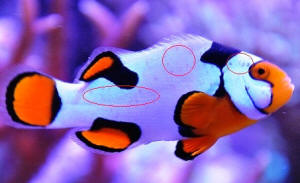
Recently my clownfish has started having grey spots on her body.
Attached is a picture.
<I see>
Other than the spots, she seems fine. She has been eating
voraciously and swimming about. No labored breathing or change in
behavior.
The other clownfish I have doesn't have the grey spots
either. It seems that she only has these grey flecks on the white
portion of her body.
What is it? I don't believe its Brooklynella, correct?
<Could be a few things, but not Brooklynella no>
My parameters:
ph: 8.5
sg: 1.025
nitrite: 0
nitrate: 0
ammonia: very close to 0
<Most likely some aspect of water quality... like NH3... or
mal-interaction with a Cnidarian...>
I also did a 5g water change yesterday on the tank (34g).
Any insight would be very helpful.
Thank you,
Donald
<Read here: http://wetwebmedia.com/clndisenv.htm
and the linked files above. Bob Fenner>
Query pertaining to "grey spot" on clownfish
<id>, Bob's input 1/26/10
Hey Bob, and crew, hope everything is well with everyone! I must
first start by saying, as usual, a BIG thank you goes to everyone
here for making the marine hobby attractive and not rocket
science!! My question is simple, in the dailies yesterday {1/25},
there was a pic of a clownfish with apparent grey spots, tis the
neatest clownfish I've seen in a while.
Was this a "Picasso/true Picasso" clown?
<Yes; tis labeled so>
I couldn't find a real good match but the ORA sight had a few
resembling the one from the query. I know that no two Picassos
are marked the same but couldn't tell enough either way. Bob,
thank you for any input you can provide. I might want to
"repick" the type of clownfish I go with to whatever
this was. Hope everyone has a great day.
Jeremiah
<And thou. BobF>
|
 |
|
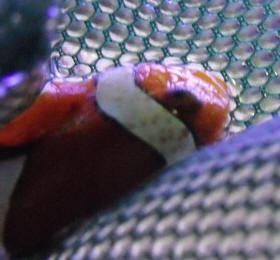
Red Spots on Clown Fish -- 01/17/10
Hi, I have been trying to research for about 2 hours now but
can't seem to find anything that looks quite like the spots I
see. I am house-sitting for a friend and noticed red spots on the
head of the two clown fish. I have attached a picture. Do you
have any idea what it might be?
Thanks!
<Looks to be "stung"... but by what? Are there new
stinging-celled life (corals, anemones) present? If the fish
behaves "normally" otherwise, I would not be overly
alarmed; would place it back in the main/display tank.
Bob Fenner>
|
 |
Bloated Clownfish 12/18/09
Hello!
<Hi there>
I hope this e-mail finds you well. Today I woke up to find my Ocellaris
Clownfish with a swollen belly and swimming (really more like hanging
out in one spot) at the top of the tank. I noticed yesterday that he
ate a large amount of frozen Mysis shrimp
<Completely defrosted I hope/trust>
when I fed, but that usually isn't a problem. Could this be the
cause of the bloat?
<Mmm, yes>
Tank parameters are normal - 8.2 pH, 1.023
<A bit low. See WWM re>
salinity, 0 nitrates, 80 degrees F... I just added a Coral Beauty Angel
and Royal Gramma yesterday, but they had been quarantined at my LFS for
several weeks and showed no signs of disease. I also have a Blue Star
Leopard Wrasse, a second Ocellaris Clown, Mandarin Goby, Skunk Cleaner
Shrimp, Harlequin Shrimp, Sally Lightfoot, and a handful of snails and
blue-leg hermits in my 38 gallon tank.
<Too small for the Centropyge, Macropharyngodon...>
Thanks in advance for your assistance.
Ashley
<Read here: http://wetwebmedia.com/marine/fishes/FishInd2.htm
the last/bottom tray. Bob Fenner>
Help w/ clownfish; mouth open. Some input on
helping oneself /WWM 11/26/09
Hi there!
<Yo!>
I'm a new saltie. My 38 gallon tank is now in it's 8th week and
the water parameters are in great condition (I do my own testing but
the water has been almost perfect for the past 3-4 weeks, just to make
sure, I brought some water sample to a local fish store on Sunday and
they confirmed my findings: ph-8.4, ammonia - 0, nitrite - 0 and
nitrate-0).
<So far, so good>
So, I've had two ocellaris since the 2nd week of starting up,
<?! Was this system thoroughly cycled by then?>
which I've named "Oce" and "Ris". Oce passed
two weeks ago. Along with Ris now are: a small diamond goby, a
lawnmower blenny,
<Mmm, I would have waited a bit longer on stocking such>
two small green chromis,
<Is a more social species...>
one small PJ (spotted) cardinal,
<Also social, live in groups>
one skunk (cleaner) shrimp - about 2 inches - the largest in the tank,
2 emerald crabs,
<Do keep your eyes on these... Mithraculus become eater uppers
rather than cleaner uppers in time>
10 turbo snails, 2 Nassarius snails, 2 margarita snails and 3 hermit
crabs.
Last week, I treated Ris from Ich using "Super Ick Cure" (API
brand)
<The liquid form I take it:
http://cms.marsfishcare.com/files/msds/super_ick_liq_112807.pdf
a bit harsh, not my even third choice for treating
Cryptocaryon...>
and it seemed to have worked.
<... your system is still infested, you know?>
I did about 25% water change just yesterday, the first water change
since the treatment. Last Thursday, I bought a Percula Ocellaris,
smaller than my current clownfish.
<... you placed this new fish in the infested system...>
I noticed that Ris has been constantly very aggressive towards the new
clownfish (always darting behind it; the most action I've seen from
Ris since I got it) and the new clownfish seemed to handle itself and
would dart away pretty quickly. Sunday afternoon, I noticed that the
new clownfish has some white almost scratches on its left body close to
its left eye. I did see it hanging around the heater so I don't
know if that could have caused the discoloring. Monday morning I
noticed it get weaker and hardly ate and by lunch time it was dead. (My
husband just saw the dead body in one corner of the tank then 20 min
later he said the body was simply "gone".)
<The true and false (hermit) crabs no doubt>
Monday afternoon I noticed Ris has its mouth open and his mouth is
abnormally white. I fed the fish just to observe if Ris would eat and
it did manage to close its mouth and eat a few flakes but not as much
as it normally does. After eating, its mouth stayed open and is still
open this minute. The rest of my tank residents seem fine.
This is now the 3rd day his mouth is open and I notice that there are
2-3 vertical red marks on his bottom lip like dry blood. During feeding
time yesterday and today, I've noticed that Ris wouldn't eat at
all.
<Trouble>
This is my first observation of the ocellaris having its mouth open
constantly since I've had it. Do you think it broke its jaw from
attacking the newer clownfish?
<A small possibility, no>
I have observed pretty big bristle worms in the tank and a small
aiptasia (that I've been trying to get rid of using "Joe's
Juice") that is attached to one of my small live rocks. Do you
think any of those could be the cause?
<Even smaller likelihood, no>
What can I do? Is there a treatment for this?
<A better environment really. The exposure to the Malachite might be
a/the principal cause here, but there are others>
I tried searching your archive but to no avail. I really would
appreciate some feedback.
Thanks,
Lota
<Try using the standard search tool:
http://wetwebmedia.com/Googlesearch.htm
with the term string: "clownfish open mouth"
Read the cached views...
Welcome, Bob Fenner>
Does anyone know why I can't keep Ocellaris
clownfish alive?? 11/11/09
Hello all! I have had two Ocellaris clownish and I have tried to keep
an orange skunk clown. Neither of which survived for more than a about
4 months. I have tested my water and Ammonia is zero as well as
nitrite, nitrate,
<Mmm, no, as in zero Nitrate? How is this achieved?>
PH is always steady at 8.2. I have a 55 Gallon acrylic tank with a
Magnum 350 canister filter, a powerhead to help circulate water, as
well as a bubble disk for my yellow tang. I have a protein skimmer as
well. I have put bio-rings in the canister filter as well as carbon and
phosp. filter pads.
<Ahh... I would not use such pads... or at least not to the point
where there is 0.0 ppm of HPO4>
A heater, at which, I keep the tank around 76-78 degrees. I just
don't know why they keep on dying!
<Might just be the chemical filtrant, but I would do a bit more to
make the water, system more stable... Add some live rock, perhaps
macroalgae>
I have kept all my other fish with no problem. I have a yellow Sailfin
tang, bi-color blenny, coral beauty dwarf angel, three scarlet hermits,
5 ninja star snails, and three blue damsels.
<And these last three might be bullying the Clowns... or...>
I also have about 45lbs or so of live rock w/ live sand. I feed red and
green marine algae on veggie clips, Spirulina flakes, brine and mysis
shrimp (frozen and thawed) all varied. I always keep calcium and DKH in
perfect ranges. I sometimes add Marine-C (and mix it with their foods)
and always add essential elements and liquid calcium when needed. I add
Iodine to help my scarlet crabs molt, which they do about every two
months or so.
I feel that I have a good thing going. I do bi-weekly 25% water changes
and I just don't know what else to do. What else do clowns eat that
I am not giving??
<They should be fine with what you list>
I quarantine them for 6 weeks and they are fine. Maybe it's just
something in my main tank.
<Yes... or...>
The orange skunk clown developed the "skinny disease"...
<Mmmm, is a symptom of a few root "causes"... but I
think...>
he got rail thin and I took him out and tried to treat him him with Ich
Away, as it treats bacterial/parasitic infections as well as it is all
organic (so it says). None of my other fish ever got this disease and I
have never seen anything else on any of the fish, as I watch it very
closely every day. My fish are fat and healthy and have vibrant color.
It is very frustrating and maybe I am missing something. Also I just
received a small chocolate chip starfish. I have researched and read
your WEB site about it. It does not like algae flakes or algae pieces.
It will spit them out.
<Correct... tis a "meat eater">
It seems to like tuna and any sort of fish that I feed it in chunks. I
want to feed it clam/oyster pieces, but I do live in Oklahoma and we
don't have much of that around here. Know of any WEB sites that I
maybe can buy some from?
<I would buy a "bag" of mixed seafood (for human
consumption) at your grocery store... And defrost a bit... shrimp,
bivalve, fish flesh... a couple times a week for this star>
Thanks for your time guys.
Jessica S.
<And last Jessica, perhaps it isn't anything you're doing or
not doing, but the "luck of the draw" with these few
specimens. I would try ordering, buying your Clowns from another
source; the best, maybe someone locally who is breeding/rearing them
for sale in the trade. Cheers, Bob Fenner>
Black spots on false percs 10/11/09
Hi Bob,
<Mike>
I am writing to you guys yet again regarding my 54 G mixed reef tank.
It has been largely successful thanks to you and your advice. The tank
has 40lbs LR, sump filtration, with Deltec MCE 600 skimmer, and run
carbon and phosphate remover (bulk reef supply) in a reactor.
Parameters are as follows: SpG 1.026, Ph. 8.3, Ammonia 0, Nitrite 0,
Nitrate 0.5, Calcium 410, dKH 3.54, Magnesium 1200. 250 watt 10 K MH.
Inhabitants include 2 false percs pair, six line wrasse, and a royal
gramma. Corals include Acros, a hammer coral, various zoos and
mushrooms.
Recently the clowns have acquired several black spots. The spots do not
appear to raised at all, but more like heavily pigmented areas.
<Could be just this>
This did seem to appear overnight. Could this be the black parasite
that typically affects yellow tangs?
<Not likely>
If so, is it a life threatening condition.
<Ditto>
They appear to be healthy otherwise. The only recent changes to the
tank have been: 1) the pair recently began laying eggs in the tank and
have done this about four times. 2) There has been a recent large
Vermetid snail "outbreak" in the tank...they are literally
all over the live rock and have "smothered" some zoo
colonies. 3) some area of coralline algae have been turning from purple
to white. Could any of these things be related?
<Possibly>
What should I do with the clowns?
<If they were mine... Nothing. I suspect the markings are
"just" stress... from the spawning, perhaps other things
going on biochemically in your system>
From reading prior posts I believe you recommend fresh water dips; or
should I take a wait and see approach.
Thanks,
Mike
<For me, the latter. Cheers, BobF>
Re: black spots on false Percs
10/25/2009
Hi bob,
<M-ster>
Wait and see worked well and the clowns appear fine. Quick follow-up
question. My Vermetid snail problem continues to worsen. I've read
the articles and I've tried most of the predators (unsuccessfully)
except hermit crabs. In your opinion, which hermit works best for
Vermetid snails (zebras seem to be mentioned most). Will these crabs
bother any of the zoos, LPS, or Acro's that I have in the reef.
<Could>
Lastly, are Vermetid know to be harmful to coral?
<Not really... can crowd a bit, but not toxic or predatory>
Are they're any other treatments other than natural predators that
you are aware of?
<There is ablation... poking them with a metal prod... B>
Thanks again,
Mike
Sick Clownfish? No Information -
09/27/2009
After feeding my clownfish, the next day i
<"I". A note to readers and would-be queriors: please
capitalize the letter "I" if you are using it as a pronoun to
describe yourself. We're all volunteers here - please, please make
our load a little lighter; it really helps us out. Sorry to make an
example of your email, Jason. Next time, please do capitalize those
"I"s.>
noticed that half of his stomach was still bloated (no growth on the
outside or anything and he is still active). Inside the stomach I can
see some black matter. Any ideas as to what this is and how to cure
it?
<No clue; there's almost no information to go on, here. Maybe
it's just that he ate too much. Maybe he ate something in the tank
he shouldn't have. Maybe he has a disease of some sort. With so
very little
information - absolutely no information about the tank, and no
pertinent information about the fish - there's no way we can begin
to discern what could be wrong. Please do read on WWM and elsewhere
regarding clownfish health, feeding, etc.>
-Jason Quan
<Wishing you well, -Sabrina.>
Percula Clownfish, hlth. 9/22/09
Hi, I have scoured your site and many others to be honest, to come up
with an explanation for what is wrong with our Clownfish. I'm
coming up empty handed.
We have a 90 gallon saltwater reef tank. The system has been set up
since 2004, and in the tank
we have 3 Hippo Tangs, 2 Percula Clownfish, 1 Damsel, Live Rock,
Several Corals.
<Of what species?>
Our readings are on mark, all fish appear healthy in size, activeness,
appearance, eating. Two nights ago, we noticed the larger of the 2
Clownfish acting strange, whereby, hanging out at the top of the tank,
swimming lethargically, appetite is still great. No white spots are
apparent, however he is now beginning to lose his color, and around its
mouth seems more pale than his body. The smaller clownfish will not
leave the other alone, "nit picking" for lack of a better
phrase. The clown in question has been at times swimming sideways,
but not laying on its side. Both of the clowns occasionally do a
"twitch dance" which I am aware is normal.
None of the fish have "ich", or white spots, or bubbles or
lesions. There is no black spots, or clear blisters like spots either.
The fins on all fish are fine, and so are the gill areas. I'm so
lost!
We have not introduced anything new to the tank, and their diet has
remained the same.
Please Help!!!!!!
Pulling at strings here!!!
Thanks so much
Jodi
<Likely "nothing" if the other clown, other fishes are not
showing symptoms. Perhaps the one fish nibbled on something in the tank
that is not agreeing with it temporarily. I would not be overly
concerned. Bob Fenner>
Re: Percula Clownfish 9/23/09
Thanks for getting back to me!
<Welcome>
He is deteriorating, his color is super pale, and hanging out at the
top of the tank, more so than not.
<I'd move to another stable set-up, stat!>
Corals include: Toadstools, button polyps, Tree Coral, Devils Hand,
mushrooms.
<Could be poisoning...>
We have an anemone for the clowns, not sure exactly which one it is.
But again, none of these things
<Oh... definitely allelopathy...>
have just been introduced, they are established in the tank.
<A mistake: Read here: http://wetwebmedia.com/cnidcompppt.htm
and the linked files above. Your system may well be on the verge of
bio-collapse. BobF>
Silly as it may sound they all have distinguishing characteristics, and
by far this is not like him.
Epsom Salts and Anti-Bacterials... Clownfish
dis., reading 9-12-09
Yesterday I removed a common clownfish from my display tank to QT
because she was not eating, was acting rather lethargic (hovering over
the substrate in one place and not moving very much) and had long,
stingy white feces that would hang but not detach. About 8:30 pm, she
developed a swollen eye (one
eye, not both). I began a regimen of treatment with Instant Ocean
Lifeguard (1-chloro-2,2,5,5-tetramethyl-4-imidazolidinone) figuring the
feces, lack of appetite and lethargy pointed toward bacterial
infection.
<Mmm, more likely parasitic, or environmental>
Only other fish in the display is a purple Dottyback who is showing no
abnormal behavioral signs. A check of the chemistry showed most
parameters to be in check (Ammonia and Nitrite = 0, Nitrate was at 40
ppm,
<Much too high by twice...>
pH 8.2, SG 1.24). I performed a 20% water change prior to removal of
the clown to QT. Clown's
quarantine tank is new seawater (purchased pre-mixed). My question is,
would it be okay to use a bit of Epsom salt in the quarantine tank to
reduce the swelling in the clown's eye while using the
Anti-bacterial or will the two negate each other?
<Are fine used in combination>
I know that I have to continue the whole coarse
<course>
of treatment with the Lifeguard, less the clown develop a bacterial
resistant strain from using it less than proscribed time. If I can use
both in conjunction, what is the dose per gallon of Epsom salts?
<Posted... on WWM>
(quarantine tank is 2.5 gallon, using air stone and some old base rock
that never sees a display tank, 50% water changes every other day,
ambient lighting provided by the display tanks MH).
I appreciate your consideration.
<Appreciate your learning to/using WWM... Please read here:
http://wetwebmedia.com/clnfshdisart.htm
and the linked files above where you lead yourself. Bob Fenner>
False Percula Prophylactic Treatment: QT is fine.
9/2/2009
Hello
<Hi David.>
I have acquired a pair of false Percula Clowns to add to my 55G with
20G sump reef tank that has never had fish in it. They were identified
as tank-raised, but there is no way to know what they may have come in
contact with in the dealer's tanks. I have put them into a 10G
quarantine tank. I want to avoid introducing disease to my reef tank.
After reading a variety of articles on dips, hyposalinity, and various
treatments. It is unclear to me whether, in the absence of observed
symptoms, if the risks and trauma of treatments outweigh the benefits.
Specifically, what course of action would you recommend?
<I would keep them in quarantine for the recommended period of 21
days. A pH adjusted FW dip with either Formalin or Methylene Blue
isn't too stressful and will 'knock off' most if not all of
the parasites the fish may have.>
<You have probably already read the article, but here it is again if
you have any questions about the methods.
http://www.wetwebmedia.com/dips_baths.htm >
Thank You
<My pleasure, do write back if you have any other questions.>
David
<MikeV>
Clownfish not looking well: Likely Allelopathy
Too many anemones and polyps in a small space. 8/6/2009
<Hi Anna>
Started our saltwater tank August 2008. We adjusted our tank slowly. We
filtered our LR for a whole 30 days, then we added the sand. We waited
an additional month and began to add fish and anemone. Knowing what we
know now we would have waited longer to add the fish and anemone. We
would have
tested our levels better and researched food.
<But you are learning.>
We seemed to be doing well until two months ago. Suddenly our Firefish
became listless, not his usual zippy self. His mouth was open and he
was gasping. He has been this way for two months now, still alive
somehow. I have no idea how his feeding has been. We see him
occasionally <Something in the water or some other fish beating him
up.>.
Last month one of our percula clowns became listless as well. He laid
on the bottom of the tank and just bobbed around in one spot. He
didn't appear
to eat much. His mouth was constantly open and turning translucent. He
began to lose color in his fins and his stripes began to fade a little
into his orange.
<This is a telling clue here,>
He disappeared, we have been unable to find him in our tank. We did
notice a spike in our nitrates and we did a water change to correct
this last week. Now our other percula clown has developed the same
symptoms.
She is listless, not eating, mouth open and paling....none of the fish
had any substance come off of them when we performed our freshwater
dips. They don't seem to have any dots or splotches on their
bodies.
<No, this isn't a disease.>
We want to find out what is wrong before we lose another. We have been
unable to find any information
on our fishes symptoms. What are we doing wrong?
<See below.>
tank: 55gallons, fully adjusted for almost a year pH and chemical
levels: normal range
<Sorry, pet peeve - What is normal? Actual values make it much
easier to diagnose.. salinity: normal <1.023 - 1.026?>
food: anemone- mysis shrimp and silversides, fish- flake food
<Fine.>
occupants: 2 percula clowns, blue damsel, Firefish, blenny, mandarin,
hermit crab, 3 snails,
<A bit crowded for a 55, but not too bad. The Mandarin is likely to
starve in such a small tank though.>
BTA, LTA, and another type of anemone whose name I have forgotten, and
numerous feather tip anemone, polyps, and corals.
<Ding! We have a winner. Too many anemones and polyps in the tank.
You essentially have a chemical war going on in your tank between the
anemones, and the various corals. Your fish are caught in the
crossfire.
You will need to remove at least two of the anemones and likely some of
the polyps.. Additionally, do run carbon in your filter to soak up
these toxins.>
<Do read here:
http://www.wetwebmedia.com/zoanthidcompfaqs.htm
http://www.wetwebmedia.com/anemcompfaqs.htm
http://www.wetwebmedia.com/cnidcomp4.htm
http://www.wetwebmedia.com/polypcompfaqs.htm >
<MikeV>
Re: Clownfish not looking well: Likely
Allelopathy Too many anemones and polyps in a small space.
8/7/2009
<Hi Anna.>
Okay, well the polyps and feather dusters and corals and sponge popped
up out of nowhere (Hello! *LIVE* rock!).
<Fine.>
At this time we have 4 red polyps and 4 yellow polyps. We have two 1
inch in diameter feather dusters, and many small ones (about 1/4 inch
in diameter at most). We have patches of sponge and coral, varying from
1/2 inch in size to 3 inches in size. All of it just showed up once we
established our rock and sand.
<Nice hitchhikers.>
We also moved in the beginning of June. We separated the fish (only one
clown at this time) and (at the time) one anemone (2 inches across)
into bags of salt water, kept our rock submerged in buckets of salt
water, kept the sand under one inch of salt water. We moved the tank
and its occupants and had it set up and adjusted within two hours.
Everything was smooth.
Only our mandarin showed stress, but as soon as we provided fresh
copepods, he was fine. Then one week later, Firefish became listless
and began losing his color. I just saw him today eating, still not his
zippy self.
<Ammonia spike or something toxic in the water...>
We have around 70lbs of live rock (guesstimate) and 60lbs of sand (2
inches deep). Most of our rock is small however, leaving our tank about
30% full.
Our pH is normal: 8.0; Nitrate is normal: 0; Nitrite is normal: 0; and
ammonia is normal: 0. We perform 30% water changes every two weeks
using RO water and we prime it. Last week, because of the sudden
nitrate spike, we performed a 50% water change. We use Reef Crystals
salt with calcium and keep our salinity at 1.024.
<This is a telling clue... Where did the nitrate come from? Nitrate
comes from decaying organics Something in the tank caused the spike.
Either the biological filtration was interrupted, or something is
dead\dying.>
Since moving we have added a large rose bubble-tip anemone, about 6
inches when open. We just this week added a third anemone, a
Condylactis I believe, about 4 inches when open.
These two remain on opposite sides of the tank, with our tiny 2 inch
long-tip anemone in the center. They never bother one another and all
eat very well.
<It is never a good idea to mix anemones, particularly ones of
different species. They are aware of each other and are
'fighting' - even if you cannot see it. Another important thing
to remember, anemones can and do sting, especially slow moving or timid
fish - like Firefish>.
I also neglected to inform you that we also have a sand-sifting
starfish.
I forgot about him as he is always under sand. We got him after the
move, after we got our second anemone (6 inches across). He takes care
of our slime.
<Another telling clue. where is the slime coming from? Also, sand
sifting stars usually consume everything edible in the sandbed and then
starve to death in systems less than 100+ gallons.
http://www.wetwebmedia.com/marsiftfaqs.htm >
Now, whatever has happened to our Firefish and first percula clown
happened BEFORE we added the new anemones and starfish. Now that the
fist percula clown has died, the second is showing the same symptoms
(listless, mouth gaping, not feeding, color blending through
stripes).
<Again, since your water quality seems ok, we can only conclude that
something in your tank is poisoning the fish, either by chemical
release or by stinging>
All of the other fish appear fine and quite content.
If it helps any: we have two powerheads on opposite sides of aquarium,
one directed up and one directed downward. We have a wave-generator in
the center. We also have two filters. The water stays very clean thanks
to our cleaning crew (hermit crab, 3 snails, and a starfish).
<Please read the articles I originally referred you to and do
consider adding carbon to your filtration system in an attempt to soak
up any noxious chemicals in your system.>
<MikeV>
|
URGENT........Sick Clownfish 7/25/09
Hello
I am wondering if you have seen this on a clown fish, or any fish
for that matter before.
<The interesting darkish band about midriff?>
We have had a suggestion it is some kind of Clownfish disease,
however, she originally showed no signs of loss of appetite, and
no lethargy, nor was/is she hanging out at the top of the tank as
suggested gasping for air.
I have attached some pictures of the fish and the strange mark
that has appeared.
It started on one side 6 days ago, a couple of mm's wide by
about 1.0 cm long, when we got home about 10:30pm that night and
it had spread across her whole middle section on both sides.
Fish was displaying no other signs of distress/sickness. We
observed her slightly flaring her gills, but nothing that you
would notice unless you were really looking hard.
The tank itself is in good condition, and none of the other fish
are displaying any symptoms.
We have relocated her to a QT, with lower salinity. (Note:
bringing the salinity back up gradually now)
In the last 4 days she has since lost all appetite and seems be
struggling.
Laying on the bottom of the QT. the gasping has stopped.
<Likely mostly due to "just" being moved,
acclimating to the new settings>
It seemed as soon as we moved her to the QT that is when she lost
her appetite. I think it distressed her a lot.
<Yes>
The mark was going but has now stopped disappearing and the same
colour is appearing faintly on her head.
We have treated her with Oodinium treatment and also an
antifungal over the last 4-5 days with no improvement.
<Mmm, I would not treat this fish... I suspect the
discoloration is either nervous involvement or some response to
stress as you state... The "medicines" will do more
harm than help>
If you could give me the heads up that would be great.
Cheers
Heath
<This animal will likely self-cure in time. Bob Fenner>
|
[1].JPG) |
Transient white patches on saddleback clown -
like a bad paint job 07/20/09
I'm a big fan of your site and have learned so much from you guys.
I did search the site, but can't find anything that addresses a
specific problem that has arisen with my female saddleback clownfish.
If I've missed something, please let me know.
I've had this fish for about 3 months, during which time she has
always been bright, active, and has had a great appetite. She's
about 3 inches long, and has grown a lot (nearly an inch) since I got
her.
After I had her for about a month, she started occasionally having
small patches of discoloration.
<Mmm, what other life is in with this fish?>
No fungus, no fuzz, no spots, no raised scales, no scratching, and the
skin on these patches does not appear irritated or red. It's just
as if someone just rubbed the black coloring off. They would disappear
after a day or two with no apparent (at least to me) pattern.
About a week ago, I was startled to notice that the white patches were
back and had gotten bigger. At one point, almost her whole right side
was white. That went away after about 5 days, but today, she's got
what looks like a sloppy racing stripe down her other side (if you
daubed the stripe on with cotton balls). Honestly, it reminds me of the
paint on an old Honda I used to drive that had lived through one too
many Texas summers.
<Understood>
About the environment: About 3 weeks ago, I added a tiny (1" or
slightly less) male. They paired up immediately, and have set up house
in the LTA I bought with the female.
<The likely source of the stinging is the Anemone>
Absolutely no aggression.
Both feed aggressively. I give them frozen mysis, New Life Spectrum and
Formula One and Two pellets, Cyclopeeze, Arctopods, and, a couple of
times a week, the small leftovers from the squid, shrimp, scallops,
krill, clams, etc., from what I feed the puffers and eels in another
tank (yes, I suffer from Multiple Tank Syndrome).
<Heeeee!>
The tank is a 40 gallon regular tank with a 29-gallon sump/fuge
that's been running for about 4 years (former residents have gone
on to bigger systems). There is no skimmer, but refugium is lighted and
grows Chaetomorpha, and there is a healthy crop of halymedia in the
display. Lights are 2x 150 MHs. I'm probably going to swap these to
a LED system soon to save energy.
<Mmmm... I'd turn off one of the 150s myself>
The clowns' tankmates include a Bluestripe pipefish (which they
ignore) and a rusty goby, along with three peppermint shrimp, a few
hermits, and a brittle star that lives on the other end of the
tank.
Corals are limited to a few softies - a long-tentacled toadstool and
devils hand, and a couple of gorgonians.
<These are likely all fine>
I want to reiterate that the clownfish and all other inhabitants seem
to feel fine. They're all eating and active. Any idea what this is
and whether I should be alarmed?
Thanks for your time,
Robin
<Thank you for sharing, writing so well, completely... I would not
be overly concerned here. I fully suspect that the stripe,
discoloration are due to the hosting anemone, the behavior of the
female, its interaction with the symbiont and conspecific. I would do
nothing different here. Bob Fenner>
Toxic writing, needing to read re Clownfish Hlth.
6/27/09
hi i
<...>
have read through all 20 pages in the clownfish pages and still can not
find a answer to my question. i have a newly acquired clownfish that
has developed some sort of sore under its lip it is brown/green wart
and has seemed to have gotten worse in the past few days. i have it in
qt it first started with some white flakes over its body so i treated
with formalin
<... too toxic>
and it cleared up and then it got a small scrape where the bump is now
so i added some Melafix
<... worthless>
and then it turned into the bump now so i have treated with copper and
it still seems to be getting worse so i am wanting to kno what exactaly
it is and what is the best plan of action as of now.
thanks
Cory.
<Cory... go back and re-read the Clownfish pages... and formalin,
phony remedies... And run your writing through spell/grammar checking
before sending it to us. RMF>
Clownfish question! Data, reading...
6/26/09
Hi there WWM crew!
<SD>
We have a problem with one of our clownfish and we don't know if
there is anything we can do. We have read some forums and your FAQ, but
we are still worried and puzzled!
A few days ago we noticed that its mouth was open all the time and at
first we thought (after some research) that it was just a case of
lockjaw
<?...>
that would eventually solve itself out, but yesterday we saw what it
looks like some kind of fungus or rotting on the outside of the mouth
and it looks like it is losing its color (becoming more and more
transparent) and basically just falling apart. The fish tries to get
some food and every now and then it manages to keep it in, if it is
small enough. There doesn't seem to be anything stuck in its mouth
and we don't have any corals or things that could have stung it. We
have also tried changing the water, but no improvements.
We have had our clownfish pair for about 2-3 weeks now and they seemed
to be getting used to the tank just fine, until the whole mouth thing
happened - the other fish is fine.
Please help! we really don't want to lose our little clownfish!
Thanks a lot!
SD
<... Need more useful data... Read here:
http://wetwebmedia.com/clnfshdisart.htm
and the linked files above... for examples... of the sorts of input
we're looking for. Bob Fenner>
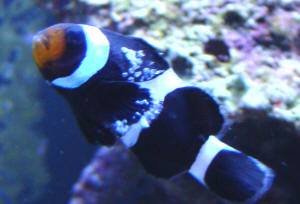
Black and white male clown fish... Aiptasia or
counter to it, mal-affected 6/25/09
Hi Guys,
<And gals>
I've gotten a lot of information from your site over the years.
This is my first time asking a question though. I have been all over
looking for an answer for this question and can't seem to get
anywhere.
I have a 2 year old black and white clown pair. I had some huge
Aiptasia in my 70 gallon reef tank.
<Mmm, Glass Anemones don't get all that big>
I have a guy that comes every two weeks to take care of everything and
I know my water biology is good. He got the Aiptasia
taken care of the other day but, I think my male was stung pretty badly
by the little suckers. He won't eat and he spends the entire day
trying to swim down. He's badly bloated. You can see his skin
prickly and his anus is real swollen. He is pooping white stringy
stuff. I have never had a problem with these clowns before. Before he
got this bad, he was acting as if he couldn't see to eat. He tried
but never got any food. I know what is happening, he's not going to
make it. I just wondered if Aiptasia could hurt a fish that badly.
<Can... might have eaten a bit, been poisoned by whatever your svc.
tech. used... I'd be asking the service what they did>
Thanks in advance
Patti in Arizona
<Welcome. Bob Fenner>
Re: black and white male clown fish, hlth.
6/25/09
Thanks for getting back to me so fast!
The aquarium guy used Aiptasia X.
<A very good product in my estimation... Seems to be safe and very
effective...>
It's what I had here at home. The Aiptasia were about the size of
quarters, maybe a bit larger.
<Oh, this is about it size-wise... You stated they were
"huge"... perhaps you meant your perception was that they
were a huge problem?>
Still no dice on the stings though?
<Nothing to do... if this is what you mean... Just wait, hope,
provide good care otherwise. Likely some were ingested by the one
clown... Only time can/will tell. BobF>
Thanks again,
Patti
|
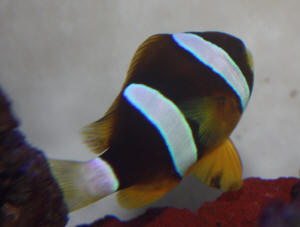
Fungus? 6/23/09
Hey all! Thanks for all your help!!
<You're welcome Scott.>
Can you help me identify what is wrong with this Clarkii clown.
This "fungus" has grown over the course of several
months, spreading very slowly. The other fish in the tank
(another larger Clarkii and violet
damsel) seem unaffected. Has any of you seen anything like
this?
<Not a fungus, is a bacterial infection commonly called fin
rot. As the infection progresses and gets deeper into the
tissues, the fish will become harder to treat. Eventually the
bacteria will infect the organs in the
body cavity and treatment will most likely be unsuccessful.
Do read here.
http://www.wetwebmedia.com/ca/volume_6/volume_6_2/mycobactera.htm>
Thanks for your help!
<You're welcome. James (Salty Dog)>
Scott
|
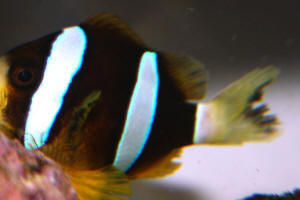 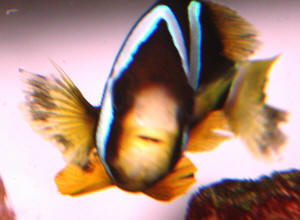
Mmm, or some sort of physical/chemical degradation? RMF |
|
Sick clown! Can't ID problem! --
6/17/09
I looked around Google, and your site and many diseases look the
same.
Seems that most sicknesses show in some form of white growth on a
fish, making it difficult to diagnose.
<Mmm, yes>
So, here's my problem. A few days ago I introduced a pair of
misbar black ocellaris clowns, they were in great health and came
from a local reefer that I know takes great care of his animals
and has been in the hobby for years.
<So?...>
These are my first marine fish, and my tank has been running for
about 5 months with soft corals, LPS and inverts. I have a great
pod population, tons of brittle starts, snails that breed,
coralline, all my corals are reproducing, etc - all signs of a
perfectly healthy and thriving tank.
After 2 days in the tank, all was well, then I did a water
change. This morning as I'm leaving for work I find that one
of them (the smaller one) has one side completely covered in a
white fuzzy coat. It's not located
anywhere specific like gills, eyes, etc, it's over the entire
body on one side. The poor guy seems to have problems move his
pectoral fin on that side as well.
The other fish is perfectly healthy. I've seen something
similar in my Mbuna tank, once when it was cycling (didn't do
a fishless cycle) and again later on when I think the fish was
stressed from transport. Side note - don't transport fish in
a backpack on a motorcycle, seemed like a good idea at the time -
"Hey, lets take a ride to that great Cichlid place and pick
up some zebras on this beautiful day!". Just like in the FW
tank, this is only effecting the one fish.
So my experience with this in FW is that the fish is doomed, will
be dead in a day or two. I had no time to do anything because I
was running late for work, so on my lunch break I will be heading
home to start mixing a fresh batch of water to place him in with
a handful of live rock (for filtering) and a spare pump to try
and observe/treat him. My best guess is that before I had these
guys I was only spot feeding my LPS (this is a 24g nano reef btw)
and now with these guys there's a daily feeding of about one
full cube of mysis/krill/whatever (same amount I used to feed the
corals) that maybe I pushed the tank into a cycle by overfeeding
the tank, and this stressed the fish. I'm going to be doing
some parameter testing when I go home to check, can't figure
any other stress that's been introduced to these guys, and
they've seemed happy and active for the last few days.
<Mmmm... a few possibilities>
I also used Aiptasia-X last night (before my water change) now
that I think of it and I've heard of that causing problems in
fish before, even though Red Sea I don't think has ever said
so.
<I have read quite a bit re this product. I consider that
it's involvement here is negligible>
Only other thing that MIGHT have caused stress is that the tank
dropped 4 degrees overnight from 78 to 74 - this is a whole other
issue since my heater was set to 76 and the tank was stable at
74, even though the heater was hot (but the little red light
wasn't on). But I don't think a 4 degree drop over night
is that severe and/or worse than what would be seen in a natural
reef....?
<Worse>
Any help would be appreciated. I'll hopefully have this fish
quarantined by tonight and ready to be treated. Time to start
making up spare water I suppose. I'll try to follow up with a
picture if I can get one.
Matt
<The larger possibilities are a "sting" from a
Cnidarian/LPS, and a heater burn... Please send well-resolved
pix. Bob Fenner>
Re: Sick clown! Can't ID problem! --
6/17/09
Bob, thanks for the response. I have a decent picture and an
update with new symptoms and status. I will attach a pic to this
email so you can get it at full resolution I apologize if
it's a bit large and clutters what I'm sure is an already
packed inbox.
<No worries>
I did some tests and got no ammonia, no nitrites, and 0-5
nitrates, so I think we can eliminate the possibility of
mini-cycle induced stress.
<The photo is definitive... am quite sure this animal was
stung... and quite likely the culprit is in the same pic... the
Euphyllia in the background...>
When I got a better look at the fish earlier this afternoon, I
noticed it had white feces hanging out of it. It wasn't as a
string, it was more like a small ball, with a tiny thread
attached to another ball that seemed to be going nowhere, as well
as a white ball floating around in the water column that looked
identical. I noticed the same thing late last night, so I started
guessing that somehow it got a block in it's intestinal
track, causing the swelling and leading to whatever is being
shown outward. As of this evening, that feces is gone, and
it's swimming around as if nothing is wrong.
<This fish may well heal of its own... even make friends with
the coral>
It's left side (same side shown in pic) is still swollen, but
I want to say not nearly as bad. And that white stuff looks like
it's falling off now, for example the pic was taken at noon
today, now at 6:40pm the white stuff is gone from the pectoral
fin. The best I can describe it's appearance is like dead
skin.
<This is so>
Yesterday was the first day I fed something other than mysis. I
fed NLS marine pellets and a cube out of a "Saltwater
Multi-Pack" by San Francisco Bay Brand pack that was a mix
of brine, krill, mysis, algaes, vitamin supplements, etc.
I also adjusted my heater to be sure it would stablize the water
at a higher temp, so now the water is sitting stable at 78.5.
<Good>
The two clowns are now hanging out with each other and being very
active, but this one still favors the one side when using the
pectoral fins. My current plan is a quarantine and treatment for
parasites, ich, and fungus using Ich Attack and Jungle Labs
Parasite Clear tablets.
<Nah>
Would you think I could be better off just leaving the fish be in
the display since she's acting normal?
<Yeah>
The only other fish is the other clown, and it shows no signs of
anything. I do understand it could have something lurking and
just have no signs *yet *but my gut tells me that it is fine and
in such a small system would have caught whatever this is
already.
<Nothing lurking... not parasitic... a chemical/physical
sting>
I'm going to forgo feeding for today just in case something I
fed led to this and to allow time for further digestion if a
blockage was the problem. I'll keep a close eye on things
tonight though.
Thanks again,
Matt
<Welcome. BobF>
|
 |
Amphiprion percula problem, 6/1/09
Hello WWM crew,
<Hi>
I would first like to thank you guys for providing such a wealth of
information that I access and use quite frequently.
<Great>
I have had a pair of wild caught true Perculas in quarantine for about
3 weeks now. They are for my tank at home, and I am aware of the risks
with wild caught clownfish, but these were so nice that they were worth
the risk.
<Just be diligent with the QT here.>
I noticed right off the bat the larger of the two had a small (what
looked like) a lesion on her chin. This was a small red patch, and I
figured it was some sort of cut or infection, and if it got worse I
would treat it.
The portion of her chin that was red never got larger, but it began to
grow some sort of white cotton like growth substance. I also noticed
that the fish also had similar looking matter in her mouth also, and
never quite closed her mouth fully. At that point I started treating
with Maracyn plus, as I figured it was some sort of bacterial
infection. During the Maroxy treatment I performed two formalin dips,
at 1 drop per gallon for 20 minutes. After the formalin dips the cotton
growth on the outside of the fish's mouth would shed, but her mouth
was still full of it. With no luck after about a week of treatment, the
growth didn't look better, but not
much worse either. With the Maracyn not fixing the problem, I switched
to Maroxy, which is a 'true fungus' infection medication. I
also used a gram pos and neg antibacterial in their quarantine (furan
2). This is their
current treatment and has been going on for the past week or slightly
longer, with little to no improvement. Today I did a little more of an
aggressive dip, which first consisted of a formalin dip very slightly
overdosed, and then a freshwater dip for about 10 minutes. At this
point, there is no cotton growth on her chin, but there is still some
in her mouth. I performed the dip an hour ago and that's where I am
currently.
<I had something that sounds very similar with a gramma years ago,
white cotton like growths all over his face and mouth. After trying
just about everything including copper and formalin and at last gave
him a FW dip, which greatly reduced the growths and after a few more
dips was completely cured. He is still with me today with no ill
effects except for a tiny bit of scaring on his face. I should probably
start calling him Pacino now.
Keep giving the pH and temp adjusted FW dips a try and see if they help
here. Unfortunately at the time I never followed up on what it actually
was but seems to be quite curable.>
The tank is a 6g with a sponge filter and an additional airstone, and
50w brand new heater. I do 65 to 75 percent water changes every 2nd
day, and follow strict dosing instructions with medications. At this
point she is not eating, but was up until about half way through
treatment. I don't think she can get food past the growth to be
honest.
<Try adding a little Selcon or similar product to the water, may
give a little boost, most likely won't hurt as long as you
don't go overboard with the dosing and foul the water.>
Below are two links to a forum with my thread and pictures.
http://reefcentral.com/forums/showthread.php?s=&threadid=1642017&highlight=inside+mouth
http://reefcentral.com/forums/showthread.php?s=&threadid=1641930&highlight=inside+mouth
Any help would be very much appreciated. Thank you very much.
Chris McCulloch
<Good luck and keep us posted.>
<Chris>
Re: Follow up on clown swimming oddly
05/23/09
Dear Mr. Fenner, and Wet Web Media crew,
<Howzit Ramona?>
My apologies that it has taken so long to send this follow up. Each day
that passes, the maroon clown improves. He is eating quite robustly,
and is swimming very normal. He definitely can see.
<Ahh!>
At this point, he is able to locate his food some of the time. I tend
to think that perhaps it may be his sense of smell that is impaired. I
am still undecided as to whether it was stray voltage that caused my
fish of many years to die, or the fact that I couldn't do a water
change for 4 weeks, or what. I may never know. I will say this, that
you were right about this problem being corrected with better
nutrition. I soak his food in Selcon for each feeding( will NOT accept
Zoecon), and feed a different variety of food each day, as opposed to
just flake food that I was feeding before, each day there is
improvement. I wanted to send this to you so that others that have the
concept that as long as they are feeding a good flake food ,they are
providing nutrition for their fish. I only hope that he continues to
improve. I will be putting him back in my big tank next week. I have
other fish that have been in QT'S now for 2 months that I will be
adding a couple of weeks after I put him in. I thought it would be lass
stressful for everyone if only he was in there , and I needed to take
him out again. May I be so bold to impose with another non related
question?
<Sure>
I had my other fish( hippo tang, Foxface lo, purple firefish) for many
years (6). I have always wanted a flame Hawkfish, but didn't think
the others would let him in.
<Mmmm, is behaviorally compatible with these fishes>
I have one now in QT, and am concerned that he will have trouble in the
80 gallon, as I keep a lot of water movement. So far, he will eat
ANYTHING !!. I run the Rio 3400 pump up through the sump, an Emperor
400 on the back, and an AP I60 GPH submersible filter behind the rocks.
Will this be too much for him to keep up with? I must say that this
fish has to be one of the most personable little cuties I have aver
seen. He already comes right up to my hand, and will take food from it.
I also have a hippo tang(again. I LOVE them.), and another Foxface.
Both of these fish already have an insatiable appetite. I am worried
whether these two HOOLIGANS will keep the clown and the Hawkfish from
getting enough food. FROM THE HEART, thank you ever so much for reading
all the emails I have sent on this subject. I hope this will be the
last one for a while. Ramona
<I think you will be fine here with this added Hawk. Cheers, Bob
Fenner>
|
Sick Fish? Maybe? 09/20/09
Hello Masters of all,
<Mmm, not I>
I have a sick fish. At least, I think it is sick. This is why I
have come to you. This fish has been in my current tank for the
last 3 months. He has a female friend that is 3 times his size
and is pregnant, or at least was.
<Not pregnant... no... not what Clownfish do>
Her egg sack seems to be getting smaller over the last 2 days.
Could you help me identify this? It looks like a white tube
growing out of the fish. It started growing out of the bottom of
his mouth. There is now one coming out of the side of his gill.
It's only on the right side of his body. There is also a spot
on his fin now.
Thank you for your wisdom,
Matthew
<Can't really make out what this is from the pix... What
other livestock have you added recently? Live foods? Bob
Fenner>
|
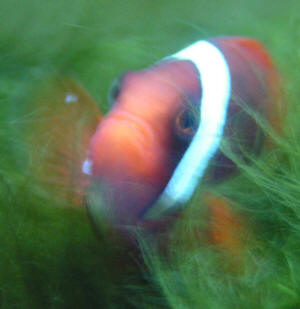 |
Clownfish with a growth/sore around its mouth
09/19/09
Hi there I have read through all of your other questions and tried to
find answers but am still perplexed. I have a 75L tank that has been up
and running for several months now. I have not added any new fish in
recent weeks and all my chemical readings are fine.
<Need to see actual values>
I have two clownfish who were bought together about 13 weeks ago, one
of which has developed what looks to be a sore underneath his mouth. At
first I thought it was an injury of some kind as the other clownfish
can be dominant at times, over the last two weeks however the growth
has got darker in colour (although it has stayed the same size) and I
have noticed the fish is having trouble eating. It seems to be unable
to open his mouth fully but until this morning it was managing to eat
normally but just small size flakes,
<Mmm, need much more nutrition than flakes can provide>
today however it was obviously hungry and went to eat a large flake and
went absolutely psycho when the flake touched it. I am guessing this is
some sort of reaction to pain maybe?
<Perhaps>
It seemed to be almost having a fit. After this incident it
wouldn't eat anything else as it was obviously spooked. It kept
looking at the food and going up to it but wouldn't eat, I
don't know what to treat it for as I'm not sure if this is a
disease or an injury as I have never had a fish with this kind of
growth/sore before? How long do injuries take to heal? Please help.
Many thanks
Emma Brown
<Would you send an image please Emma... As well as your water test
results? I will reiterate that such a small volume is untenable... in
terms of sustaining good, consistent water quality... What you are
experiencing could well be a developmental issue (captive produced
clowns do have a quite high incidence of genetic troubles), or very
likely as you speculate, an injury issue... But we need more data to
make first order approximations. Bob Fenner>
Sick clown fish... no real data of use, reading
5/11/09
Hi, I have a black and white clown about 1 1/2 years old. He was
growing and very active. all of a sudden He stopped eating and was
acting different than normal but had no changes in his appearance. I
removed him to a quarantine tank
<Why?>
and after a couple weeks he began to eat a very small amount but was
listing and staying in bottom corner. It seems he can't eat flakes
he can only swallow brine shrimp. He's been like this for 3 months
and now his
face is loosing pigment.
<Maybe losing it as well>
Water quality is fine
<Oh, that's good>
and no other fish have been affected. Is it a internal parasite? How
should I medicate him? Please help
I feel bad for him. thanks Mike
<... Please read here: http://wetwebmedia.com/clnfshdisart.htm
and the linked files above. Bob Fenner>
Re: Sick clown fish, more reading
5/12/09
Sorry about the weak data in my previous e-mail. Prior to the clowns
illness there was a newer fish i had to flush a few weeks before, with
some white spots on his tail.
<?>
The clown had been aggressive towards that fish and had been nipping at
him, maybe he ingested something?
<? What?>
No other fish in the main tank had developed any symptoms and are still
fine. That's why i quarantined the clown, because i feared that
something was spreading. After reading your chart of clown fish
diseases, I believe the clown has either - Internal parasites (of the
lumen)... usually protozoan (e.g. Octomita/Hexamita) or worms of
various possibilities.
<Both of these are very commonly in/with Clownfishes... particularly
wild-caught specimens or captive-produced ones kept in the same
water>
Although the feces are not white they sometimes stay connected to the
fish but appear to be brown in color.
<Could be just food/faeces>
After my clown didn't eat for about 2 weeks hew began to eat a 1-3
brine shrimp a day but no flakes. After eating like this for 1 week
there was a very big black turd at the bottom of the tank which makes
me think he is plugged up. His appetite has increased a tiny bit but
his face is losing color and he's definitely weak.
What brand of medicated food if any do you recommend and where could I
find it?
<I'd make your own... with Metronidazole and Prazi... unless you
can locate a source of Levamisole...>
If I use Epsom salt how would I administer this?
<Posted>
Are there any other things i could do or look for?
<Also>
Thank you in advance, Mike
<When in doubt, keep reading. Most all that is commonly known re
captive husbandry is archived on the site. BobF>
|
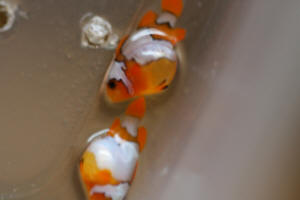
Re: ? Dead, bloated Clownfish young
5/5/09
Hi Bob. I have some clownfish babies 4-5 months. A few of them
have swollen over a few days ,week. Here is a pic. Any advise on
what to do? Thanks in advance
Jackson Harkey
<? Only a few... something is very wrong here. Am wondering
why only some would be so affected if there are a number of young
in the same system. What are you feeding? Is there a source of
fine bubbles in this system? Scary stuff! I'd carefully cut
the dead ones open... with just a single-edge razor blade will be
fine... Report back to me what you observe inside the body cavity
(lumen) AND alimentary canal. BobF>
|
 |
|
Disease? 4/25/09
Sorry, forgot to attach the photos the first time!
<No problem, we gots them now!>
Hey guys... been a while since I've had to pick your
collective brain! I must be learning something!!! I have a
Clarkii clown that has developed a black "stain" on a
couple of his fins. You can see them in the attached
pictures?
<Yes.>
Is this a disease?
<Not likely.>
If so, or if not, what is it?
<Well, with the frayed fins it is likely a water quality or
tankmate issue. So, what do your water test tell you, who else is
in the tank, what is the composition of the system, in what time
period did this develop?>
Thanks for the advice!!!
<Welcome, Scott V.>
|
 |
|
|