|
|
| Home | Marine Aquariums |
Freshwater Aquariums |
Planted Aquariums |
Brackish Systems |
Ponds,
lakes & fountains |
Turtles & Amphibians |
Aquatic Business |
Aquatic Science |
Ask the WWM Crew a Question |
| Please visit our Sponsors | ||||
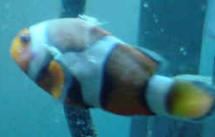
True Percula Clownfish possibly infected with Amyloodiniumiasis 2/18/09 Dear WWM Crew, <Chad> I bought a pair of True Percula Clownfish four days ago. I have a large QT setup but couldn't use it. I was medicating another fish with Cupramine (copper) for ich and didn't want to subject my new clowns to the medication. Normally I would've held off on the clowns but I'd been looking for a pair like this for a very long time. I felt the safest place to put them was the refugium. In hindsight I should've set up another QT. They both looked good at the store, the male ate right away, the female was a bit more hesitant but did eventually eat. Over the last few days in the fuge, the female has eaten but the male has not. They've been acting relatively normal save for their breathing. The male's been breathing rapidly the entire time. The female's been breathing rapidly as well but not quite as bad as the male. I also noticed that their gills seem to be puffed out a bit. Like they're swollen. I've noticed no lesions on their bodies, no white spots, no mucus. At first glance they look perfectly normal and healthy. They haven't been hanging out near the surface and have not tried to scratch themselves on anything. After some research I realized however that I may have a case of Oodinium on my hands. <Mmm, doubtful on two counts... these fishes would be dead, and the rest of the fish in the system afflicted> I immediately set up a hospital tank and treated them with the recommended amount of Cupramine. <... won't treat what they likely have> I realize copper is not a very good medication for Oodinium but It's the only medication I had on hand. I'm also not 100% sure they're infected with Oodinium. <I'm almost positive it's not> I've noticed some stringy poop coming from the female. Could this be a sign of an internal parasite? <Mmm, yes> For now my clowns are in a 21 gallon hospital tank with a powerhead and a heater. I don't have a small HOB filter so I'll be doing 50% water changes every few days. My question to you is this. Do you think I'm dealing with Oodinium? <... no> If so, you recommend freshwater dips and formalin correct? <Is one approach> I have three fish in my display tank that are very dear to me. Do you think it's possible that I took the infected fish out before the Oodinium had a chance top jump off and infect the tank? <Over days time? No... t'were this Amyloodinium, your fishes would likely be all dead> I'm guessing time will tell on that one. Should I observe the clowns in copper for a few days? Just wait it out? Should I begin freshwater dips and Formalin? <Mmm, no, no, and something else> I really want to avoid killing my fish with the cure if you know what I mean. Some info regarding my system: 225 gallon reef (about 3 months old) 75 gallon sump/fuge ammonia = 0 Nitrites = 0 Nitrates = 0 PH = 8.2 - 8.3 Phosphates = 0 CA = 410 Mg = 1250 KH = 8 Any help would be greatly appreciated. Regards, Chad <Please start reading here: http://wetwebmedia.com/brooklynfaqs.htm and the linked files above. Bob Fenner> Re: True Percula Clownfish possibly infected with Amyloodiniumiasis 2/18/09 Interesting, Brook was my first thought but I didn't see the tell tale white mucus coating. Unfortunately both clowns perished last night. The stress of the move to the hospital tank coupled with the copper treatment must've sped up the process. <Agreed> Cupramine recommends half concentration for the first two days, I guess it was still too much. <Yes... Clownfishes and other close invertebrate symbionts are often housed in retail, wholesale and collecting stations apart from other fishes (with invertebrates) to avoid copper exposure period. They are quite sensitive to it> Without proper intervention on my part I feel these clowns were doomed from the start. <Might I ask... were they wild-collected, or likely, at least housed in water, a system confluent with wild-collected Amphiprionines?> I'm relieved that you don't think it's Velvet. I lost sleep worrying about my other fish. This close call has strengthened my resolve to QT EVERY new arrival. <Ah yes> There's nothing like coming close to a loss to make you realize how important something is to you. <Unfortunately so> In this case a 7" Blonde Naso Tang with 3" streamers, a Yellow and a Purple Tang that hang out with each other and do not fight. Thank You Mr. Fenner! Regards, Chad <Welcome Chad. BobF> Re: True Percula Clownfish possibly infected with Amyloodiniumiasis -- 02/19/09 I believe they were wild caught. <Too likely so> I got caught up in the excitement of my find. Normally I'm much more selective. I'll be leaving wild caught clowns alone from now on. Thanks again, Chad <Welcome Chad. BobF> Clown Disease & Treatment: Oodinium Hello Anthony! <cheers Thanassis> Summer holidays are over and here I come with my first problem: My mail Ocellaris has Oodinium, while the female shows no signs yet. <this is very dangerous with clowns... fast progressing> The clown does not get close to the cleaner shrimp, so it can not clean him from the parasites. I am thinking of giving a FW dip with Methylene blue to the clown and then move him to my quarantine tank, where I will move the cleaner shrimp as well. Is it a good idea? <yes... very good. You may medicate with formalin too> I am also feeding food soaked in liquid garlic. <very nice> Any other actions I could take? <this is exactly what Id do... no worries. Keep in QT for at least 4 weeks... and do as many small water changes as possible by siphoning (parasites) from the bottom of the bare glass aquarium. DO check out the excellent articles on these parasites by Steven Pro on reefkeeping.com magazine> Thanks as always, Thanassis <by the way my friend... I will be relatively close to you later this year: I'm giving a presentation in Milan Italy in November for GAEM. (also in Germany in December). Perhaps we can take a slow boat to visit each other <G>. Ha! best regards, Anthony>
Tomato Clown woes Good morning, I purchased a 3-4"
Tomato Clown from my LFS about a week ago. My LFS store held her (I
assume, based on size) for me 10 days previous to that, and I checked
her several times during that period. <That is a good procedure, but
not a replacement for a stay in a proper quarantine tank.> She
looked healthy and ate voraciously when I took her home. After adding
her to my 75 gallon, she seemed healthy, active, and ate well (Omega
One flakes and Ocean Nutrition Formula One frozen). However, about 3-4
days ago I noticed a few patches of a white/gray sheen on her
skin/scales. It was only noticeable when viewed from certain angles.
She continued to eat well and remained active. I watched her carefully
for the next day, and the sheen turned into "rough" looking
scales, with a white-ish color. Thinking that it might be water quality
issues (although all tests looked good: 0 NH4, 0 NO2, 0-2 NO3, pH 8.2,
salinity 1.0215, Alk 3.2 meq, Ca 350), I did a 20% water change. It was
nearing time for a scheduled change anyway. Unfortunately, things have
gotten worse. This morning she seemed interested in food, but just
mouthed it and spit it out, and the white/rough patches look larger.
She also seems less active and is holding her fins semi-closed. After
reading through your FAQs, I was immediately drawn to Brooklynella, but
most accounts of that suggest that the fish would have been dead by
now. <It is a fast progressing disease.> Are they any good web
photos of a Brooklynella infection? <You maybe able to find a
picture somewhere, but by that time it maybe too late. Your description
definitely seems parasitic in nature, either Brooklynella or
Amyloodinium. Both can be effectively treated with Formalin baths and
removal to a separate quarantine/hospital tank. Please search through
our website, www.WetWebMedia.com for more details on the suggested
treatment.> I'd appreciate your diagnoses and treatment advice.
Thanks very much, John H. <You are welcome. -Steven Pro> |
|

|
Features: |
|
| Featured Sponsors: |